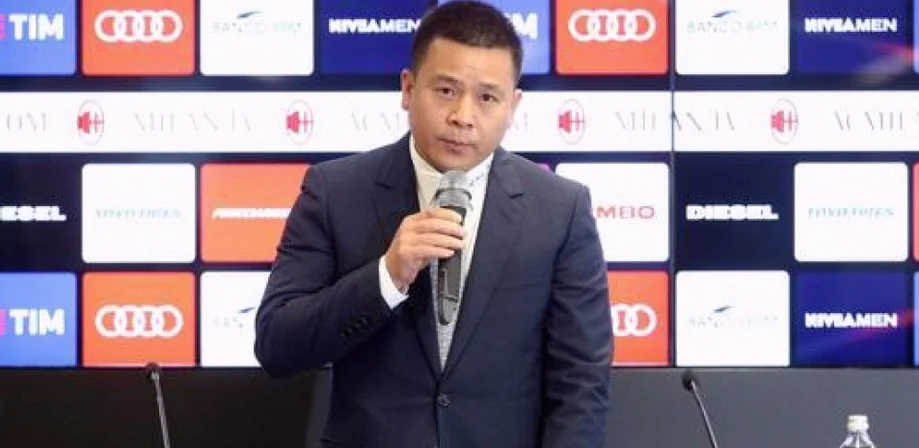
Nearly a decade after Milan changed hands, the financial structure behind Yonghong Li’s 2017 takeover continues to produce consequences far from the pitch. A Hong Kong court has now ordered the liquidation of Rossoneri Sport Investment Co., Limited, one of the companies within the former Milan owner’s corporate network.
The decision
The Hong Kong Court of First Instance granted a winding-up petition against Rossoneri Sport Investment on 30 June 2026, with its reasons subsequently published. The action was brought by General Fantasy Company over an unpaid claim of €17,966,989.59.
The debt arose from a €15 million loan paid to the Hong Kong company in August 2016. General Fantasy, owned by Li’s wife Huang Qingbo, maintained that the money was due back after 24 months, in August 2018, under terms including annual interest of 7%. With interest included, the claimed amount approached €18 million.
Rossoneri Sport Investment challenged the petition, arguing that the loan was not valid, had not fallen due, or had become time-barred. Initial reviews of company material had not fully clarified the financing arrangement. However, General Fantasy produced evidence of the transfer and four later communications in which the debtor company acknowledged the liability.
The court found that material sufficient to establish the debt. Those acknowledgements also meant that the limitation argument could not prevent the winding-up order.
A financing structure returns to court
Rossoneri Sport Investment formed part of the group of offshore entities through which Li controlled Milan after the club was purchased from Fininvest in 2017. The latest ruling therefore reopens a chapter from an acquisition whose funding arrangements have remained under scrutiny long after Li lost control of the Rossoneri.
China Citic, acting in connection with five funds that subscribed to $150 million in bonds used to help complete the Milan purchase, became involved in examining the Hong Kong company’s position. In September 2024, through its subsidiary China XinZhi Overseas Investment Holdings, it appointed two PwC professionals to manage shares that had been pledged as security for the financing.
During discussions with Citic, Li had identified the five funds’ bond financing and lending from Elliott Management as the sources supporting the acquisition. He did not mention the €15 million loan later claimed by the company owned by his wife.
Rossoneri Sport Investment relied on that omission in attempting to dispute the claim. The court, however, did not consider it a basis for refusing liquidation, particularly in light of the payment evidence and the subsequent acknowledgements of the debt.
The longer shadow of the 2017 sale
Li’s personal financial position had already brought the Milan transaction back before Hong Kong courts. His personal bankruptcy was reported in November 2025 after being declared by the Hong Kong court in July that year.
That case concerned liabilities of about $289.17 million, valued at roughly €250 million at the time. It stemmed from Li’s personal guarantee to the five investment funds connected to the $150 million bond issue that contributed to the takeover financing.
Failure to repay those obligations prompted creditors to pursue claims against Li and companies tied to the offshore structure used for the deal. More than eight years after Elliott took control of Milan, the club’s sporting story has long moved on, but the financial architecture of the previous ownership remains unfinished business in Hong Kong.