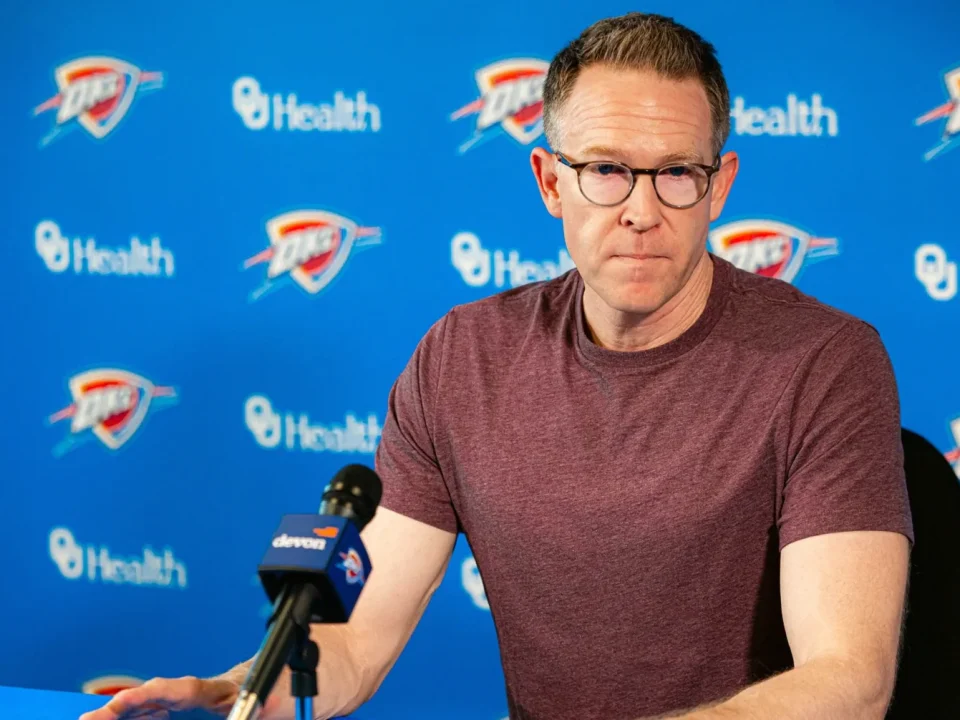
Sam Presti’s basketball education did not start in an NBA front office. It started with a one-on-one beating in an empty suburban Boston gym, followed by a former pro taking the time to teach a teenager how to guard, move his feet and keep chasing the game.
A lesson that stayed with Presti
Before becoming Oklahoma City’s longtime general manager, Presti was a 17-year-old high school player headed for Division III basketball. During the 1990s, he was at the Lexington Club outside Boston when a man he assumed was an ordinary office worker asked him for a game.
The matchup was lopsided. The player across from him was Jim McCaffrey, a former Holy Cross guard who had been drafted by the Phoenix Suns roughly a decade earlier. McCaffrey handled the game easily, but the part Presti carried with him was what happened after the score stopped mattering.
McCaffrey stayed on the floor and coached him through defensive stance, foot placement and the offensive counters he had used. Presti later said McCaffrey had truly coached him, not merely beaten him in a pickup run.
Presti went on to play at Emerson College, then built his career with the San Antonio Spurs and the Thunder. In 2023, while revisiting Bill Bradley’s book “Values of the Game,” he was struck by Bradley’s definition of leadership: helping people reach thoughts, beliefs and actions they might not have found on their own.
That sent Presti looking for McCaffrey nearly three decades after their gym encounter. McCaffrey remembered the Lexington Club, but not the specific teenager he had played. Still, Presti’s call triggered McCaffrey’s own memory of a coach whose influence had lasted much longer than their time together.
From the locker room
McCaffrey arrived at Saint Michael’s College in Colchester, Vermont, as a walk-on in the fall of 1981. Growing up in Rutland, he had decided at age 10 that he wanted to play professionally. He trained for hours, hitchhiked to find tougher competition and still came out of high school without a scholarship offer.
At Saint Michael’s, McCaffrey connected with Stan Van Gundy, then a young University of Vermont graduate assistant working nearby in Burlington. Van Gundy’s first coaching job paid $1,000, tuition and three meals a day, often eaten at Saint Michael’s.
The two began with offseason pickup workouts, progressed to organized training and eventually played full-court one-on-one for long stretches. McCaffrey recalled his mother wondering where he was spending eight hours at a time; his answer was that he was with his friend Stan.
McCaffrey later transferred to Holy Cross, while Van Gundy built a lengthy college and NBA coaching career that included taking the Orlando Magic to the 2009 NBA Finals. McCaffrey eventually became an executive with Eastdil Secured in London, but he still remembered Van Gundy’s daily message: carry respect for yourself and the game, then improve every day.
McCaffrey said Van Gundy taught him how to become a basketball player. Van Gundy did not initially see those workouts as anything extraordinary. To him, he had been a young coach spending time with a player who wanted to work.
But Van Gundy’s recollection went back to the early 1980s and an assignment from Herb Livsey at Snow Valley Basketball School in California. Livsey asked Van Gundy, then in his early 20s, to pick up famed coach Pete Newell in Palos Verdes and drive him about two hours to the camp. Van Gundy was then expected to remain near Newell for several days.
Van Gundy treated the ride and camp access as a coaching clinic, peppering Newell with questions. More than the X’s and O’s, he remembered what the assignment said about Livsey’s belief in him. Van Gundy had recently been a Snow Valley camper himself, and Livsey could have handed the duty to any eager young staffer.
Instead, Livsey gave Van Gundy an opening. Van Gundy said that confidence made him feel he had a legitimate future in coaching.
Livsey spent four decades running Snow Valley, while also working in college basketball, professional basketball and NBA scouting. He did not view his support of Van Gundy as a singular act, but he had his own example of somebody opening a door.
In the mid-1950s, Livsey was 19 when he read about Bob Cousy’s basketball camp in Pittsfield, New Hampshire. He wrote Cousy seeking a job. The camp did not need another basketball instructor, but it did need an archery teacher.
Livsey claimed he was an expert archer despite never having used a bow. He took an archery class, hitchhiked and walked part of the way to New Hampshire, then arrived at the camp ready to learn. He worked there for two summers and absorbed everything he could from Cousy.
When Livsey was preparing to marry and could not return for a third summer, Cousy called him into the office. Cousy told him he had rarely seen a young person love basketball as much as Livsey did, and urged him to pursue the chance to own or operate a basketball camp if that opportunity ever came.
That short conversation helped set Livsey on the path to Snow Valley. Cousy, speaking shortly after his 98th birthday, did not remember the meeting with Livsey. But he immediately understood the larger point because his own basketball path had been redirected by another teacher.
In the early 1940s, Cousy was an eighth-grader at O’Connell basketball court in St. Albans, Queens, when playground director Morty Arkin introduced himself. Cousy had recently left baseball to devote more time to basketball and was still learning the game.
Arkin told him he had potential, taught him to control the ball with his fingertips, stressed the follow-through on his set shot and pushed him to develop his left hand. Cousy said that was when he fell in love with basketball.
Cousy became one of the defining guards in NBA history and retired from the Boston Celtics in 1963. He could remember Arkin as a heavyset man with dark curly hair, though not his age. What Cousy never lost was the memory of Arkin being the first person to teach him the game’s fundamentals and one of the first to recognize something in him.
That line runs from Arkin to Cousy, Cousy to Livsey, Livsey to Van Gundy, Van Gundy to McCaffrey, and McCaffrey to Presti — a chain built not on transactions or titles, but on time spent in gyms and the choice to offer one more player a lesson.