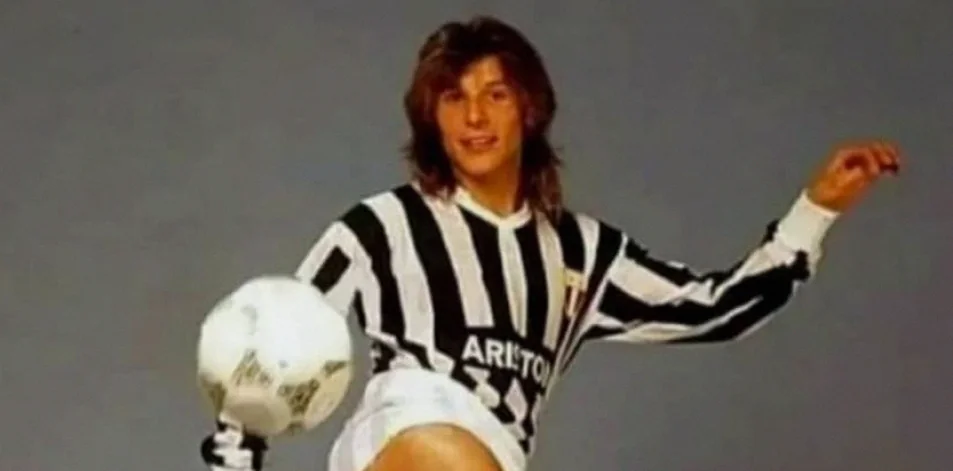
One photograph altered the direction of Juventus’s summer in 1987. Claudio Caniggia, then a 20-year-old River Plate forward, appeared in an Argentine magazine wearing the black-and-white shirt of a club he had not yet formally joined. The image was harmless in intent: Caniggia smiling, blond hair loose, balancing in a ballet-like pose as if striking a ball. For Juventus president Giampiero Boniperti, however, it crossed a line. The agreement existed, but the contract had not been signed. The proposed transfer was called off.
Juventus searching for a new cycle
The episode came at a delicate point for Juventus. The club had recently closed its extraordinary decade under Giovanni Trapattoni, a period that brought six Serie A titles between 1976 and 1986 as well as major European trophies.
- Juventus won the UEFA Cup in 1977.
- The club added the Cup Winners’ Cup in 1984 and the European Cup in 1985.
- The side’s core had included World Cup winners Dino Zoff, Claudio Gentile, Antonio Cabrini, Gaetano Scirea, Marco Tardelli and Paolo Rossi, later joined by Michel Platini and Zbigniew Boniek.
Rino Marchesi succeeded Trapattoni and finished second in his first league campaign, behind Diego Maradona’s Napoli. But the season also brought disappointments in the Coppa Italia and European Cup. Platini then retired, leaving Boniperti to rebuild at a moment when Serie A had become the game’s principal destination.
Foreign-player rules permitted each club two non-Italians. Juventus already had Michael Laudrup, the gifted Danish forward whom Trapattoni had described as the best player in the world in training. Boniperti wanted an attacking partner capable of providing pace and personality after Platini.
The Argentine chosen for Turin
Boniperti’s attention turned to Argentina, where the 1986 World Cup triumph had reinforced the country’s reputation as football’s richest source of attacking talent. Omar Sivori, a friend of the Juventus president with strong contacts in Argentina, drew attention to Caniggia.
The River player had made his Argentina debut in Zurich in June 1987, in a friendly against Italy. He was seen as close to Maradona and was known at River as “El Hijo del Viento” for his speed. Another nickname, “Pájaro”, reflected both his slight frame and his reputation off the pitch.
Juventus had confidence in its record in the foreign market since Italian football reopened its borders in 1980. Liam Brady had brought technique, Platini had become a defining figure, Boniek had flourished in Europe, and Laudrup was regarded as an exceptional talent. Caniggia was meant to be the next chapter.
An agreement was reached with River Plate and with the player, who was eager to move to Italy. Then came the magazine shoot for El Gráfico.
The shirt that ended the agreement
Caniggia posed in a Juventus jersey carrying the Ariston sponsor, apparently unaware that the gesture could be interpreted as an announcement before the paperwork had been completed. When Boniperti saw the picture, he decided that the player had acted prematurely and withdrew from the deal.
River Plate informed Caniggia that Juventus had stopped the transfer. The forward was left stunned, and the club instead pursued a different solution for the 1987-88 season: Liverpool striker Ian Rush.
- Rush arrived with an established scoring record in England.
- His spell in Italy did not work, amid a difficult and disjointed season for Juventus.
- Juventus finished sixth in Serie A and secured a UEFA Cup place only through a play-off derby against Torino.
- The club exited the UEFA Cup in the second round, losing to Panathinaikos.
- Torino also eliminated Juventus in the Coppa Italia semi-finals.
The poor campaign prompted another overhaul in Turin. In that context, the abandoned Caniggia transfer became one of those enduring stories of a club transition: a promising signing undone not by a medical, a fee or a tactical disagreement, but by a shirt worn too soon.
Caniggia reaches Italy by another route
Italy did eventually receive Caniggia, although not in Juventus colours. A year later Verona paid three billion lire to sign him, moving ahead of Roma, who had hesitated and then redirected their plans towards Brazilian Renato Portaluppi.
Verona, still close to the memory of their historic Scudetto three years earlier, introduced the Argentine with a local comparison to Pierino Fanna, but with the added distinction of Caniggia’s famous long blond hair. The player’s Serie A journey had begun, while Juventus were left to consider how differently their rebuilding might have unfolded had that summer photograph never been taken.