Long before footballers became familiar faces beyond the stadium, Sandro Mazzola helped open a door that Italian football had kept closed. In the early 1970s, while captaining Inter and holding his place in the Italy side, Mazzola became the public face of Ferrero’s Duplo and Brioss campaign. The result was not merely a successful commercial: it marked a change in the relationship between Serie A, television and everyday Italian life.
The coach and the club
Mazzola was not a coach, but his place within Inter gave the story its weight. He was one of the most recognisable players in the country, respected well beyond the Nerazzurri support and trusted by parents, children and grandparents alike. His moustache was so closely associated with his public image that “Il Baffo” became one of the labels attached to him.
At the time, football’s rules still resisted the idea of players appearing in advertising. Mazzola had joined the agency Lista as a partner, in an effort to take sporting figures beyond the limits of matchday and present them as credible figures in domestic life. Lista reached an agreement with Ferrero, the Alba-based confectionery company founded in 1946 by Pietro and Giovanni Ferrero with Piera Cillario.
Ferrero was already dominant in Italy and saw in Mazzola the right figure for a campaign aimed at families. Yet there was an obstacle: Lega Calcio regulations prevented players from undertaking commercial work.
The barrier was removed in January 1974. Sergio Campana, president of the Italian Footballers’ Association, which he had founded in 1968, announced that players would be able to advertise without first seeking permission from the league. Franco Carraro, then president of Lega Calcio, supported the arrangement after discussions with Mazzola and recognised the commercial possibilities that football could bring.
There had been precedents. Giuseppe Meazza had promoted Diadermine products in the 1930s, including toothpaste advertised as safe for enamel and beneficial to the gums. But the Mazzola campaign belonged to a different television age, one in which advertising could turn a footballer into a regular presence in Italian homes.
There was brief concern within the league about players endorsing products while wearing their club colours. A commission was envisaged to govern the division of rights in such cases. The practical answer was simple: the players appeared in ordinary clothing or neutral football kit, rather than in an Inter shirt.
A family face for Italian television
Ferrero paid Mazzola around 30 million lire, a considerable sum for the period. When filming began, he arrived at the studio accompanied by his wife and children. The campaign’s creators saw an opportunity in that family setting and brought them into the advertisements.
For three years, television viewers saw Mazzola handing snacks to children running towards him. The campaign used the line “Fed like champions” and was linked to a competition. Customers found postcards inside the product packs, attached the required proofs of purchase and sent them to Ferrero. The prize was a day spent with Mazzola.
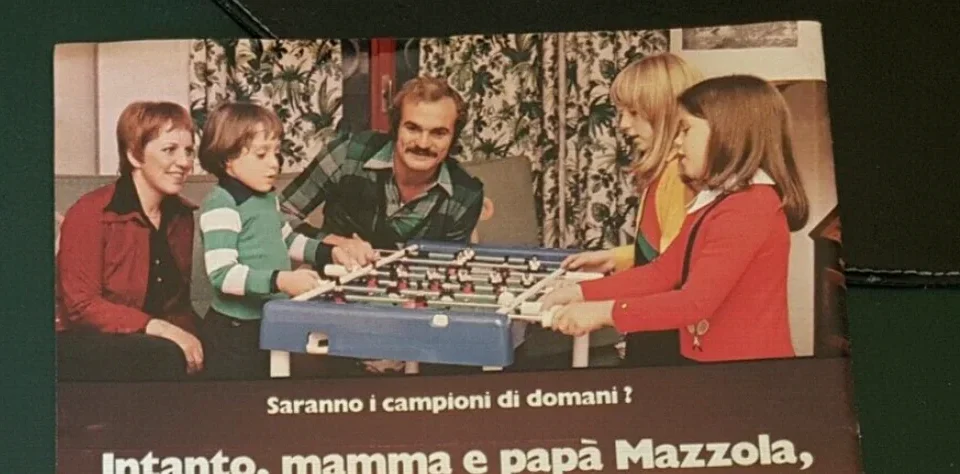
The family were also used in print advertisements: playing table football, sitting together in the living room or spending time in the garden. The children were presented as tomorrow’s champions, while the accompanying message said that their parents fed them well with Duplo and Brioss.
Football moves into the everyday
Mazzola’s commercial work later expanded beyond the family campaign. A popular print series presented “Mazzola’s advice” alongside illustrations of match situations. Wearing a generic football strip and holding a ball, he offered practical guidance on the game.
One example, identified as his eighteenth piece of advice, dealt with defensive heading against an opponent: rise early, meet the ball cleanly and avoid making contact with the other player. It was an early attempt to make a champion’s authority useful not only to supporters, but also to young players and readers.
The success of the Mazzola advertisements encouraged Ferrero to involve other leading footballers, including Fabio Capello, Gigi Riva, Romeo Benetti, Pietro Anastasi, Giorgio Chinaglia and Enrico Albertosi. In that sense, Mazzola’s work became part of a wider shift. Football was no longer confined to the Sunday afternoon or the radio commentary; its leading men had become part of Italy’s shared television culture.