The Rays arrived at the American League Championship Series with a roster built less by one pipeline than by a steady stream of trades, claims, free-agent bets and Rule 5 chances. With the series even at 1-1, Tampa Bay’s October club reflects an organizational habit: find players wherever they are, then give them a role that fits.
Game 3 is scheduled for Thursday at 1 p.m. ET, with Tampa Bay looking to turn its deep 26-man roster into an edge over the final stretch of the series.
Quick facts
- Sixteen of the 26 Rays on the ALCS roster, or 61.5%, were acquired in trades.
- Three were Tampa Bay Draft picks: left-hander Ian Seymour, outfielder Chandler Simpson and shortstop Taylor Walls.
- First baseman Jonathan Aranda was signed internationally by the organization.
- Reliever Bryan Baker tied for the Major League lead with 41 saves after joining Tampa Bay from Baltimore in July 2025.
- Outfielder Victor Mesa Jr. hit 14 homers with an .825 OPS in 79 games after the Rays acquired him in February.
Tampa Bay assistant general manager Kevin Ibach said the club approaches roster building with the idea that no potential move should be ignored. The front office studies transactions across the game, hoping the volume of work pays off during September and into October.
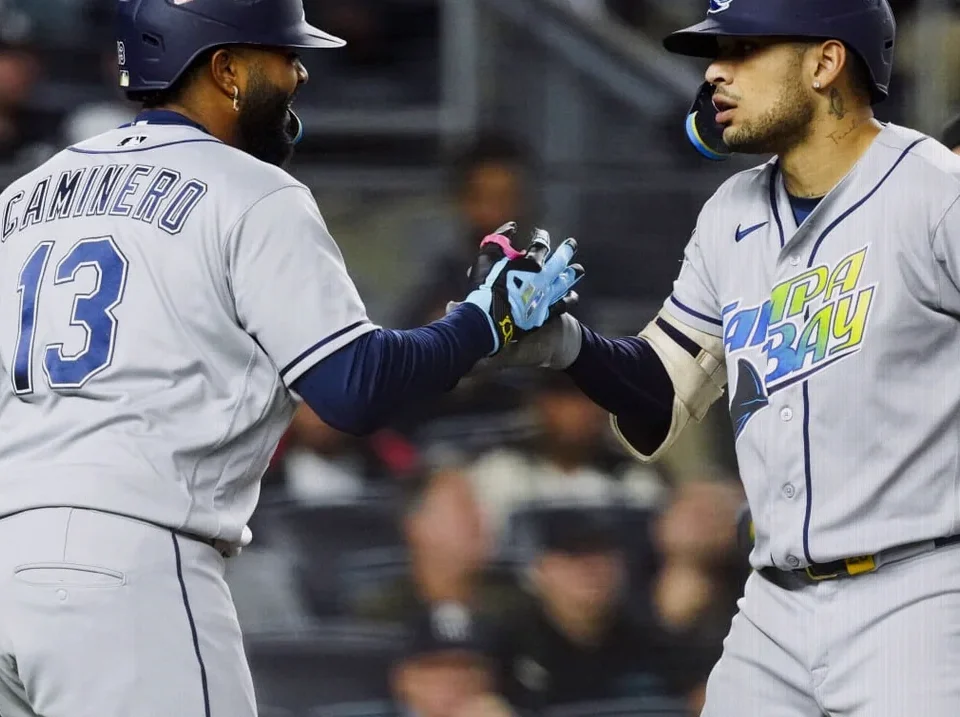
The trade group is large and varied. It includes Baker, third baseman Junior Caminero, outfielder Jonny DeLuca, designated hitter Yandy Díaz, catchers Nick Fortes and Liam Hicks, right-handers Brody Hopkins, Griffin Jax, Freddy Peralta, Drew Rasmussen, Cole Sulser and Tyler Wells, plus Mesa, infielder Richie Palacios, outfielder Ryan Vilade and second baseman Ben Williamson.
Tampa Bay also has four Major League free-agent additions in right-hander Nick Martinez, infielder Jorge Mateo, left-hander Steven Matz and outfielder Cedric Mullins. Left-hander Cam Booser came aboard through Minor League free agency, while right-hander Kevin Kelly was selected in the Rule 5 Draft.
The paths were not always clean. Kelly, Hicks and Wells had all been Rule 5 selections at different points in their careers. Wells was taken from Minnesota’s system by Baltimore in 2020, and Miami selected Hicks from Detroit in 2024.
Baker, Mesa and Palacios have each been designated for assignment. Mateo and Vilade went through that process twice, while Sulser was DFA’d three times and has had two separate runs with the Rays, first in 2019 and again beginning in 2024.
Booser’s route was longer still. He retired from baseball before working his way back to the mound and eventually into Tampa Bay’s bullpen.
Those stops and starts have become part of the club’s identity. The Rays frequently move early on players headed toward waivers, sometimes completing small trades for cash or a lower-level prospect before another club can make a claim.
Mesa offers a clear example of the approach. Miami designated the 25-year-old on Feb. 3, and Tampa Bay made a trade for him three days later. He did not reach the big leagues with the Rays until May 24, then became a productive bat and a reliable defender in right field.
Hicks, Mesa, Palacios and Vilade have all become meaningful pieces of the offense, while Baker has anchored the late innings. The roster construction has left Tampa Bay with contributors who know what it is like to be overlooked, moved or squeezed off a roster.
Ibach said that background can create a chip-on-the-shoulder edge, but the clubhouse environment matters just as much. Players are not asked to arrive and carry the lineup as a No. 3 or No. 4 hitter; instead, they are given complementary jobs and room to settle into them.
Depth, Ibach said, matters across all 162 regular-season games and becomes even more important in October. A player acquired in the Rule 5 Draft, on waivers or through a modest trade can become a factor when the games carry the most weight.
For the Rays, that is more than a roster-building theory. It is the group on the field in the ALCS.