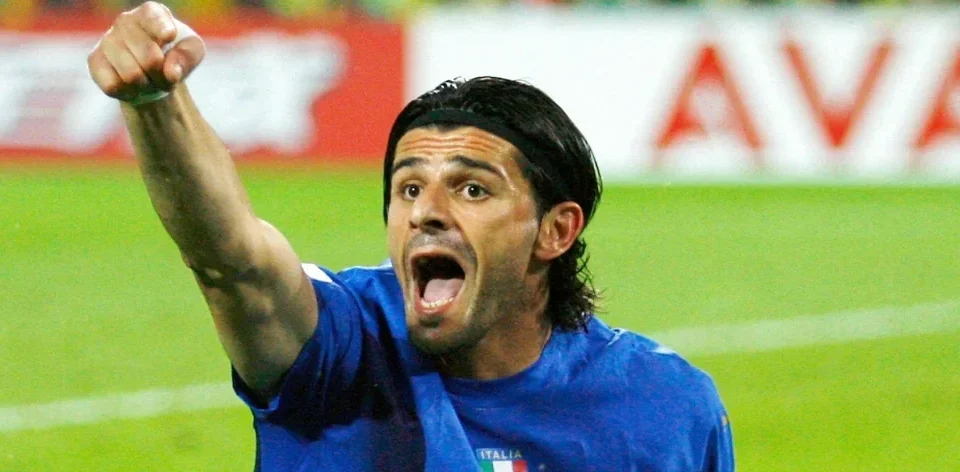
Vincenzo Iaquinta’s name still carries the weight of a World Cup winner, a Champions League hat-trick and 15 seasons at the top of Italian football. Yet, a decade into a legal ordeal involving his family, the former Italy forward says the battle to defend his father has become the defining struggle of his life.
The decision
Iaquinta’s father, Giuseppe, has been in prison since 2015 under Italy’s 416-bis mafia-association legislation, following his involvement in the Aemilia investigation, the major Emilia-Romagna trial concerning ’Ndrangheta-linked organised crime. Prosecutors described Giuseppe Iaquinta as a key figure in criminal groups operating in the region.
The former striker rejects that picture entirely. He says his family has been judged through its surname and fears for his father’s health in prison. “They will end up killing him there,” Iaquinta said, adding that he retains faith in justice but considers the burden of the case increasingly difficult to bear.
“We have been caught in something bigger than us and every setback pulls us further into it,” he said. “I will fight to prove my father’s innocence. It is the fight of my life. We have nothing to do with the mafia; we despise it.”
Iaquinta was also convicted, receiving a suspended sentence, over the failure to properly safeguard two firearms and 126 rounds of ammunition which had been passed to his father. He called it an error rather than criminal conduct, stressing that the weapons had been legally registered and saying his father removed them without informing him of the change.
He disputed the application of an aggravating provision which held that he had assisted criminal groups through legally owned firearms. “That does not make me a criminal,” he said. “These are things that can ruin a life. I have lived with a nightmare for ten years and it feels as though it has no end.”
A World Cup memory untouched by time
The legal case has altered the public conversation around a player who once belonged to one of Italy’s most celebrated national squads. Iaquinta won the 2006 World Cup and still describes Fabio Cannavaro lifting the trophy as the finest moment of his life.
He recalled feeling 20 years of work and sacrifice pass through his mind in the seconds after the final. His tournament had begun with a goal against Ghana, when Samuel Kuffour’s misplaced back pass allowed Iaquinta to make it 2-0.
For a forward who had begun in amateur football, scoring on the World Cup stage carried special meaning. He remembers his father crying after the match and regards that goal as belonging to both his parents as much as to him.
Iaquinta described Marcello Lippi’s Italy as a close, unpretentious group, built on players who had not forgotten their provincial-club beginnings. The dressing room, he said, was full of jokes and rivalry, with Andrea Pirlo and Gennaro Gattuso regularly at odds in the playful manner of teammates, alongside figures such as Marco Materazzi, Daniele De Rossi and Francesco Totti.
Lippi’s trust in him was central to his international career. Iaquinta said the coach had admired him from his Juventus period and used him across the front line, as a winger, support striker and centre-forward. He also took him to the 2010 World Cup in South Africa, even though the player was not fully fit.
Udinese, Juventus and the injuries
Before the national team triumph, Iaquinta had become a leading figure at Udinese under Luciano Spalletti. He remembers that side as one playing football ahead of its time, with Spalletti combining demanding work on the pitch with an ability to build a united squad.
One memory captures the coach’s character for him: Iaquinta, proud of being the dressing room’s arm-wrestling champion, challenged Spalletti and was beaten almost immediately. The coach’s message, delivered with a smile, was that it was time to stop showing off.
At Udinese, Iaquinta and Antonio Di Natale formed a prolific attacking partnership. His Champions League debut brought a hat-trick against Panathinaikos, followed by a high-profile meeting with Barcelona.
He also recalls a habit of scoring on debuts, whether for Italy, Juventus or Cesena, where he later played alongside Adrian Mutu. But injuries repeatedly interrupted his career and changed the way he approached matches.
“Mentally, they were terrible,” he said. “You go onto the pitch afraid, always worried about getting hurt again.”
That concern followed him at Juventus after Antonio Conte arrived. Iaquinta said Conte initially wanted to keep him, included him in pre-season training and monitored his condition closely after another setback. A further injury eventually ended the prospect of working together, a missed opportunity Iaquinta still considers one of his regrets.
The players who remain in his mind
Across his long career, Iaquinta played with leading figures of his generation, but he places Gianluigi Buffon above the rest. In training, he said, Buffon could simply decide that no one would score.
For Iaquinta, Buffon remains the greatest goalkeeper the game has produced. It is a judgement formed in the daily competition of training grounds, far from the courtrooms and headlines that now surround a different part of his life.