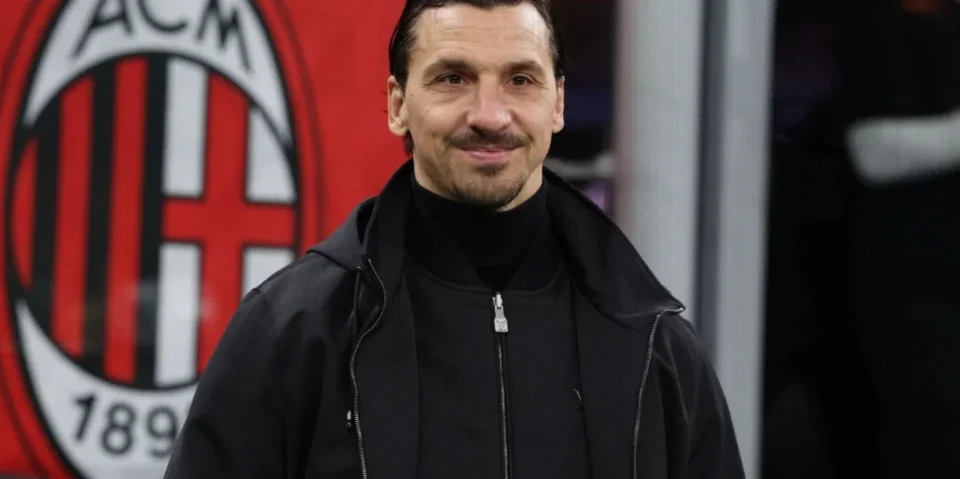
Zlatan Ibrahimovic turned 45 with Milan looking back at the familiar images: celebrations alongside Andrea Pirlo, Ronaldinho’s tribute, the 2011 Scudetto in his hands and the wide-armed goal celebrations that once made him the centre of every Rossoneri gathering. Yet his present relationship with the club is defined less by visibility than by distance.
While marking his birthday with a new Ferrari F80, Ibrahimovic remains one of the most discussed figures around Milan despite rarely occupying the foreground. Three years after ending his playing career, the former striker has become a senior adviser within Gerry Cardinale’s RedBird organisation, rather than a conventional Milan executive with responsibility for the club’s daily affairs.
A role beyond Milanello
Ibrahimovic’s position has often been misunderstood by supporters expecting the same forceful presence he carried as a player. He works directly with Cardinale and RedBird, holds shares in the investment group and is paid by the fund. Milan is an important part of his brief, but not the only one.
Cardinale trusts Ibrahimovic as an adviser and as a figure capable of interpreting the European football environment. The Swede has been involved in strategic discussions, including the processes that led to the search for a sporting director and then a head coach. His remit, however, does not extend to the routine management of the team or to intervention in training-ground matters.
Both men have publicly described that arrangement in similar terms: Ibrahimovic is expected to retain his own direct character in the new role, while Cardinale wants him to continue doing precisely that. He remains one of the owner’s principal eyes and ears on Milan, operating largely away from public view.
From retirement to an advisory position
- Ibrahimovic brought his playing career to an end after a long and difficult period of reflection.
- A few months later, he accepted Cardinale’s approach and joined RedBird as a senior adviser.
- Over the following three years, he took part in high-level planning rather than the club’s everyday sporting administration.
- On 14 September, he returned to Milanello on the eve of the Benfica match after a six-month absence from the training centre.
That Milanello appearance came during a period in which Cardinale had been spending considerable time in Milan and around the club. Ibrahimovic’s visit also arrived when the owner was unable to be present himself, reinforcing the sense that the Swede’s function is linked to Cardinale’s wider oversight rather than to a permanent operational role at the club.
Limits of influence and supporter scrutiny
The distinction matters in a season in which Milan’s ownership has altered the club’s direction and placed several departments under renewed scrutiny. Ibrahimovic can be assessed for his choices and his advice, but his actions have remained within the authority and freedom agreed with Cardinale.
He is not responsible for the day-to-day work on the pitch. Such involvement would also risk creating tension with Amorim, who is protective of his responsibilities and independence as coach.
During protests against the ownership, some Milan supporters included Ibrahimovic in their criticism. The contrast was sharp: gratitude for the player who delivered decisive moments and dissatisfaction with the adviser whose precise responsibilities have not always been clear.
That anger has since eased, though judgment on his second life at Milan remains suspended on the direction of the season. Ibrahimovic’s public profile may have changed markedly since the Scudetto celebrations, but his underlying role has not: he is Cardinale’s trusted adviser, close to Milan without being a day-to-day Milan director.