
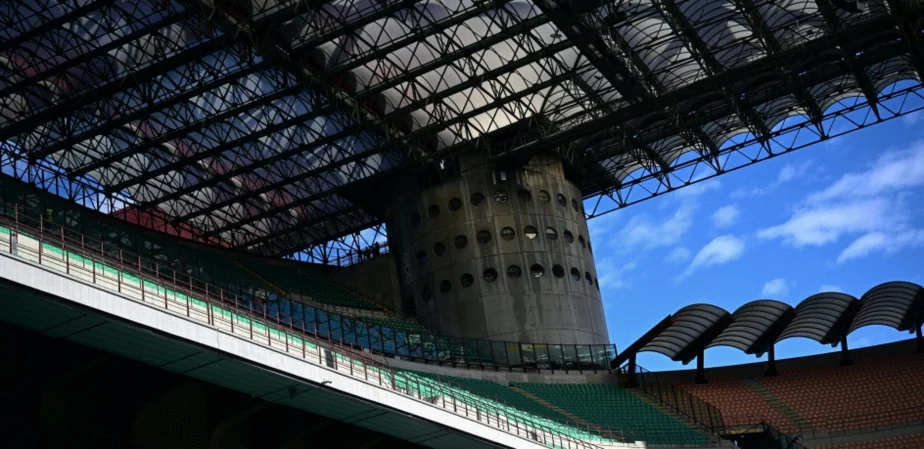
San Siro’s final season could leave supporters with more than memories. Inter and Milan are considering a scheme that would allow season-ticket holders from the stadium’s last year of use to buy or receive their own seat before the Meazza is dismantled, turning part of Italian football’s most familiar ground into a personal keepsake.
The decision
The proposal appears in the environmental assessment prepared for the new stadium project. It identifies the recovery of seating as an initiative with particular environmental and symbolic importance, even if it would make only a limited financial difference within a demolition operation of this scale.
Before structural works begin, the clubs could arrange supervised collection days for eligible subscribers. Access would require advance booking and be managed sector by sector, while appointed staff would oversee the removal process, check routes through the stadium and record each seat handed over.
The assessment uses an indicative total of 75,817 seats. If 80% were sold or reused by supporters, 60,654 could be recovered rather than discarded. On a cautious estimate of 4.5 kilograms of plastic per seat, that would keep 272,943 kilograms of plastic out of the waste stream — roughly 273 tonnes.
The document stresses that the principal value is not a major saving against the overall volume of demolition material. Instead, it presents the initiative as a visible example of circular economy principles: a practical gesture in the farewell to a stadium whose meaning has long reached beyond either Milan club.
A larger demolition operation
Seat recovery would form one small part of a selective demolition plan described as technically and environmentally complex. The approach is intended to limit the impact of the works while recovering as much material as possible.
Current estimates point to around 225,000 tonnes of structural rubble, approximately 100,000 tonnes of steel from removing the roof and 34,804 tonnes of scrap from reinforcement. Other expected material includes 4,000 tonnes of plastic, 5,000 tonnes of plant and technical equipment, 2,500 tonnes of plasterboard and close to 1,000 tonnes of friable materials containing asbestos.
Existing installations and fittings would be stripped out before the stadium’s main structure is taken down. That process would include doors, windows and frames, suspended ceilings, fixed furniture, partition walls, raised floors and other internal components.
Reinforced-concrete debris is expected to be broken down and separated from its metal reinforcement on site, reducing transport needs and improving material recovery before the rubble is sent to specialist recycling facilities.
The estimated cost of demolishing San Siro is €115,260,367. Works connected to the Patroclo Tunnel add about €12 million, taking the combined figure beyond €127 million.
The timetable remains the central question
Milan mayor Giuseppe Sala has called on Inter and Milan to present an updated stadium rendering soon and to provide assurances that their new home will be ready for Euro 2032.
For Sala, the Meazza’s demolition belongs to the following year, 2033. He said he did not understand why so much attention was already being devoted to the subject, with the immediate focus still on the new stadium and its delivery schedule.