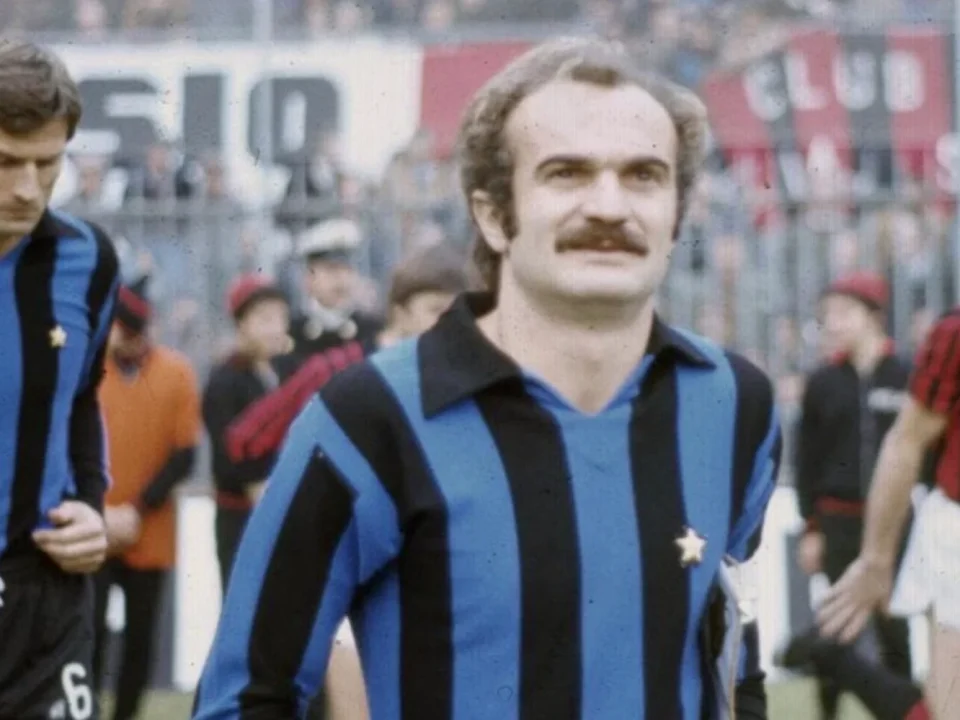
Sandro Mazzola’s story ran from Turin to Milan, from the shadow of Superga to the summit of Europe, and through an Inter era that still shapes the club’s memory. He died aged 83, leaving behind a career in which family history, international success and the changing role of the footballer were tightly bound together.
Born in Turin on 8 November 1942, in the same generation as Dino Zoff and Giacinto Facchetti, Mazzola was the son of Valentino Mazzola, the Great Torino captain who died in the Superga air disaster of 4 May 1949. The tragedy, his parents’ separation and the family’s move from Turin marked his early years.
Yet he became one of the few sons of a celebrated player able to carry such an inheritance without being reduced by it. Giampiero Boniperti considered Valentino Mazzola the finest Italian player of his time; Sandro would establish a standing of his own in the black and blue of Inter.
Quick facts
- Born in Turin on 8 November 1942; died aged 83.
- Won four Serie A titles, two European Cups and two Intercontinental Cups with Inter.
- Scored twice in Inter’s 3-1 European Cup final victory over Real Madrid in Vienna in 1964.
- Won the 1968 European Championship with Italy and finished runner-up at the 1970 World Cup.
- Helped found the Italian Footballers’ Association in 1968 with Gianni Rivera, Giacomo Bulgarelli and lawyer Sergio Campana.
Benito Lorenzi brought Mazzola to Inter, although Helenio Herrera was initially unconvinced and suggested a loan move to Lecco. Club president Angelo Moratti pressed for the young player to be retained, as he would also do in the case of Mario Corso.
Mazzola started against Venezia on 4 November 1962 and did not surrender his place. Wearing number eight, he combined acceleration, balance and an economical dribble with a sharp eye for space. He could strike with either foot, but his game was based more on timing and movement than brute force.
Inter’s great European side gave him the stage. Luis Suárez supplied passes, Corso offered combinations and Aurelio Milani occupied defenders; Mazzola found the decisive lane. In Vienna on 27 May 1964, his two goals helped Inter beat Real Madrid 3-1 in the European Cup final.
Ferenc Puskás later came to the Inter dressing room with his shirt for Mazzola. The Hungarian told him he was worthy of his father, adding that fate had allowed him the honour of playing against Valentino Mazzola.
There were other moments that captured his style. Against Vasas in Budapest on 8 December 1966, in the European Cup last 16, he took possession from Gianfranco Bedin and drove through the Hungarian defence before finishing left-footed. In Bern, during Switzerland’s 1-1 draw with Italy, he also produced a goal remembered for the control and improvisation that preceded the shot.
Mazzola’s Italy career contained both achievement and argument. Ferruccio Valcareggi restored him for the replayed 1968 European Championship final against Yugoslavia after a fierce dispute over his omission from the first match. Italy won 2-0 through Gigi Riva and Pietro Anastasi.
At the 1970 World Cup, he became central to the celebrated rotation with Rivera. Mazzola began matches against Mexico and West Germany, with Rivera generally entering after half-time. The arrangement did not apply in the final against Brazil: Mazzola played throughout, while Rivera came on for Roberto Boninsegna for only six minutes in a 4-1 defeat.
Italy returned from Mexico as world runners-up. The debate around that final, and especially Rivera’s limited involvement, became part of the country’s sporting folklore.
On the field, Mazzola gradually moved deeper, from forward areas towards a creative role behind the attack. Away from it, he was also part of a broader change in Italian football. In 1968 he joined Rivera, Bulgarelli and Campana in founding the Italian Footballers’ Association, with Campana becoming its long-serving president.
After retirement, Mazzola remained involved in Inter’s sporting direction. As a managing director under Ivanoe Fraizzoli, he contributed to a period that brought one league title and two Coppa Italia trophies.
He also identified major targets including Carlo Ancelotti, Pietro Vierchowod, Michel Platini and Paulo Roberto Falcão, although none arrived. Ownership hesitation, political pressure and even administrative misunderstandings prevented those plans from becoming Inter signings.
Ernesto Pellegrini later ended his Inter role. Mazzola had a brief spell at Genoa, returned to Inter under Massimo Moratti and was among those who backed the idea of bringing Ronaldo to the club. He also worked in coaching education at Coverciano and had a difficult final association with Torino.
His playing career began in unusual circumstances at the Stadio Comunale on 10 June 1961, when Juventus beat an Inter youth side 9-1 amid a dispute between the clubs. Omar Sívori scored six and Boniperti made his final appearance, converting a penalty.
It ended on 3 July 1977 at San Siro, with Inter losing 2-0 to Milan in the Coppa Italia replay. Mazzola addressed referee Cesare Gussoni with a line from Dante — “It is willed there, where power decides” — and received a 700,000-lira fine.
Between those two afternoons stood a player who belonged to Inter’s greatest side, but also to Italian football’s wider history: a European champion, a World Cup finalist, a players’ representative and an enduring bridge between Torino’s lost generation and the Inter that conquered Europe.