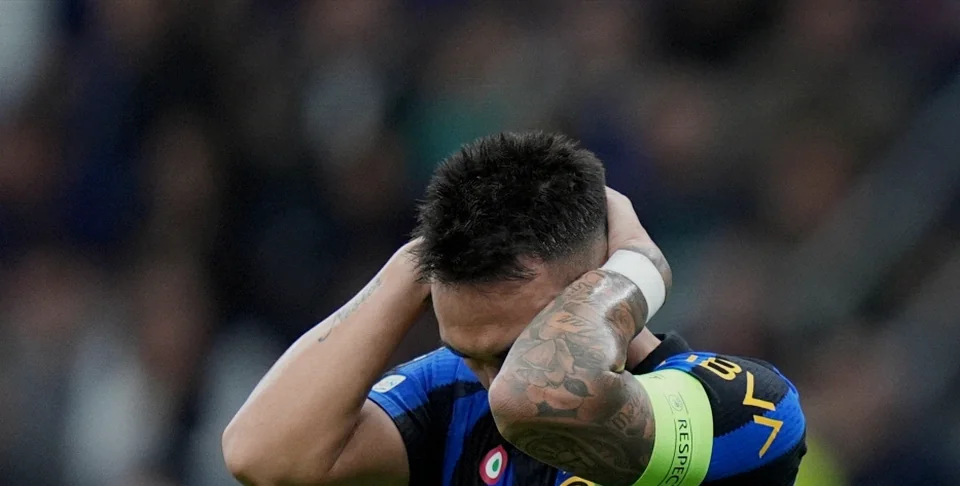
Inter’s domestic authority has yet to find its European equivalent under Cristian Chivu. A 4-3 defeat to Club Brugge at San Siro left the Nerazzurri with no points from their opening two Champions League fixtures, their seventh loss in the last eight matches in the competition, and a campaign already threatened by instability at both ends of the pitch.
The immediate arithmetic is unforgiving. Inter’s hopes of progressing directly to the last 16 have been seriously damaged, with a return of at least five wins and a draw apparently required from the remaining six league-phase matches. Even a route through the play-offs has become more complicated after a night in which Brugge repeatedly exposed the uncertainty behind Chivu’s side’s attacking ambition.
Nicolò Tresoldi was the central figure, scoring a formidable hat-trick for the Belgian visitors. The Italian-born forward, who remains in contention internationally for both Italy and Germany, gave another reason for Roberto Mancini’s staff to consider moving quickly over his future. A declared Milan supporter, Tresoldi delivered a performance that will be remembered across the city for very different reasons.
Brugge had issued an early warning when Tresoldi struck the crossbar following a corner. Their opener came soon afterwards from an Inter set piece. A favourable rebound released Carlos Forbs into space, and Hakan Calhanoglu was forced into a long recovery run before bringing him down. Referee Saggi awarded the penalty, which Tresoldi dispatched into the top corner.
Inter answered with some force. Calhanoglu hit the frame from distance and Nicolò Barella sent the rebound over, while Brugge remained vulnerable whenever the home side moved the ball quickly towards the final third. Yet the visitors carried menace themselves, particularly through Hans Vanaken’s movement between midfield and the left side of attack.
Lautaro Martinez had a header ruled out for offside before eventually levelling shortly before the break. The equaliser began with Josep Martinez making an important low intervention on Sabbe, who had been close to winning a second penalty for Brugge. The Spanish goalkeeper then started the move through Piotr Zielinski, with Inter progressing through Marcus Thuram and Federico Dimarco before Lautaro finished.
That sequence should have offered Inter a platform for the second half. Lautaro had another clear chance early after the restart, but Yann Sommer blocked his close-range effort with his foot. The former Inter goalkeeper then became an unavoidable reference point as the evening turned. Sommer’s save was followed minutes later by Martinez leaving his area and losing control of the situation near midfield, allowing Tresoldi to put Brugge back in front.
A night shaped by errors
The contrast in the two penalty areas was severe. Sommer had preserved Brugge’s lead; Martinez had handed it back. Inter lost their spacing and composure after the second goal, while their response increasingly depended on spirit rather than a settled pattern of play.
Pio Esposito, introduced for Thuram, had the opportunity to equalise but produced a weak finish. Brugge then hit a post through Virgili before Tresoldi completed his treble from a Martinez parry. The goalkeeper could only push the ball into a dangerous area, and the striker punished Inter again.
Lautaro reduced the deficit to 3-2 after another save by Sommer, briefly creating the sense that San Siro might yet witness a familiar comeback. But substitute Spence drove forward on the counterattack and set up Vermant for Brugge’s fourth. Inter’s final goal, scored by Bonny from Aleksandar Stankovic’s assist, softened neither the result nor the wider concern.
Chivu’s squad contains many of the players who reached Champions League finals in 2023 and 2025 under Simone Inzaghi. Their European pedigree has not simply disappeared, but the present version of Inter looks disconnected from it. In Serie A, the season has offered control and momentum; in Europe, it has brought errors, confusion and a growing question over why the same group cannot yet make its authority travel beyond Italy.