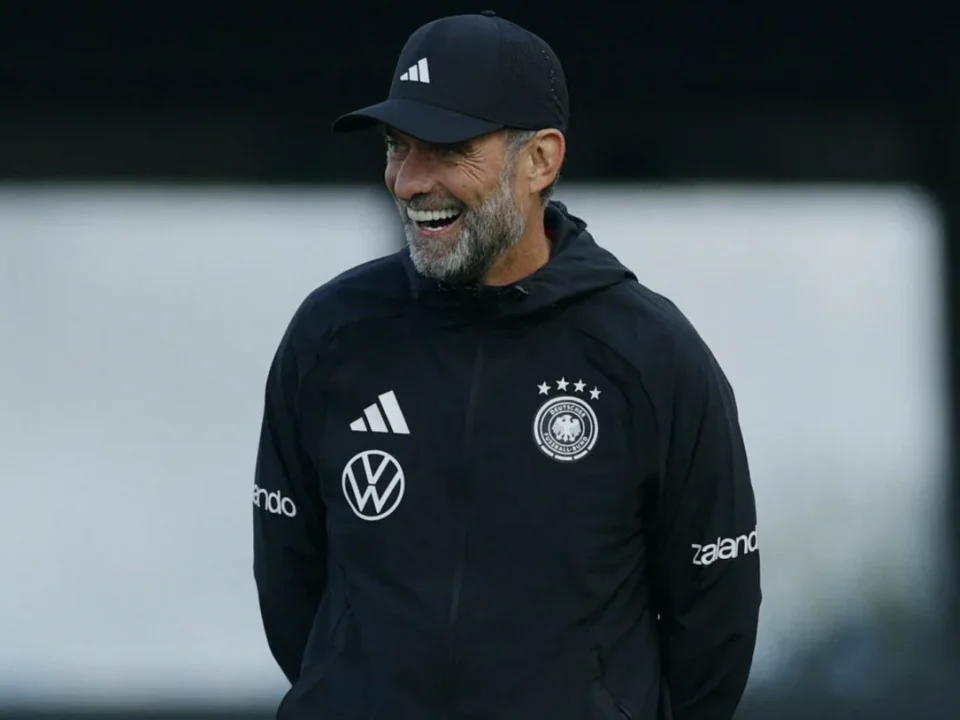
Germany’s new era begins under the lights on Thursday, with Jürgen Klopp taking charge for the first time against the Netherlands at 20:45. Before a ball has been kicked, the 59-year-old has already made the scale of his reset clear: 44 players selected, 16 newcomers brought into the picture and a promise that the national side will play on the front foot again.
Klopp spreads the opportunity across two squads
Klopp met his players at the start of the week in Herzogenaurach, but his first decisions had been prepared long before the training camp opened. Germany have endured another damaging summer, falling before the last 16 of a World Cup for a third successive tournament after a 1-1 draw with Paraguay and a 4-3 penalty-shootout defeat.
Julian Nagelsmann’s departure created the opening for Klopp, who had remained available in recent months. After a decade of success with Liverpool, including the club’s 2020 Premier League title, he now takes on a Germany side still searching for a convincing identity since lifting the World Cup in 2014.
For the opening Nations League window, Klopp has named two separate groups of 22 players. The first squad will face the Netherlands on Thursday and Greece on Sunday. A second selection is scheduled to play Serbia on Thursday, October 1, before travelling to Greece on Sunday, October 4.
The unusual arrangement serves several purposes. It allows Klopp to assess a wider field of players, underlining his belief that Germany’s talent pool remains deep despite growing doubts around the level of the country’s leading footballers. It also means clubs will not lose their internationals for the full 14-day break.
Sixteen players have been called up for the first time. Freiburg are particularly well represented, with Philipp Treu, Max Rosenfelder, Yannik Engelhardt and Derry Scherhant included. Some of that group featured in Freiburg’s Europa League final defeat to Aston Villa, which ended 3-0.
Clear choices in goal and midfield
Klopp has also settled two key questions early in his tenure. Marc-André ter Stegen will be Germany’s first-choice goalkeeper, a decision eased by Manuel Neuer’s international retirement.
Joshua Kimmich, meanwhile, is expected to operate in midfield rather than at full-back. It is the role he occupies at Bayern Munich and the position in which he wanted to be used at the last World Cup.
The football itself is set to reflect Klopp’s best-known principles: direct attacks, rapid vertical passing and an aggressive high press. His high-energy style brought success and spectacle at Borussia Dortmund and Liverpool, and Germany now hope it can provide a jolt to a national team that has too often looked short of conviction.
A message beyond the pitch
Klopp has arrived to considerable public enthusiasm, but he has also set a boundary with the German media. He has said he would step down if criticism crossed from football into attacks on his family.
He has also spoken about national identity at a politically tense moment, with the far-right AfD having won elections in Saxony-Anhalt. Klopp said he hoped not to have to discuss politics in future, but added: “I want our flag to stand for something again. I want people to feel happy and fortunate to live in this wonderful country. I do not want national pride to be left in the wrong hands.”
That message has been echoed in a cap whose production Klopp personally oversaw. Its inscription reads: “One among 83 million.” Germany’s new coach now has four Nations League fixtures, 44 players and a first match against the Dutch to begin turning that idea of unity into results.