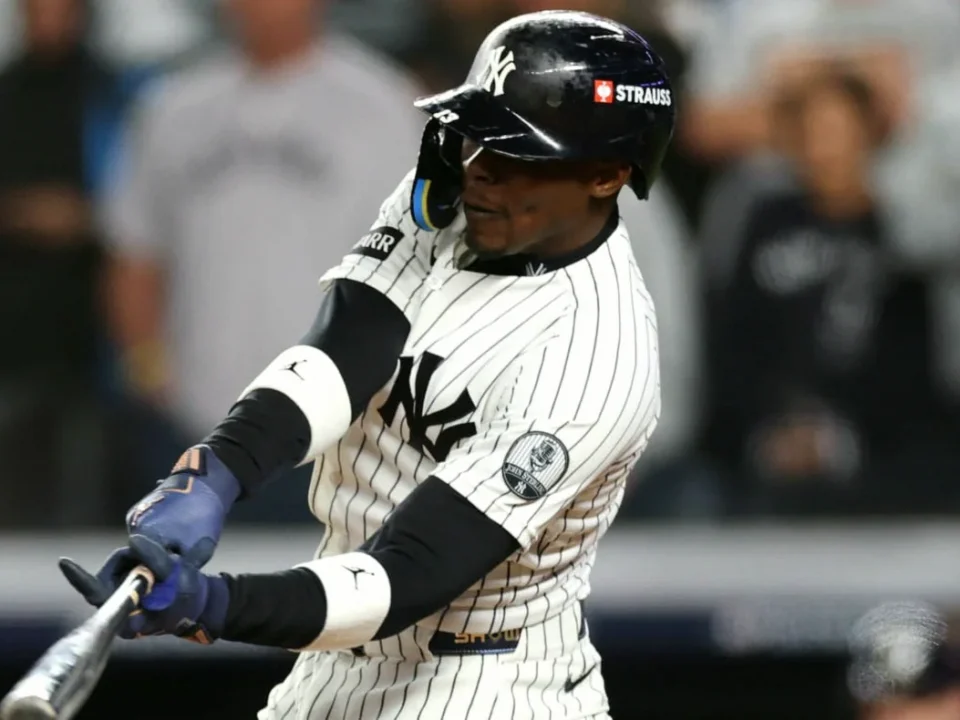
Jazz Chisholm Jr. heads into free agency with the kind of résumé that makes a front office pause: a 29-year-old second baseman with power, speed, defensive range and three straight seasons worth at least 3.0 fWAR. The Yankees may be ready to turn the page anyway, leaving Chisholm as one of the more volatile—and potentially rewarding—names on the winter market.
His 2026 season did not become the 50-homer, 50-steal chase he envisioned in spring camp, when he said he had a feeling “it’s going to be an amazing year.” Still, Chisholm supplied 19 homers, a career-best 41 stolen bases and a 3.5 fWAR season over 137 games.
Quick facts
- Chisholm will be 29 on Opening Day 2027.
- He hit .231/.312/.399 with 19 home runs, 55 RBIs, 69 runs and a .711 OPS in 2026.
- His 41 steals ranked third in the American League.
- He recorded 15 Outs Above Average, placing him in MLB’s 98th percentile, but finished at minus-6 Defensive Runs Saved.
- He struck out 157 times in 532 plate appearances, a 29.5% strikeout rate.
- A reasonable market projection is three or four years at about $20 million annually.
There was production in the Bronx, but also a lasting October stumble. Chisholm’s throwing error against Tampa Bay in Game 2 of the American League Division Series could remain the snapshot Yankees fans remember most clearly from his time in pinstripes.
At the plate, the split against left-handed pitching will follow him into negotiations. He posted a .218/.269/.381 line against southpaws, compared with .238/.331/.407 versus right-handers.
The larger issue is contact. Chisholm’s 30.9% whiff rate sat in the 13th percentile of the majors, while his strikeout rate landed in the bottom 10% of MLB. Those were not one-year concerns; he also ranked in the bottom 10% in both categories during his 30-30 campaign in 2025.
A Yankees reunion remains possible
New York has alternatives if it lets Chisholm walk. Luis García Jr. could return to second base, where he has played most of his career, while Anthony Volpe showed this season that he can handle the position as well.
That does not eliminate a reunion, but it gives the Yankees flexibility. The club may also hesitate to attach a qualifying offer worth roughly $23 million after getting limited value from Trent Grisham, who received one this year.
Chisholm’s age and recent WAR totals make that one-year figure defensible on paper. But his offensive trend, including what may have been his weakest hitting season since 2021 by weighted runs created plus, makes a qualifying offer less certain.
Second-base openings around the league
Detroit has a clean opening with Gleyber Torres again approaching free agency. Hao-Yu Lee is viewed as a versatile piece who could work in a super-utility role, while Chisholm would bring a left-handed bat and speed to the Tigers’ lineup.
Toronto could simply hand second base to Ernie Clement, but Clement closed poorly, producing a combined .442 OPS in August and September. Ross Atkins has said Clement must earn the job in camp, and the Blue Jays could shift him into a utility assignment if they shop for more offense after scoring an MLB-low 648 runs.
The Angels have the most obvious offensive need. Los Angeles finished 29th in the majors with 655 runs, ranked last with a .679 team OPS, and got only a .620 OPS from second base—last in the American League and 28th overall.
With Stan Kroenke now in charge, signing a two-time All-Star such as Chisholm would qualify as an early statement move for the new ownership group. It would also address a position that badly needs a jolt.
San Diego has a different kind of case. The Padres slugged .384 from the left side in 2026, 23rd in baseball, and could create a second-base opening by moving Jake Cronenworth to first.
Chisholm’s left-handed pop would help there, and his personality would not be out of place in that clubhouse. His flair sometimes stood apart in New York, but it could fit more naturally with San Diego’s roster.
Cincinnati may be the sharpest baseball match. The Reds received a .608 OPS from second base, 29th in MLB, and their .693 OPS against right-handed pitchers ranked 27th.
The question in Cincinnati would be contract length. The Reds would need to decide whether they want to commit multiple years, while Chisholm could instead seek a one-season prove-it arrangement and return to the market next winter.
What the market can bear
Chisholm joins Brandon Lowe and Luis Arraez near the front of a second-base class that also includes Mauricio Dubón and Torres. He is arguably the most dynamic offensive player in that group, although the number of available infielders gives clubs more options than usual.
His age remains a major selling point. Chisholm is three years younger than Lowe, Seiya Suzuki and Randy Arozarena, and he is the only one among that group to reach at least 3.0 fWAR in each of the past three seasons.
A reported target of eight to 10 years at $35 million per season appears far beyond the likely range. Only Robinson Canó and Marcus Semien have secured nine-figure free-agent deals as second basemen: Canó signed for 10 years and $240 million with Seattle in December 2013, while Semien received seven years and $175 million from Texas in December 2021.
DJ LeMahieu’s six-year, $90 million Yankees deal before the 2021 season is the next reference point, though LeMahieu carried 25 career bWAR at the time. Chisholm enters the market with 14.2.
Three or four years around $20 million per season feels more in line with Chisholm’s recent value. The swing-and-miss risk will limit the ceiling, but a club willing to bet on his athleticism, 20-homer power and game-changing speed could find a second baseman with plenty left in his prime.