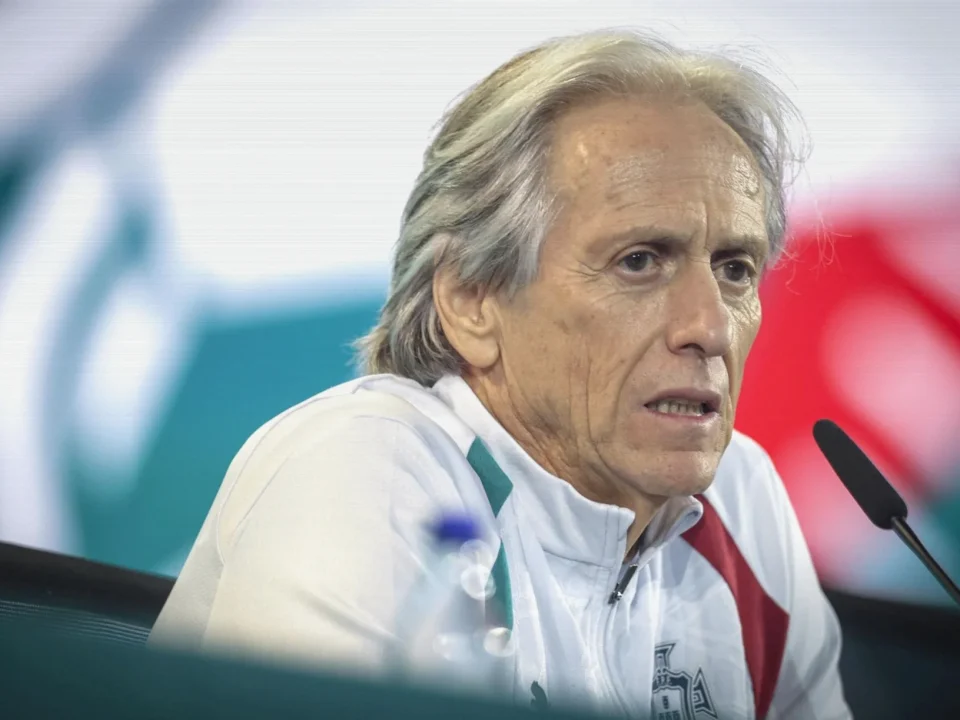
Lisbon begins a new international chapter on Thursday, when Jorge Jesus takes Portugal into a Nations League meeting with Wales for the first match of his career as a national-team coach. At 72, after major club spells in Europe, Brazil and Saudi Arabia, the former Flamengo and Al-Nassr manager has inherited a side rich in celebrated talent and carrying expectations of a more forceful identity.
Jesus replaces Roberto Martínez after a World Cup campaign that left supporters and observers dissatisfied with the use of what is widely regarded as Portugal’s strongest generation. Martínez did win the previous Nations League, but the wider feeling was that the team had not consistently reached its potential. Jesus has made clear that continuity is not his intended route.
A different Portugal in prospect
-
Following his appointment after the World Cup, Jesus said his footballing vision bore no resemblance to that of his predecessor, stressing the point with a blunt “zero”.
-
On the eve of the Wales match, he repeated that players familiar from the Martínez era may be used in different roles, with the aim of creating fresh movement, a new game culture and a different collective rhythm.
-
“Football is an art performed by the players and the coach,” Jesus said. “My way of seeing the game differs from the former manager’s. That can allow the same players, perhaps in positions unlike those they occupy at their clubs, to produce another dynamic. I believe in the players and in my work.”
There are overlaps between the two coaches: both have favoured sides that seek possession, press high and defend far from their own goal. The expected distinction is in the intensity with which Jesus demands those habits. His teams have tended to impose themselves more aggressively and for longer periods, rather than treating that approach as negotiable during a match.
Shape, roles and the midfield question
The former Benfica coach has often built attacks around positional interchange and greater freedom for forward players. His previous teams have regularly used two strikers, whether in a 4-4-2, 4-2-3-1 or 4-1-3-2, alongside a midfield structure containing a deeper holding player and a more advanced creator. That formula could be especially relevant against less powerful European opponents.
It would mark a departure from much of Portugal’s World Cup setup, which generally featured João Neves, Vitinha and Bruno Fernandes in a three-man central midfield, wide attackers on either side and Cristiano Ronaldo through the middle.
Jesus does not consider himself a 4-3-3 specialist. He is open to using three central midfielders, but wants their duties to differ. In particular, he values a defensive midfielder who wins possession and protects the centre-backs.
“I prefer a second forward to a third midfielder,” he said, while adding that it will not be an automatic rule in every game.
João Palhinha, now at Benfica, is widely expected to benefit from that preference and could start against Wales. The reference point for the role is the type of anchoring midfielder Jesus used in Flamengo’s 2019 side, with Willian Arão providing balance behind a more adventurous team.
João Félix may also find a more central route into the side. One possibility is Ronaldo leading the line with Félix close behind him as a second striker, rather than beginning from one flank and drifting inward.
A short first camp
The opening assignment also underlines the main challenge of international management for a coach renowned for daily intervention. Jesus has only had one full training session before his debut, held on Wednesday; Tuesday’s work was lighter. Portugal have four fixtures across 15 days in this extended international window, but Jesus will not see the squad again until November and then only in March 2027.
-
Jesus arrived at the federation’s base and said he had not yet felt a major change in routine, noting that there is always work to do while he is there each day.
-
Wednesday brought his first complete session with the group ahead of Wales.
-
During the opening 15 minutes, which were visible to the media, he joined the players for the initial running, handed out bibs and offered frequent instructions.
-
After this four-match window, the long gaps between gatherings will test how quickly he can transfer a detail-driven club method to the national side.
That adjustment may be significant. Jesus is known for close video correction and for demanding precision in body position, running technique and ball striking. Such work can shape technical and tactical relationships over months at a club, but international camps leave little time for that level of repeated contact. His experience across decades of management may help him find alternatives, yet Portugal’s first camp offers only a brief introduction to his methods.
Ronaldo’s immediate place
One certainty for Thursday is Cristiano Ronaldo’s involvement. The Portugal captain attended Wednesday’s press conference and remained in the room to listen to Jesus afterwards. The new coach confirmed Ronaldo would start against Wales, while declining to make the same commitment regarding Palhinha.
Jesus explained that Ronaldo’s status justified a direct answer, but insisted that status does not mean an unconditional entitlement to play every match. He said the key issue is how long Ronaldo can continue and whether he is physically able to do so.
“Cristiano is a symbol of Portugal and of the national team,” Jesus said. “That does not give him the right to play every game; that is the coach’s decision.”
Recalling their year together, Jesus pointed to a match in Hong Kong as evidence of Ronaldo’s draw: the stadium held 55,000 when the forward played, but only 3,000 when he did not. With a smile, the coach said he hoped Ronaldo would score once or twice against Wales and could then be withdrawn early, provided no physical problem arose.
The Wales match will not reveal every part of Jesus’s plan. It can, however, offer Portugal’s first view of a manager who promises sharper aggression, a dedicated midfield shield and more room for a second forward beside the country’s enduring No. 7.