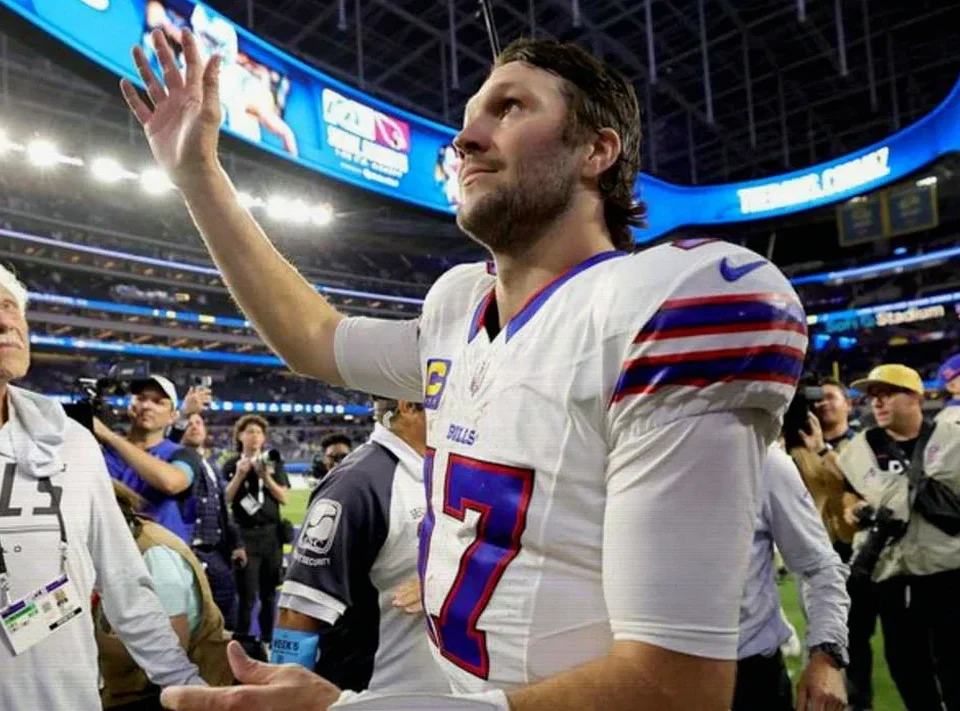
Josh Allen powered the Buffalo Bills to a 37-34 overtime win over the Los Angeles Rams, delivering a career-defining rushing performance as Buffalo overcame another troubling defensive collapse to improve to 4-1.
Allen ran for 121 yards, his highest single-game total since his 2018 rookie season, and repeatedly put his body on the line in the deciding stages at Los Angeles. The quarterback generated 90 of those yards over the final 20 minutes and 50 seconds, turning several critical situations into first downs with physical scrambles and designed runs.
Buffalo’s offense had struggled to move the ball through the air for much of the night without No. 1 receiver DJ Moore. But Allen took control late, and Greg Rousseau’s overtime field-goal block gave the Bills the opportunity to finish the game.
Allen takes over in the biggest moments
With Buffalo trailing 20-19 in the fourth quarter, Allen broke free for 22 yards and chose contact rather than stepping out of bounds. He later converted a third-and-5 with a 15-yard run in a 27-27 game, then added a 21-yard scramble on second-and-17 during the same late sequence.
After Rousseau denied the Rams on a field-goal attempt in overtime, Allen immediately moved Buffalo into position with a 19-yard run on second-and-7. He followed it with a 13-yard designed keeper on the next snap.
Asked about the decision to absorb hits despite understanding the importance of protecting himself over a full season, Allen attributed his approach to the situation.
“It was just the flow of the game,” Allen said.
Backup quarterback Shane Buechele said Allen’s demeanor changes when a close game demands a spark.
“You see that look in his eye,” Buechele said. “In games that are tight and going back and forth, when the offense needs something, you see it—and then he puts on a show.”
Wide receiver Trent Sherfield compared Allen’s late-game mode to a video-game player activating an X-factor ability.
“When he takes off, I picture that X lighting up,” Sherfield said. “That’s when he becomes impossible to stop.”
Allen’s rushing total was particularly notable because Buffalo had never previously won a game in which he topped 100 rushing yards. This time, his running helped compensate for a passing attack that had produced little until late.
Through nearly 57 minutes, Bills wide receivers and tight ends had combined for only four catches and 26 yards. Allen connected with Khalil Shakir on two important late completions, including one in the fourth quarter and another in overtime, but the threat of Allen running created much of the pressure that opened those opportunities.
Tight end Dalton Kincaid called Allen the league’s MVP and its best quarterback, then emphasized how extraordinary the performance felt from inside the huddle.
“It’s incredible,” Kincaid said. “He does something during the game and I’m yelling at him that he’s an absolute psycho—in the most complimentary way possible.”
Defense gives up another major second-half surge
Buffalo’s defense nearly wasted Allen’s effort. The unit contained the Rams early, even as Los Angeles opened with a 14-play drive that consumed nearly eight minutes and followed it with a 13-play touchdown possession lasting close to seven minutes.
During the first half, the Bills allowed only two plays of at least 10 yards and held the Rams to 3.7 yards per snap. That control disappeared after halftime.
Los Angeles scored 27 points in the second half and eventually reached 34, the highest point total Buffalo has surrendered this season. From the opening of the third quarter through overtime, the Rams averaged 7.6 yards on 41 plays and produced 13 gains of 10 yards or more.
The Bills had already yielded 31 points to the Texans, 31 to the Lions and 29 to the Patriots. Against the Rams, the problems spread across every level of the defense.
Buffalo’s front struggled to consistently pressure Matthew Stafford despite facing the strongest offensive line it has encountered this season. The Rams found repeated openings in the intermediate middle of the field, while Buffalo’s boundary cornerbacks had trouble against Los Angeles’ accomplished receiving tandem. The safety group also appeared late to too many plays.
The run defense was the one relative bright spot, but the Rams did not need to rely on it. Stafford dropped back 54 times as the passing game repeatedly moved the offense.
Puka Nacua was targeted 24 times, five more targets than Allen threw to all Buffalo wide receivers combined. Nacua caught 17 passes, nearly matching Allen’s 19 attempts to wideouts.
Igbinosun replaces Hairston at cornerback
Buffalo made one significant personnel adjustment in the secondary. Rookie Davison Igbinosun replaced Maxwell Hairston after Igbinosun had been the more effective cornerback in Week 4.
The move came despite head coach Joe Brady having said after Saturday’s final practice that Hairston would start. The switch nevertheless reflected a need for improvement in a secondary that has struggled early in the season.
The Bills have maintained that the defense should improve as the season develops, but the Rams game raised deeper concerns. Buffalo’s ability to rush the passer was expected to be a major strength, and when that pressure fails to arrive, the rest of the unit has been vulnerable.
Further lineup changes could be necessary if Buffalo is to reach its defensive potential. The roster may also need another offseason influx of talent better suited to the new scheme, particularly with depth becoming an issue.
Buffalo now needs meaningful defensive progress against more than the winless Los Angeles Chargers. Asking Allen and the offense to score 30 or more points nearly every week is a dangerous formula as the Bills move deeper into October and toward the postseason race.