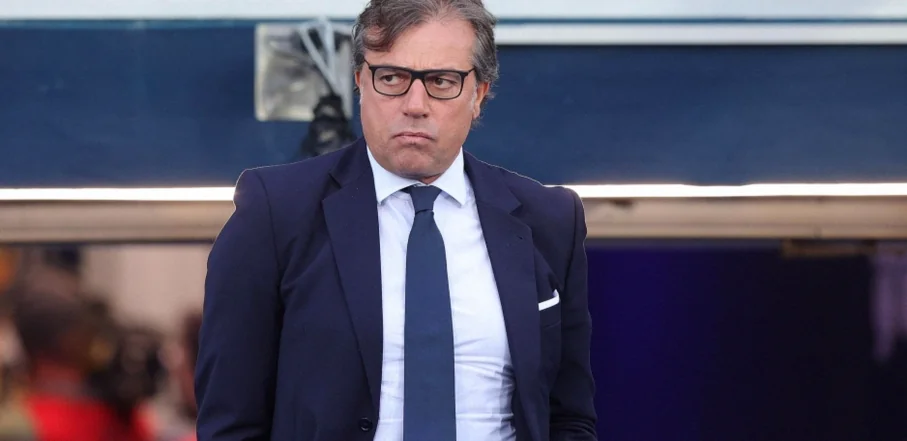
Juventus have ended Cristiano Giuntoli’s two-year spell in charge of football operations, closing a project that began with sweeping authority and ended with a negotiated departure. The former Napoli executive leaves after 697 days, three coaches, one Coppa Italia and a rebuilding plan whose financial discipline was clearer than its sporting return.
The decision
Giuntoli and Juventus agreed to terminate his contract, with the executive receiving an €850,000 settlement. The formal confirmation arrived on 3 June, following a tense meeting with Exor chief executive John Elkann on 29 May, shortly after the ceremonies marking 40 years since the Heysel disaster.
The separation came despite Juventus reaching the minimum target of Champions League qualification under Igor Tudor. By then, however, Giuntoli’s relationship with Elkann had deteriorated. The club was not mentioned in Exor’s subsequent letter to shareholders, a notable change after Elkann had previously presented Giuntoli as a central figure in shaping Juventus’ future.
That earlier mandate, issued when Giuntoli arrived from Napoli on 7 July 2023, was substantial. He had helped build Napoli’s third Scudetto-winning side through signings including Victor Osimhen, Khvicha Kvaratskhelia and Kim Min-jae. Juventus, meanwhile, were rebuilding after the capital-gains case, the points deduction and a season outside European competition.
His first year in Turin was more restricted than expected. Giuntoli had endured a prolonged exit dispute with Napoli president Aurelio De Laurentiis, while trusted colleagues Giuseppe Pompilio and Stefano Stefanelli could not join him until a year later. Giovanni Manna worked alongside him at Juventus before leaving for Napoli the following summer. Massimiliano Allegri also remained firmly in place on a contract that still had two years to run.
In that initial window, Juventus signed Timothy Weah from Marseille for a little over €10 million and moved on younger players, notably Nicolò Rovella and Radu Drăgușin. With only Serie A and the Coppa Italia to contest, the season initially carried the feel of a holding period.
Yet Juventus were challenging Inter for the title by January. Allegri wanted additions to sustain that pursuit, but the winter arrivals were defender Tiago Djaló and young Argentine midfielder Carlos Alcaraz. Giuntoli was already looking beyond Allegri and identified Thiago Motta as the coach for the next phase.
After the February defeat to Inter at San Siro, Juventus slipped away in the league and the relationship between Allegri and Giuntoli became increasingly strained. Allegri told the director not to attend training, having learned through Adriano Galliani that Juventus were pursuing Monza goalkeeper Michele Di Gregorio without his involvement.
The break became public after Juventus beat Atalanta in the Coppa Italia final. Allegri waved Giuntoli away during the celebrations, then lost his temper after the match. Juventus dismissed the coach for conduct the club said was incompatible with its values and those representing it. Champions League qualification was nevertheless secured, clearing the way for Giuntoli’s overhaul.
That overhaul was built around lower wages, a younger squad and compliance with UEFA’s tightening financial requirements. Elkann had said Juventus would place greater trust in Next Gen players while creating a sustainable cost structure, reducing the proportion of operating income spent on salaries and amortisation.
The summer of 2024 was therefore uncompromising. Federico Chiesa, Wojciech Szczęsny, Mattia De Sciglio, Daniele Rugani, Arthur, Filip Kostić, Nicolò Fagioli, Arkadiusz Milik and Weston McKennie were among those excluded from the main group after refusing departures or reduced renewal terms. Milik and McKennie were later brought back into the squad.
The wage bill was reduced by more than a third. But a transfer campaign exceeding €200 million was partly funded by the sales of Next Gen prospects Matías Soulé, Enzo Barrenechea, Samuel Iling-Junior, Dean Huijsen, Moise Kean and Tarik Muharemović. Juventus ultimately made 16 signings during Giuntoli’s tenure.
Sunday’s picture
The new Juventus began with promise under Motta, but serious injuries to Bremer and Juan Cabal undermined the season. The principal summer purchases — Douglas Luiz, Teun Koopmeiners and Nico González — did not deliver as expected, while Motta struggled to establish a bond with parts of the senior group, particularly former captain Danilo.
January brought Alberto Costa, Randal Kolo Muani, Lloyd Kelly and Renato Veiga, taking Giuntoli’s additions for the 2024-25 campaign to 13. They did not prevent a difficult March: Juventus went out of the Coppa Italia to Empoli and then suffered heavy league defeats, losing 4-0 to Atalanta and 3-0 to Fiorentina.
Giuntoli decided Motta had to go and preferred Roberto Mancini as a replacement. The ownership did not approve that solution, favouring an interim appointment until the end of the campaign. Tudor was selected instead and achieved the Champions League place.
It was enough for Juventus to remain among Europe’s leading clubs, but not enough to preserve Giuntoli’s position. His work brought lower costs and a younger squad, while the results of the costly rebuild remained uncertain. With the Scudetto still distant after several years, Juventus again chose urgency over allowing a longer project to mature.