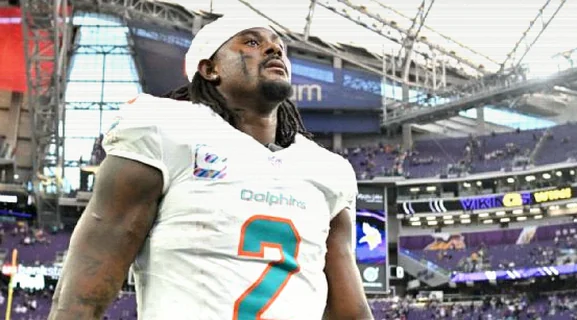
Malik Willis has become the centerpiece of Miami’s rebuild, with the Dolphins committing to the quarterback on a three-year, $67.5 million free-agent contract and reshaping their roster around his development. The early results have been uneven through four games, and Miami has also lost Pro Bowl running back De’Von Achane to a torn ACL, but Willis remains the club’s chosen leader for a young offense.
What changed for the franchise
First-year general manager Jon-Eric Sullivan made Willis the Dolphins’ only multiyear free-agent signing of the offseason, a clear indication that Miami intends to give the former Tennessee Titans and Green Bay Packers quarterback a real opportunity to establish himself as a starter.
The front office has embraced a younger, less expensive roster build. Miami dealt wide receiver Jaylen Waddle to the Denver Broncos for a first-round draft pick, a move Sullivan framed as part of a plan to add rookie-contract talent around Willis over multiple draft classes. The Dolphins expect to gain more room to operate in free agency next year and again in 2028.
Miami’s offense is the NFL’s youngest, placing an especially large responsibility on Willis. Head coach Jeff Hafley noted that the quarterback is directing a unit that includes three rookie wide receivers, a rookie tight end and a rookie fullback, while also making his first full-time start since college.
Willis addressed his offensive teammates before the Dolphins’ stadium practice that closed training camp. His message centered on professionalism, pride and treating each practice rep as meaningful work, even when the offense was not running calls designed specifically to beat the defense.
He was later voted a team captain. Before camp, Willis also brought teammates to Jacksonville for a week of workouts, covering their hotel stays while the group held morning field sessions, afternoon weight training and team-building time. Veterans Jalen Tolbert and Malik Washington attended, along with tight end Greg Dulcich and rookie tight end Seydou Traore.
Willis entered the league as Tennessee’s third-round selection, No. 86 overall, in 2022 after throwing for more than 5,000 yards and 47 touchdowns at Liberty. His athletic traits were evident, but his early professional experience exposed areas that needed refinement. In six extended appearances as a rookie, he went 31-for-61 for 276 yards with three interceptions.
After that season, Willis began extensive work on his mechanics with quarterback coaches Sean McEvoy and Will Hewlett and arm-care specialist Tom Gormely. The focus was on generating throws with his lower body, improving repeatability and reducing the strain created by relying too heavily on arm strength. Video review, motion-capture work and plyometric throwing were part of the process.
“My first season did not go the way I wanted,” Willis said. “I wanted to find ways to improve. Learning to use my hips and lower body instead of throwing with only my arm has made me more accurate and more consistent.”
Tennessee drafted Will Levis in the second round in 2023, and Willis attempted only five passes in three appearances that year. The Titans traded him to Green Bay after 11 games and three starts.
His Packers stint changed the trajectory of his career. When Jordan Love suffered an MCL sprain in the 2024 opener, Willis started twice and completed 25 of 33 passes for 324 yards and two touchdowns. He also ran for 114 yards and a touchdown in those games.
Once Love returned, Willis ran Green Bay’s scout-team offense. That role gave him more exposure to opposing quarterback styles, defensive structures and the decision-making required in different systems. Hafley, then the Packers’ defensive coordinator, occasionally had to remind Willis to stay in the pocket when the practice script called for a stationary quarterback.
Willis again made the most of limited action in 2025. Against the Chicago Bears in Week 16, he completed nine of 11 passes for 121 yards and a touchdown. In his Week 17 start against the Baltimore Ravens, he went 18-for-21 for 288 yards and a touchdown, adding 60 rushing yards and two scores.
Hafley and Sullivan both knew Willis from their Green Bay tenure. Willis said he valued Sullivan’s detailed feedback on film, while Hafley’s energy during practice stood out to him. Those prior relationships helped bring Willis to Miami.
Through four games with the Dolphins, Willis ranks 27th in QBR, 18th in passing yards and 29th in completion percentage. He has been sacked nine times and hit 33 times. His average time to throw is 2.93 seconds, compared with a league average of 2.86.
Offensive coordinator Bobby Slowik is working to strike a balance between allowing Willis to extend plays with his mobility and getting the ball out on schedule. Slowik said the offense must avoid depending too heavily on off-schedule plays, which can undermine consistency.
“There has to be enough freedom for him to create,” Slowik said. “But if you live in that off-schedule world, consistency drops sharply. Malik is the one who has to find that balance.”
Willis has not softened his own assessment of his start. After Miami’s Week 3 loss to the Kansas City Chiefs, he said a loss did not merit a passing grade, adding that he holds himself to at least the same standard he expects from the rest of the offense.
The Dolphins have repeatedly defined 2026 as a developmental season rather than one judged solely by victories. Miami has a 14-player rookie class receiving significant snaps, a difficult remaining schedule rated ninth toughest by Football Power Index, and an offense now forced to move forward without Achane.
The long-term question will be whether Willis can play well enough to remove any interest in selecting a quarterback near the top of the 2027 draft. For now, Miami has made its decision: Willis has the opportunity to lead the rebuild and prove that his growth in Green Bay can carry over to a full season as a starter.