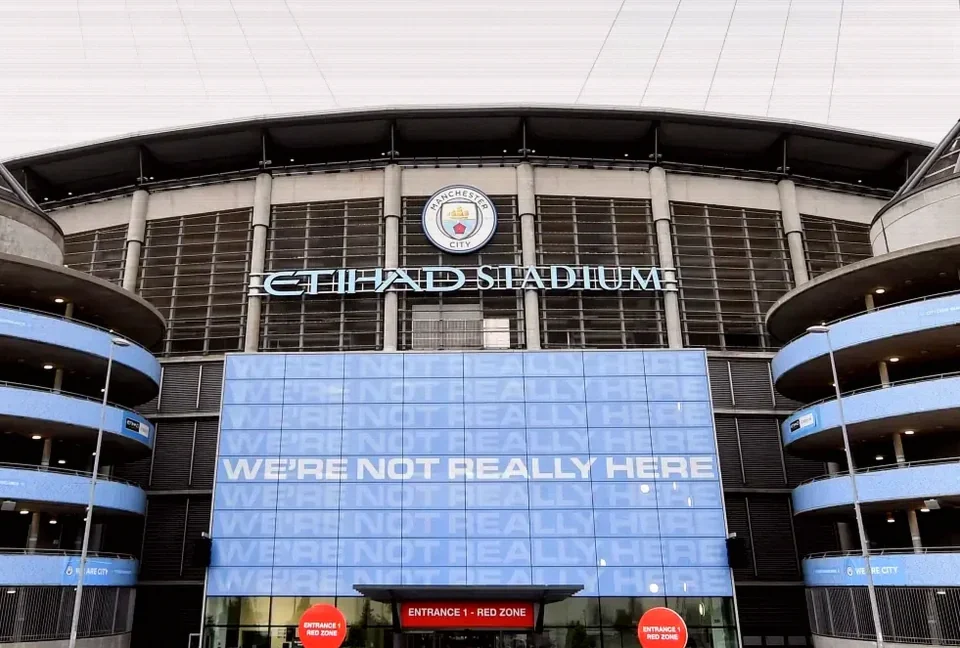
On the east side of Manchester, the road around the Etihad Stadium has become a public ledger of a football dispute that reaches far beyond matchday. Near the ground, a defiant “Us against the world” message speaks for Manchester City supporters after an independent commission found the club guilty on 115 financial-rule charges. Across the city, the response has been harsher: City imagery has been vandalised, while signs beside Wharfside Way and towards Salford Quays have called the club “cheats” and demanded relegation.
The Premier League confirmed on Tuesday that the commission had upheld every charge concerning serious financial breaches. The case covers nine campaigns, from 2009-10 through 2017-18, and leaves City facing a range of possible penalties: a points deduction, an exceptional financial sanction or, at the most severe end, relegation.
City will appeal. Chief executive Ferran Soriano has said the club will continue to assert its innocence after findings that described sham commercial agreements and a lack of cooperation with the inquiry. The commission concluded that the alleged deception amounted to £900 million, or $1.19 billion, over the period under examination. A later private hearing will consider the sanction, with the appeal process already promised by the club.
A rivalry sharpened by the record book
The years in question include three City title-winning seasons: 2011-12, 2013-14 and 2017-18. Manchester United finished second in the first and third of those campaigns, while Liverpool were runners-up in 2013-14. The prospect of sporting and financial consequences has therefore revived old arguments among clubs who believe their own interests were damaged.
For United, the affair carries an awkward internal dimension in Omar Berrada. The club’s present chief executive worked for City between 2011 and 2024 in several senior roles, spanning much of the period addressed by the charges. His previous employment had already caused concern at United, including for co-owner Jim Ratcliffe, because of the knowledge Berrada would have acquired of City’s financial operations. Berrada does not believe the verdict affects him personally and does not expect to be drawn into the proceedings.
United supporters have nevertheless made their position plain. The Manchester United Supporters’ Trust wants the strongest available punishment, arguing that City should answer for what it calls systematic wrongdoing on an industrial scale. In a city where red and blue have long marked competing identities, the legal outcome has made that separation conspicuous again.
Eastlands and the cost beyond football
The issue is not confined to trophies and league tables. City Football Group’s development around the Etihad, roughly three kilometres from central Manchester, has become a major part of the regeneration of Eastlands and neighbouring Ancoats and Beswick. Around £300 million has gone into reshaping a former industrial area into a mixed leisure, entertainment and community district.
Planned work includes taking the stadium to a 60,000-seat capacity, alongside a Radisson Blu hotel, a commercial centre and a zipline. City also pays Manchester City Council more than £4 million each year. That local economic relationship has brought anxiety over whether Abu Dhabi’s owners could reconsider their wider commitment if the club is confronted by substantial Premier League claims.
Greater Manchester mayor Bev Craig has said the priority must be to protect the jobs and livelihoods of residents living around the Etihad. Andy Burnham, formerly the mayor of Manchester and now England’s prime minister, has also warned that he would be deeply concerned to see the Emirati ownership leave, describing it as an important partner in the remaking of modern Manchester.
Burnham, an Everton supporter, had previously backed an independent regulator after his own club received a points penalty for financial mistakes. The City ruling now places renewed focus on that position and on his relationship with the club’s owners. For the moment, the formal process moves behind closed doors; outside the Etihad, however, the argument is already playing out in paint, banners and a divided cityscape.