The dispute over the FIGC’s possible commissioners is becoming a test of boundaries inside Italian sport’s governing rooms, with Serie A’s wider institutional landscape watching closely. CONI’s executive board is due to meet on Tuesday to examine the failed registration of FIGC president Giovanni Malagò and vote on whether the federation should be placed under administration.
Attention has initially focused on which members of the CONI board can take part in that decision. The question is whether professional links to the FIGC should require certain representatives to step aside when the vote is held.
Quick facts
- CONI’s executive board will meet on Tuesday over the failed registration of FIGC president Giovanni Malagò.
- The board is expected to vote on a possible FIGC commissioners’ arrangement.
- Elisabet Spina and Diana Bianchedi have been identified as figures who may be asked not to vote over potential conflicts.
- Marco Buonfiglio, son of CONI president Luciano Buonfiglio, has worked for Elevate since the start of the season.
- His work includes commercial projects linked to Venezia’s planned new stadium.
CONI’s internal view is that Elisabet Spina, the Milan women’s sector chief representing coaches, should not vote. The same assessment has concerned Diana Bianchedi, who served as Italy national team delegation head for the FIGC for 13 days before her contract ended on 30 September.
That approach has prompted a broader argument: if those professional connections are sufficient to rule out participation, where should the line be drawn for the board’s other members?
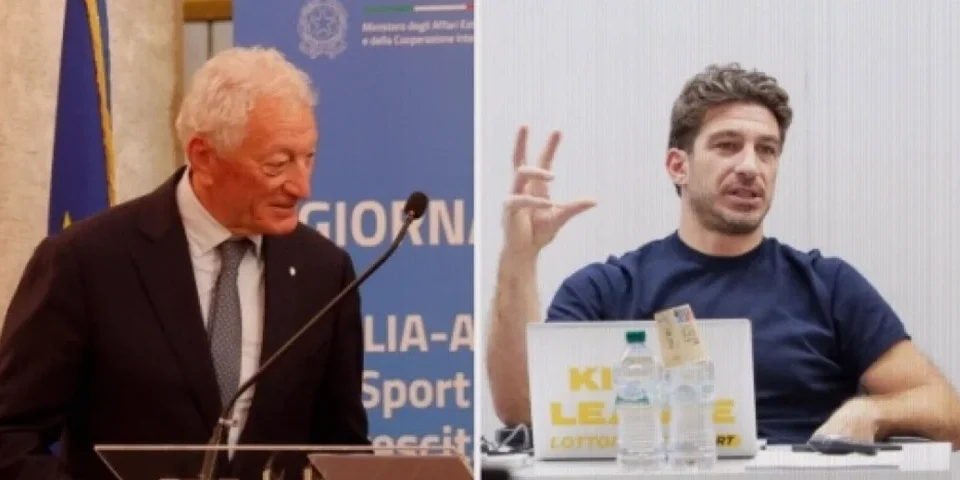
A new element concerns CONI president Luciano Buonfiglio. Venezia have confirmed that his son Marco has been employed since the beginning of the championship by Elevate, an international sports and entertainment agency.
Marco Buonfiglio is involved in several Elevate assignments, including work concerning Venezia. His role is centred on the corporate side of the club’s new stadium project, covering commercial areas such as naming rights, hospitality and sponsorship.
The connection is viewed as more substantial than his previous association with the Kings League. He may have moved on from that work after taking the Elevate role, although his LinkedIn profile still lists him as commercial director of the parallel competition.
The issue for Tuesday is the position in which a FIGC administration could place Luciano Buonfiglio. Whether he were appointed commissioner himself or selected another figure for the role, CONI’s president would be exercising exceptional influence over the federation while his son’s employer works on a major Venezia commercial project.
For Italian football, the procedural vote is therefore no longer only about the FIGC’s immediate future. It has also become a question of how clearly CONI can separate its decision-makers from the clubs and projects affected by its choices.