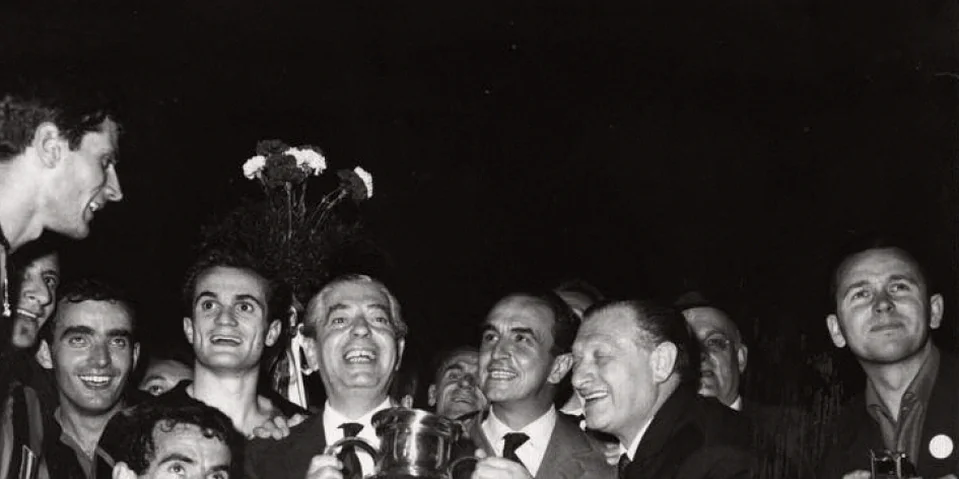
Inter’s greatness under Helenio Herrera was never confined to one afternoon, yet the European Cup final in Vienna on 27 May 1964 remains its most complete portrait. At the Prater, the Nerazzurri defeated Real Madrid 3-1, overcoming a side that still carried Alfredo Di Stefano, Ferenc Puskas and Francisco Gento. Sandro Mazzola scored twice, Aurelio Milani added the other, and a team that had begun its domestic title run in 1963 found the stage on which its authority became European.
The eleven who defined an era
Herrera’s Inter changed personnel across the period from the first Scudetto in 1963 to the last in 1966, but the Vienna line-up has become the enduring image of La Grande Inter. It represented a club that brought pride to its supporters and to Italian football more broadly.
- Goalkeeper: Giuliano Sarti.
- Defenders: Tarcisio Burgnich, Giacinto Facchetti, Carlo Tagnin, Armando Guarneri and Aristide Picchi.
- Forwards and creators: Jair, Sandro Mazzola, Aurelio Milani, Luis Suarez and Mario Corso.
Real Madrid took a formidable reputation into the final, but Inter’s collective discipline and attacking precision settled the contest. Mazzola put Inter ahead, Milani restored the lead at 2-1, and Mazzola’s second completed the 3-1 victory. It was the first of two consecutive European Cups for Herrera’s side; Jair’s decisive goal against Benfica delivered the second in 1965, aided by an error from Portuguese goalkeeper Costa Pereira.
A defence built on authority and purpose
Sarti arrived in Milan in the summer of 1963 at the age of 30. He had already won the Italian title with Fiorentina in 1956 and had suffered a European Cup final defeat to Di Stefano’s Real Madrid while playing for the Viola. At Inter, he became known as the “Ice Goalkeeper”: calm in his area, effective off his line and uninterested in spectacular saves for their own sake.
His game was economical, based on command rather than display. Herrera regarded him as “the man of the revolution”, while teammates and supporters saw him as a rock behind the side. Sarti organised those in front of him and could begin moves from deep, qualities that marked him as one of Italian football’s first modern goalkeepers.
- Tarcisio Burgnich was the right-sided marker, a defender of exceptional physical force who accepted direct duels and rarely gave ground. Fast enough to stay with opponents and strong in the air, he later finished his career as a libero, helped by experience and tactical understanding.
- Giacinto Facchetti was promoted by Herrera because of his stride and athletic presence, then developed into one of the finest left-backs of his generation. His left foot and energy allowed him to support defence, midfield and attack, effectively creating a new Italian reference point for the attacking full-back. In 1966, he became the first defender to score 10 goals in a single league season.
- Carlo Tagnin, signed from Bari at Herrera’s request, had the task of following the opposing side’s most gifted player. In Vienna, that responsibility meant Di Stefano. Tagnin concentrated entirely on the Madrid forward, repeatedly anticipating him and limiting his influence, allowing Inter greater freedom to construct their own attacks.
- Armando Guarneri was the centre-half who dealt with opposing strikers through positioning, strength and timing. Called the “Gentleman Stopper”, he was never sent off during his career. He did not abandon his position for attacking adventures, but his dependability was central against the leading centre-forwards of the 1960s.
- Aristide Picchi began as a right-back before Herrera moved him into the libero role. From behind the defence, he directed teammates alongside Sarti, judged when to intervene and when to delay, and often stopped attacks before they became emergencies. When he recovered possession, his instinct was purposeful: look up, find Suarez, and give the ball to the player who could shape the next phase.
The defensive structure was not merely about resistance. It gave Inter a platform from which each player’s particular function became clear: Tagnin could take care of the opposition’s principal artist, Guarneri could hold the central line, Picchi could read danger behind them, and Facchetti could turn recovery into momentum down the left.
Speed, imagination and the making of champions
On the right, Jair supplied the acceleration that made Inter so dangerous once the ball was won. Nicknamed the Black Arrow, the Brazilian winger could be found helping his full-back and, moments later, racing into space to meet a Suarez pass. With Garrincha blocking his path in Brazil’s national side, Jair found at Inter the environment in which he reached the summit in Italy, Europe and the world.
Herrera’s side suited him. Jair could carry the ball towards goal or pick out Mazzola and Milani arriving in the area. Pace and a precise finish were his defining qualities, and his 1965 European Cup final goal against Benfica secured Inter’s second continental crown.
Mazzola, the son of the great Valentino Mazzola, was entrusted with responsibility while still very young. Initially used as a centre-forward and later in a deeper attacking role, he combined a powerful stride with quick dribbling and equally quick thinking. He seemed able to anticipate where a move would go before others had fully seen it.
Before the final in Vienna, Mazzola had been unsettled after speaking with Puskas and watching Di Stefano’s close control. Suarez offered him encouragement before the match, a gesture that mattered in an occasion of such scale. Mazzola responded with two goals and became a defining figure not only for Inter but for Italian football in the 1960s.
- Aurelio Milani gave the attack a physical focal point. Herrera valued his movements because they pulled open opposing defences and created room for Mazzola’s runs. Milani had previously finished as Serie A’s leading scorer with Fiorentina, and although he was not the team’s most refined technician, his willingness to occupy centre-backs was indispensable. His goal in Vienna made it 2-1 before Mazzola settled the final.
- Luis Suarez was the side’s great organiser. Once an advanced Spanish-style attacking midfielder, he was moved deeper by Herrera and became the controlling creator in front of the defence. His passing could release Jair with remarkable accuracy, while his authority made him an important guide for younger teammates.
- Mario Corso wore number 11, played with his socks lowered and offered the unpredictability that even Herrera struggled to regulate. The coach admired his extraordinary left foot but was frustrated by what he considered indolence, regularly asking for his sale in the summer. President Angelo Moratti refused, treating Corso almost as family. Corso’s feints, floated passes, chipped deliveries and curling free-kicks could change a match in an instant.
Herrera’s Inter as a championship story
The lasting force of La Grande Inter lay in the way its individuals fitted a larger idea without becoming anonymous. Herrera found roles that suited character: Sarti’s composure, Burgnich’s confrontational defending, Facchetti’s forward thrust, Tagnin’s marking, Guarneri’s reliability and Picchi’s judgement.
Further forward, Suarez supplied the game’s direction, Jair provided its speed, Milani did the demanding work against central defenders, Mazzola brought decisive quality, and Corso retained the freedom to invent what nobody else had considered.
From the 1963 Scudetto to the 1966 title, Inter wrote a period of sustained dominance rather than a single triumph. Vienna was its defining afternoon: a 3-1 win over Real Madrid, a European Cup in the hands of the Nerazzurri, and an eleven whose names still read like a complete account of how a side can become a legend.