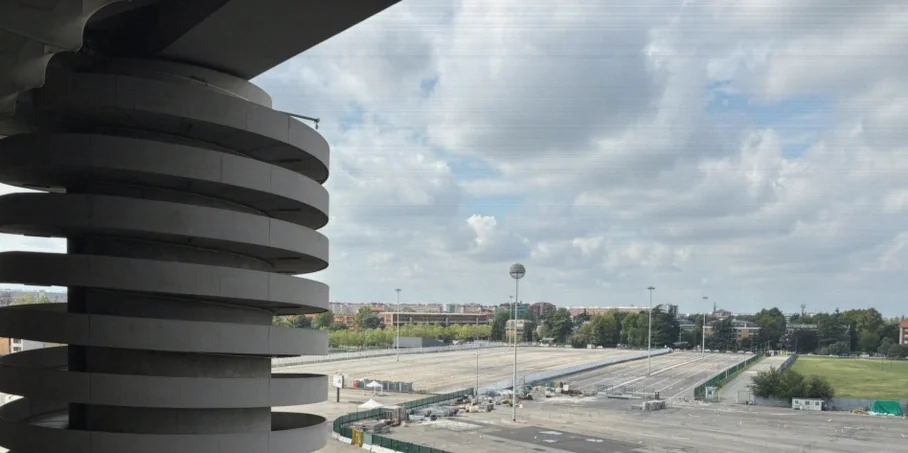
San Siro has begun to change at the edges, long before the new stadium rises beside it. The work is still modest in scale: rubble removed, access routes adjusted and space cleared around the western side of the Meazza. Yet these are the first visible signs of a project that Milan and Inter hope will reshape the district by 2032.
Quick facts
- The new stadium is planned for 71,500 spectators and is valued at €2.149 billion.
- A first rendering is expected by the end of October, with construction scheduled to begin in the second half of 2027.
- Milan and Inter completed the purchase of the stadium area on 5 November for €197 million.
- The existing Meazza is expected to remain in use during construction, before partial preservation and demolition work.
- The project still requires municipal and regional approvals and faces administrative and criminal proceedings.
The historic southern ticket office was demolished in June, taking with it one of the old matchday landmarks of the stadium. On the west side, two entrances have disappeared and several of the large circular metal canopies that sheltered supporters in bad weather have also been removed.
The changes are intended to create room for the construction site. For a period, old and new San Siro are expected to stand opposite one another, before the skyline around the stadium is altered for good.
A long road back to a shared plan
If the timetable is met, the replacement venue will be ready in 2032. Construction must start in the latter half of 2027, but the formal route remains demanding: the implementation plan must pass through Milan City Council before the Region assesses the technical and economic feasibility project.
There are legal questions too. A ruling from the Regional Administrative Court is awaited on appeals lodged by local committees, while a criminal investigation into alleged bid-rigging remains open.
For Milan and Inter, the present agreement closes a circuitous chapter. Their stadium project was first presented in July 2019, when the clubs unveiled Populous’ proposed “Cathedral” design. At that stage, the plan was supposed to be complete by this year.
Instead, the process became defined by delay, changes of direction and separate ambitions. Both clubs consistently maintained that rebuilding the Meazza, or simply maintaining it after it ceased to be used, would be too expensive. Their preferred route was demolition, apart from protected elements including one tower and part of the Curva Sud.
In October 2019, the city gave its initial approval subject to 16 conditions. Those included reducing the amount of concrete in the scheme and retaining part of the present stadium.
San Donato, Rozzano and the return to San Siro
By early 2023, the two Milan clubs appeared to be moving apart. Milan explored San Donato, buying land and working with the local authority on a viable independent development. Inter examined options in Rozzano-Assago.
Even as Milan’s alternative progressed through the required administrative steps, San Siro remained the underlying priority. In September 2024, Mayor Giuseppe Sala stated that neither club would renovate the existing stadium, a declaration that helped reopen the prospect of a joint project within Milan.
In March 2025, the clubs delivered their feasibility document to Palazzo Marino. It set out the plan for the new ground, while time pressure increased around the future of the Meazza.
The decisive shift came when the sale of the entire stadium area to the two clubs was put on the table. Discussion was pushed back to September 2025 amid Milan’s wider urban-planning investigation, leaving the parties working against a 10 November deadline.
From that date, the second tier of the Meazza would have become subject to a historic and architectural protection that would have prevented its demolition. The transaction was concluded five days earlier, on 5 November, at the €197 million valuation established by the Revenue Agency in July and subsequently confirmed after further scrutiny.
The Meazza’s final years
The purchase gave the joint scheme the foundation it had lacked through years of uncertainty. It does not remove every obstacle, but it keeps Milan and Inter together and anchors their future only metres from the stadium that has carried both clubs through generations of Sunday afternoons.
For now, the Meazza remains open and full. Its crowds will continue to fill the old structure for several more seasons, while the western perimeter begins to reveal what lies ahead: not simply a building site, but the closing stretch of a 13-year stadium story that began as an idea in 2019.