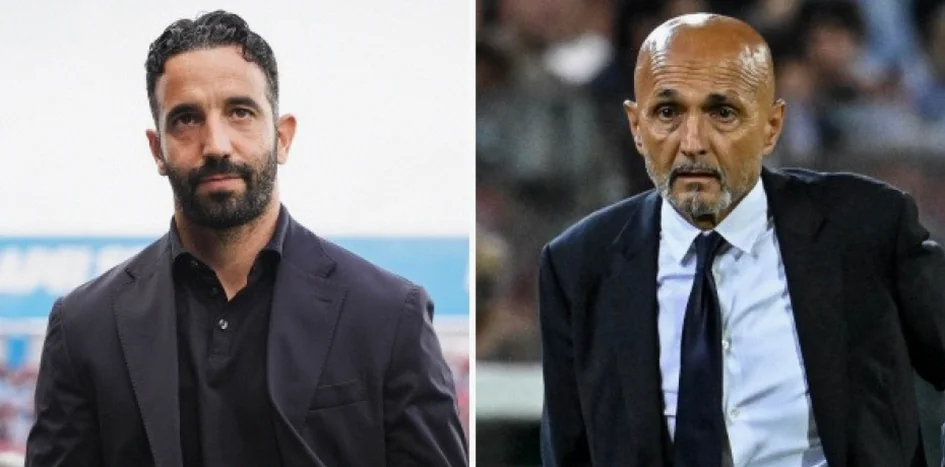
Milan and Juventus are asking their supporters for patience at a point in the season when patience can feel like a wager. Both clubs retain the scale of their ambitions and the weight of their histories, yet recent draws have left them short of the authority they want to project. Their coaches, Amorim at Milan and Luciano Spalletti at Juventus, are pursuing football that seeks control rather than compromise. The difficulty is that the work remains ahead of the results.
The decision
There is a shared logic behind the two projects. Milan and Juventus want possession to dictate the rhythm of a match, with the ball worked through congested areas until a defence is opened through repetition, movement and positioning rather than direct force. It is demanding football, especially when a squad has not fully been built for it.
Inter have the advantage of continuity, while Como have been able to establish a recognisable identity through targeted investment and clear planning. Roma offer the most persuasive recent example of a team increasingly shaped by its coach. Gian Piero Gasperini inherited the order and discipline restored by Claudio Ranieri after a period of severe disorder, then gradually moved the side higher up the pitch and increased its speed without losing that defensive foundation.
Roma have not met every request made by Gasperini, but their growth has been clear. Donyell Malen’s arrival, and his use ahead of Artem Dovbyk, has helped make several attacking mechanisms more straightforward. The club have also benefited from an environment willing to unite around the prospect of improvement, rather than turn every unmet expectation into an internal crisis.
That is why the attempts of Amorim and Spalletti should not simply be dismissed. A coach’s ideas need time, repetition and players able to carry them out naturally. Yet neither Milan nor Juventus can expect their concepts alone to provide comfort. Both must make choices that bring their football closer to the immediate qualities of their squads.
For Spalletti, that tension is particularly familiar. He can still speak to Juventus through the club’s traditions of duty, pride, care and resistance to decline. But those values must accompany the tactical plan rather than exist apart from it. The detached ending at Reggio Emilia remains the clearest warning sign: it was a conclusion Juventus cannot allow to become a habit.
Spalletti’s effort to raise the group is evident, although his reading of matches also exposes limits within the squad beyond the injury list. Juventus lack a specialist centre-forward, a quick and decisive distributor capable of adding suddenness to their possession, and wide players who can combine effectively when Kenan Yildiz, their outstanding individual talent, is unavailable or contained. There are many names in the attacking group, but fewer genuinely distinct options than the list suggests.
There was, however, encouragement in Sardinia from the minutes given to Alajbegovic. More broadly, Juventus are regularly getting the ball close to the opposition goal. That does not solve their problems, but it suggests the direction of travel is not fundamentally wrong. Spalletti’s career has repeatedly shown his ability to improve players through demanding work, with his spell in charge of Italy the notable exception: there, limited training time and an excess of ideas made the task harder.
Milan are going through a similar period of assimilation. Amorim’s concepts appear to require time, and some of the available interpreters have made the process less clean than intended. There is a sense that, with a fully fit squad, he might select options that appear more obvious to supporters. Instead, his choices can look unusually elaborate, as though he is reluctant to settle for the simple answer.
Still, doubt and revision are part of a developing side. Milan’s key figures offer signs of how the project might settle. Moreira provides a forward outlet, Adrien Rabiot needs space to arrive with conviction in the final 16 metres, Christian Pulisic remains the clearest-minded attacker when play becomes compressed and anxious, and Luka Modric continues to give the team order and continuity.
The intention is unmistakable: Milan want to occupy the other half of the field, remain there and construct attacks there. Compared with last season, it is a substantial change. It has cost them some balance and made them look vulnerable at moments, but that vulnerability has not translated into frequent punishment. The players’ application has helped, and the team often becomes clearer as a match develops and necessity sharpens their decisions.
Milan and Juventus are level as the Serie A sides to have allowed the fewest shots on target. The figure needs context, however, because neither has yet faced Inter, Como or Roma, three teams that consistently produce a high volume of attempts. Milan are also only 14th for shots taken, illustrating a side with compactness but insufficient attacking release.
Their matches are often being played between the penalty areas, orderly rather than explosive. Milan’s centre-forward has at times drifted deep to ease the circulation of possession, but that has also left him unable to command the area that should be his. The same unease can be seen among Juventus’s strikers.
That may be the most revealing image of both clubs: forwards carrying uncertainty, teams caught between an intended style and the players currently available to deliver it. Milan and Juventus remain competitive, but neither is secure. Their next progress will depend not on abandoning their coaches’ ideas, but on making those ideas more usable before faith becomes frustration.