On 19 January 1964, Milan did more than beat Inter 2-0 at San Siro: they turned a city derby into one of the season’s defining disturbances. A pre-match deception unsettled Helenio Herrera, Milan took control through Fortunato and Gianni Rivera, and the second half descended into dismissals, injuries and a tunnel confrontation involving the usually unflappable Giacinto Facchetti.
Key takeaways
- Milan won 2-0, with Fortunato scoring after 13 minutes and Rivera adding the second shortly after the half-hour.
- Milan director Gipo Viani had Dino Sani announced in the line-up despite knowing the midfielder was injured.
- Inter finished with nine men after Luis Suarez and Mario Corso were sent off.
- Facchetti was later suspended for one match after striking Milan’s Bruno Mora in the stadium tunnel.
- The victory left Milan level with Bologna at the summit after the first half of the Serie A campaign.
The announcement that altered the derby
The match became known as the “speaker derby” because its first decisive moment came before the teams entered the field. An hour before kick-off, the San Siro announcer named Sani in Milan’s side. Viani knew otherwise: Sani had been unable to train properly since Wednesday and was not fit to play.
Herrera reacted to the announcement by changing Inter’s midfield, bringing Zaglio in for Tagnin. Only after reaching the pitch did the Inter coach realise that Sani was not among the Milan players at all, but seated in the stands. By then, the adjustment had been made and Milan had gained the initiative.
The Rossoneri quickly played with the assurance of the reigning European champions. Fortunato opened the scoring in the 13th minute and Rivera doubled the lead after the 30-minute mark. Inter struggled to settle, while Milan’s Brazilian forward Amarildo had his sisters, Nicea and Maria de Carmen, celebrating enthusiastically in the grandstand. Their dancing drew whistles and angry reactions from the section occupied by Inter officials.
Miguel Munoz, the Real Madrid coach, was also watching. Madrid were due to meet Milan in the European Cup, a competition the Rossoneri had won at Wembley in 1963 against Eusebio’s Benfica. Munoz left impressed by the scale of Milan’s performance, judging them an exceptionally strong side.
Inter’s collapse and the Facchetti affair
As the contest slipped away, Inter’s frustration became physical. Suarez was dismissed after grabbing Mario Trebbi by the neck, forcing him down and then kicking him. The Spaniard later maintained that Trebbi had insulted the memory of his mother, saying that he had lost control after the alleged remark.
The dispute did not end at the final whistle. Suarez and Trebbi were both selected for doping control, which at that time was carried out in rooms at a hotel in Piazza della Repubblica rather than at the stadium. On seeing Trebbi there, Suarez again tried to confront him, pushing him against a wall and demanding that he repeat what had been said on the pitch. Trebbi denied ever insulting Suarez’s mother.
With Suarez already off, Corso reduced Inter to nine. Mora had gone down following a challenge when Corso kicked him, then followed with another blow as the Milan player lay on the ground. Referee Antonio Sbardella of Rome had no alternative but to dismiss him.
The damage extended beyond the red cards. Milan lost Paolo Maldini to a knee problem, while Inter’s Jair and Milan’s Fortunato ended the afternoon limping. Yet the most surprising incident came after the match, in the passage leading to the dressing rooms.
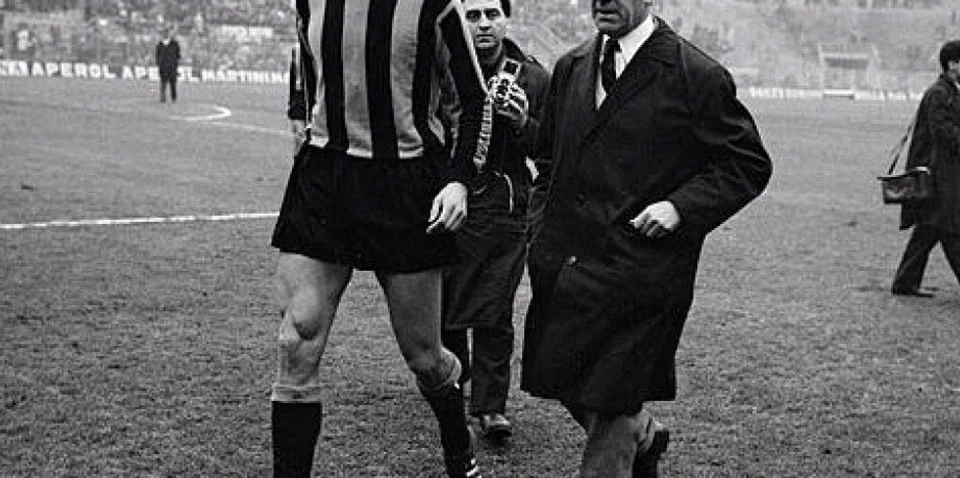
Facchetti, already regarded as one of Italian football’s fairest players, struck Mora in the back. Milan initially claimed there may also have been a kick, although the episode was later defined as a single punch. Facchetti said Mora had insulted him. A linesman, Tosi, arrived as the confrontation was dying down, while a security officer separated the players; it later emerged that the officer supported Inter.
Sbardella asked for an explanation and was told he would receive the full account in the officials’ room. Facchetti referred to an “disrespectful remark” from Mora, but the case eventually went before sporting judge Barbé. Suarez, Corso and Facchetti each received a one-match ban. Inter considered an appeal before deciding not to proceed.
For Facchetti, the suspension was an extraordinary exception in a career built on restraint. His only later Serie A dismissal came in April 1975 against Fiorentina, when he was shown a second yellow card after protesting a handball by Gianfranco Casarsa. The referee that day, Vittorio Vannucchi, was only officiating his third Serie A match and punished Facchetti’s sarcastic applause after the complaint.
Amid the disorder, San Siro still carried the social theatre of a Milan derby. Luisella Riva, wife of Milan president Andrea Rizzoli, drew attention in leopard-print fur, boots and a fur hat. Actress Franca Bettoia, an Inter supporter, watched behind dark glasses, while Sylvia Casablancas Spadaccini, newly married to Milan board figure Cesare Spadaccini, was another prominent presence in the stands. But it was the match itself that endured: Milan’s controlled victory, Inter’s unraveling, and a derby whose tension reached even Facchetti.