Goal celebrations are often football’s smallest public rituals: a private reference turned outward for a stadium, a dressing room or a family watching from home. Milan’s history is full of them, and Gonçalo Ramos’s gesture on Sunday night offered another reminder that a scorer’s signature can become part of his story as surely as the finish itself.
The decision
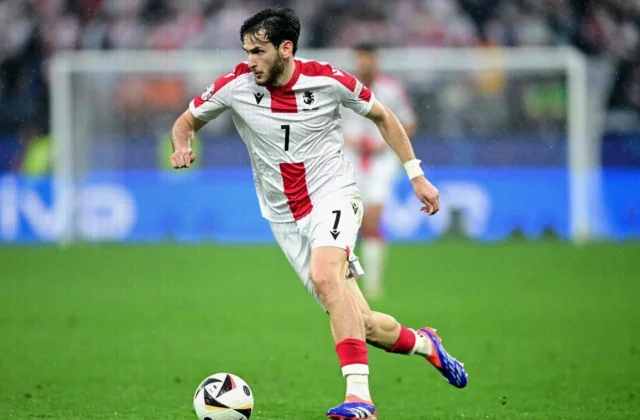
Ramos’s choice of celebration was made long before his chipped finish past Nyland in Norway against Portugal. After scoring, he formed imaginary pistols with his hands, fired twice and blew across the barrels. It is a routine he developed after encouragement from his father, a former player, who advised him to find something recognisably his own.
The Portugal forward has previously explained that he discussed the idea with Benfica team-mates before putting it into use. Their approval settled the matter: the double shot and the final gesture became his calling card.
It is not an unfamiliar image in Milan. Krzysztof Piatek made the gunslinger celebration his own during his short but forceful Rossoneri spell, often adding a slide across the turf before raising his hands. His return justified the confidence for a while: in the opening six months of 2019, the Polish striker scored nine times in 18 matches for Milan.
Piatek gave the ritual a linguistic explanation. When he first reached Genoa, he was regularly called a bomber; in Polish, he noted, the term has a different sense, closer to a man who shoots than simply a prolific centre-forward. The pistol gesture followed naturally from that interpretation.
Sunday’s picture
Ramos’s celebration belongs to a broad Milan tradition in which goals have been marked with everything from restraint to theatre. Some gestures arrived as spontaneous expressions; others were carefully prepared, carrying a dedication that outlived the match itself.
Paolo Rossi’s raised arms remain one of Italian football’s defining images from the 1982 World Cup, where he finished as the competition’s leading scorer with six goals as Italy won the trophy. Marco van Basten offered Milan supporters a similarly uncomplicated response after finding the net: arms aloft, occasionally just one. For a player so frequently troubled by ankle pain, those seconds were also a brief release from it. He scored eight times across 35 appearances in Milan.
Christopher Nkunku brought a more elaborate routine. He keeps a balloon in his sock, takes it out after scoring and inflates it with his arms spread wide. The idea began as a tribute to his son, who enjoys balloons. The colour has reflected the club kit: blue at Chelsea, red at Milan and again red at Leipzig.
Rafael Leao’s celebration came from a social-media post in 2021, when he used a surfer emoji. The image travelled from his online profile to the pitch, where his surfing motion became closely associated with his Milan goals. The club embraced the connection when it announced his contract renewal in June 2023 with an image of a surfboard in the sand. It also reflected the Portuguese winger’s roots, with Portugal a notable destination for surfing.
Christian Pulisic’s ritual centres on the half-tiger tattoo on his left forearm. He raises the arm across his face so the tattoo’s eyes align with his own. The ink dates back to his teenage years at Borussia Dortmund. His tattoo artist had suggested placing it in a way that could work as a future celebration, though Pulisic later said that had not been the original intention. He tried the pose almost by chance during a match, and it stayed with him. Diego Moreira has also used a similar arm-across-the-eyes gesture.
Hearts have their own place in football’s visual language. Angel Di Maria was an early prominent exponent, while Alexandre Pato used one in his first Milan appearance, against Napoli in January 2008. Pato directed the sign towards Stephany Brito, who later became his wife. His time at Milan was brief, but it contained goals, acceleration, dribbling and a celebration supporters still recall.
Olivier Giroud added a more mischievous image to a match of much greater consequence. On 5 February 2022, Milan came from behind to defeat Inter in the derby, a result of major importance in the Scudetto race. Giroud scored both goals, and after the second he ran away with his tongue out, a grin and a provocation in equal measure.
Tijjani Reijnders found a different way to turn a familiar expression into a personal habit. He would smile, spread his arms and pull a face that could look like frustration, often directing it towards the Curva while at Milan. The meaning was gentler than the expression suggested. At home, he has said, he jokes by saying “C’est la vie” when things do not go his way; after a goal, he preferred to give that motto its place on the pitch rather than in a moment of disappointment.
Images that stayed with Milan
Some of the club’s enduring celebrations were shared rather than individual. During the 1998-99 Scudetto season under Alberto Zaccheroni, George Weah and Zvonimir Boban produced one of its most memorable photographs in a 2-0 win away to Juventus. Boban created the second goal, Weah controlled and beat Angelo Peruzzi at the near post, and the pair ran off holding hands. It was an instinctive scene that reflected an understanding between players in very different roles.
Another collective moment came in September 2004, in Milan’s match against Reggiana. Andriy Shevchenko opened the scoring, then Cafu and Kaká joined him in a cradle motion. The dedication was for the newborn son of Alessandro Costacurta. A full-back, midfielder and striker stood together, united by a gesture as much as by the trophies and major European nights they had shared. Kaká and Shevchenko also accounted for two Ballon d’Or awards between them.
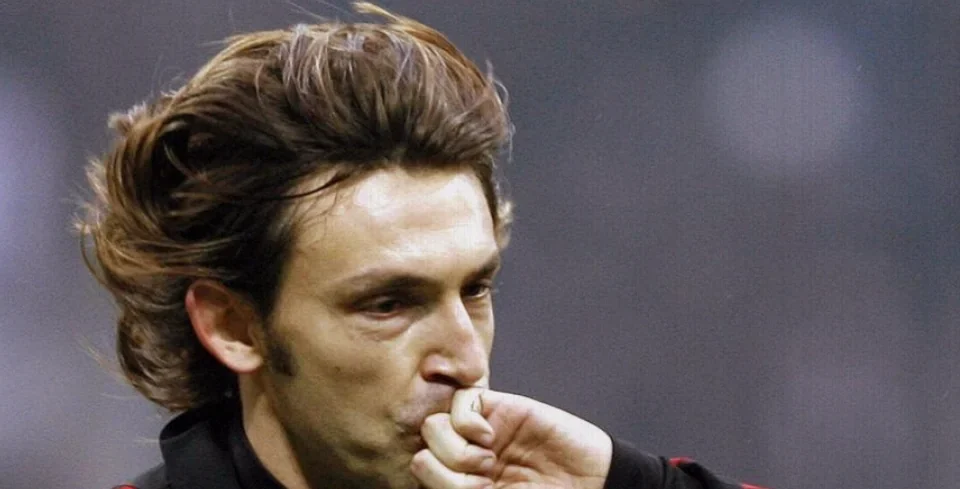
Andrea Pirlo’s celebrations matched his economy as a player. He did not use the same gesture after every goal, but a particularly fine free-kick or long-range strike could bring a kiss to the ring finger of his left hand, a discreet dedication to his marriage.
Roberto Baggio chose something less understated at San Siro on 28 April 1996. Milan beat Fiorentina 3-1, with Baggio scoring the second. He removed his shirt, placed it on the corner flag and stayed there before his team-mates arrived around him.
Alberto Gilardino’s imaginary violin began before his Milan years, during his time at Parma. The idea was agreed over dinner with Marco Marchionni: if Gilardino scored, he would play the invisible instrument and Marchionni would provide a bow. Gilardino found the net, followed through with the plan and retained the violin as a lasting part of his identity as a scorer.
From a raised arm to a balloon, a cradle or a surfboard, these scenes have rarely needed explanation once supporters have seen them often enough. Ramos’s double shot is built on the same principle: a goal lasts a moment, but the image that follows can remain for years.