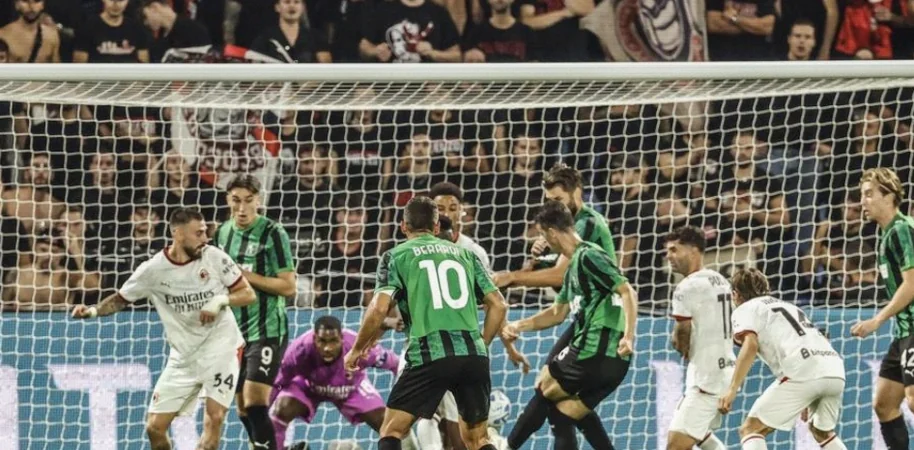
Milan’s draw at Sassuolo was not decided by one corner alone, but the equaliser at Reggio Emilia brought a recurring weakness into sharper focus. Ruben Amorim’s side had taken the lead through Adrien Rabiot, yet failed to slow the match, retain possession or limit the home side’s momentum. Odenthal’s late intervention from a set piece cost the Rossoneri two points and reinforced the concern that this team still struggles when the match becomes tense.
A pattern that is affecting Milan’s season
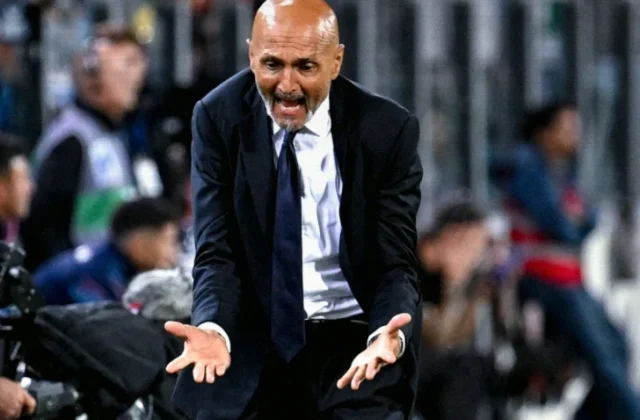
Amorim was clear after the match: “We cannot concede goals like that from a corner.” His wider complaint was about game management. Milan should have kept the ball after going ahead, controlled the contest and halted Sassuolo’s response. Instead, they allowed three counter-attacks after Rabiot’s goal and gradually dropped deeper.
Odenthal’s strike was Milan’s third concession from a dead-ball situation this season, following goals against Torino and Juventus. Across two of those episodes, the points lost have amounted to four. With more care in such moments, Milan would now be level at the top with Inter and Lazio.
There is an additional detail to the Sassuolo goal: Odenthal, described as Aquilani’s fourth option, has now scored more often than Ramos. More importantly for Milan, he found the freedom to decide a match that had been within their control.
How Sassuolo found the equaliser
- Sassuolo used a rehearsed low corner, with Laurienté delivering the ball along the ground rather than lifting it into the box.
- Doig got in front of Moreira and allowed the delivery to travel into the central area.
- Moreira turned away as the ball arrived and could not make the interception, while Ramos remained in position rather than attacking the danger.
- The ball then ricocheted inside the Milan penalty area, with too little decisive intervention from the visiting defenders.
- Pulisic had been assigned to track Odenthal but lost him early in the move, giving the Sassuolo defender room to shoot.
The image at the end of the move was damaging. Seven Milan players were crowded close to Mike Maignan, leaving the goalkeeper with bodies and legs in his line of sight. Musah attempted to block the trajectory with an outstretched foot, but the greater problem was the collective lack of aggression. Milan reacted to the ball rather than meeting it, and accompanied the phase instead of ending it.
Against a low corner, the first responsibility is to stop the ball crossing freely through the heart of the area. The player at the near post must attack it and clear it. Milan did neither sufficiently at Reggio Emilia.
The earlier warnings against Juventus and Torino
The Sassuolo episode did not emerge in isolation. At the Stadium, Milan conceded a stoppage-time goal when the side had appeared to believe the three points were already secured. Federico Gatti equalised after a free kick that De Winter could have avoided conceding.
- Koopmeiners and Locatelli exchanged passes before the set piece, catching Milan short of clear reference points.
- The ball was delivered accurately into the area.
- Gatti rose between De Winter and Loftus-Cheek to meet the cross.
- Although Milan had seven players in the box against five Juventus players, the Juventus defender won the decisive duel.
The marking existed in theory, but the communication did not. Loftus-Cheek and De Winter appeared uncertain over who was responsible for Gatti, while Milan’s defensive line retreated early instead of holding a higher position and attempting to catch runners offside. Gatti headed the ball directly in front of Loftus-Cheek, who could have closed the space more firmly.
That goal did not ultimately take points from Milan, but it exposed the same tendency: a defensive unit retreating before the delivery has been made, leaving opponents able to attack the ball with greater conviction.
Torino had already offered another version of the problem. Gineitis delivered a low cross, Ramos lost Adams after the forward checked his run, and the Milan defence continued to fall back towards Maignan. Adams then had time to set himself and score an outstanding finish into the top corner.
The quality of the strike was undeniable, but Milan’s failure was in their reading of the moment. No player attacked the cross, challenged Adams’ movement or made his finish more difficult. A more experienced defensive intervention could have disrupted the forward before he struck.
Amorim’s defensive question
Milan’s issue is not simply the number of goals conceded from corners and free kicks. It is an uncertain identity in defensive situations. The side has used a mixed approach, largely based on man-marking but with zonal elements, and too often neither element has worked cleanly.
The individual responsibilities have also been unclear. Players have lost runners, failed to communicate over switches and been too passive when the ball arrives in dangerous areas. The repeated sight is of defenders moving towards their own goal rather than stepping out to meet the threat.
Amorim has room to intervene on the training ground: Milan can defend higher, use the offside line with more coordination, become more forceful in duels and establish clearer responsibilities between the player marking an opponent and the player protecting the space.
For a side trying to remain alongside Inter and Lazio at the summit, those details are no longer minor. Sunday afternoons are often decided by one delivery, one loose ball and one moment of concentration. At Sassuolo, Milan again learned that protecting a lead requires more than having taken it.