October has a way of making a pitcher’s ordinary assignment feel like a high-wire act. More than 3,000 postseason starts have been made, yet only a small group of arms has carried a no-hit bid beyond seven innings. Just three postseason games have reached the finish with the hit column empty: Don Larsen’s perfect game for the Yankees, Roy Halladay’s one-man masterpiece for Philadelphia and Houston’s four-pitcher effort in the 2022 World Series.
The latest near-miss came in Tampa Bay’s 2026 American League Division Series opener, where Drew Rasmussen gave the Rays nearly eight hitless innings against the Yankees at Tropicana Field. Jonathan Aranda’s home run supplied a 1-0 edge, and Rasmussen protected it while matching Tyler Glasnow’s Rays postseason record with 10 strikeouts. Austin Wells finally lined a two-out double down the right-field line in the eighth, ending the bid, though Wells was thrown out trying for third. Rasmussen left after 101 pitches, and Bryan Baker handled a clean ninth for the save.
That was the familiar October formula: a starter working through the late innings, a crowd counting outs, and one ball finally finding grass—or, in a few rare cases, never finding it at all.
The three October no-hitters
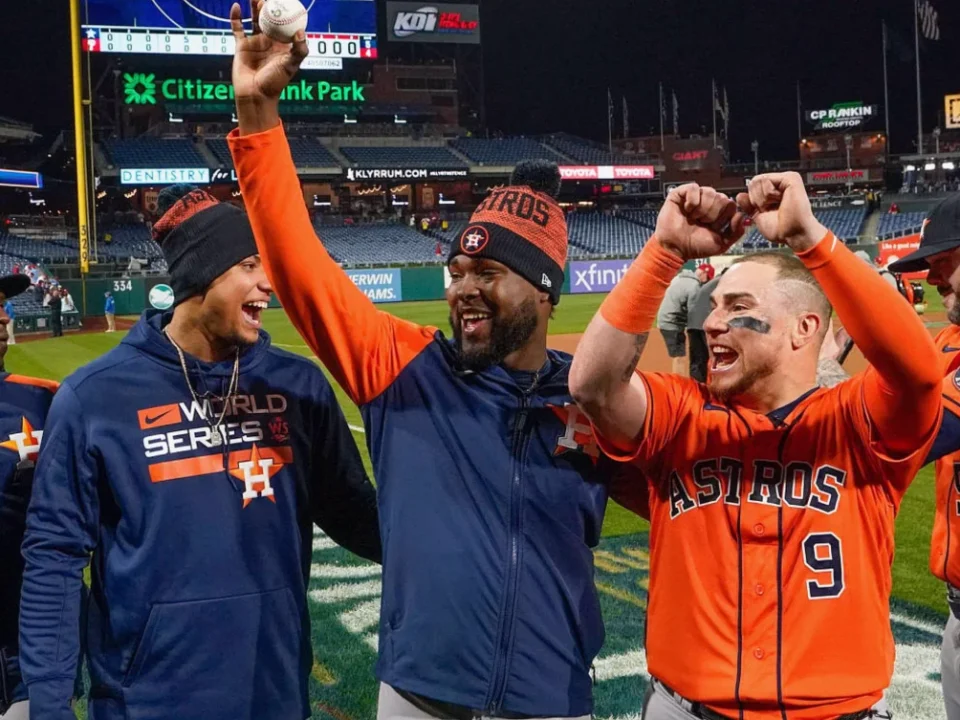
Houston produced the most recent postseason no-hitter in Game 4 of the 2022 World Series at Citizens Bank Park. The Astros had dropped Game 3 and trailed Philadelphia two games to one, so Cristian Javier’s six hitless frames did more than set a tone. He struck out nine Phillies before handing the ball to Bryan Abreu, Rafael Montero and Ryan Pressly, who completed the first combined no-hitter in postseason history. It was the second World Series no-hitter and the third postseason no-hitter overall.
Javier had already been part of a combined no-hitter against the Yankees that June, making his World Series turn another chapter in a remarkable season. The Philadelphia setting also carried a historical wrinkle. Halladay had authored the previous postseason no-hitter in the same ballpark in 2010, while Astros manager Dusty Baker had been in the opposite dugout that night as Cincinnati’s manager.
Halladay’s 2010 National League Division Series debut was the peak of a career built around control and durability. He had thrown a perfect game during the regular season, then opened the Phillies’ series against the Reds with a no-hitter. Brandon Phillips, Orlando Cabrera and Joey Votto went down in order in the first, and Halladay never let the game loosen its grip. Jay Bruce’s fifth-inning walk was the lone blemish between Halladay and perfection.
For Halladay, who had reached the majors with Toronto as a 21-year-old in 1998 and did not pitch a postseason game until he was 33 with Philadelphia, the moment had particular weight. The Phillies swept Cincinnati and moved on to the NLCS, but that opening game remains the October image attached most firmly to Halladay.
Before Halladay and Houston, there was Larsen. His Game 5 performance in the 1956 World Series remains the only perfect game ever thrown in the postseason. It came at Yankee Stadium against the Brooklyn Dodgers, three days after Larsen had lasted only 1 2/3 innings and allowed four runs in Game 2. With the Series even at two games apiece, Casey Stengel trusted him again on short rest.
Larsen later said he had control unlike anything else he experienced in his career. The Dodgers nearly disrupted history twice: Jackie Robinson’s second-inning liner glanced off the third baseman’s glove but was fielded by shortstop Gil McDougald, who beat Robinson to first by a step; in the fifth, Mickey Mantle ran down Gil Hodges’ deep drive in center. Larsen finished the job on 97 pitches, striking out pinch-hitter Dale Mitchell for the final out before Yogi Berra leaped into his arms.
The bids that slipped away
The Braves came close to creating a combined World Series no-hitter in Game 3 against Houston in 2021. Ian Anderson gave Atlanta five no-hit innings despite three walks and only four strikeouts, reaching 76 pitches with a 1-0 lead on a cold, damp night at Truist Park. Brian Snitker went to the bullpen, and A.J. Minter followed with a scoreless sixth while Luke Jackson covered the seventh. Tyler Matzek entered for the eighth, only to watch Aledmys Díaz, batting as a pinch-hitter, drop a soft single into left. Atlanta still won 2-0 and moved ahead two games to one in the Series.
Aníbal Sánchez owns two prominent entries in this particular October ledger. In the 2013 ALCS opener at Fenway Park, he held Boston hitless for six innings while walking six and striking out 12 across 116 pitches. Detroit used Al Alburquerque in the seventh, Jose Veras for the first two outs of the eighth, Drew Smyly for the final out of that inning and Joaquin Benoit in the ninth. With one out remaining before the final two outs, Daniel Nava singled to center, but the Tigers preserved a 1-0 win.
Six years later, Sánchez took a no-hitter into the eighth in Game 1 of the NLCS for Washington. Jose Martinez, used as a pinch-hitter, floated a soft two-out single into center to spoil it. Sánchez became the first pitcher to work at least six innings while permitting no more than one hit in two separate postseason games, with his 2013 Detroit start serving as the earlier example.
Michael Wacha was only 22 when he made his postseason debut in Game 4 of the 2013 NLDS, his 16th major league start. St. Louis faced elimination against Pittsburgh, and Wacha carried a no-hitter into the eighth with two runs of support. He struck out nine, walked two and surrendered Pedro Alvarez’s one-out solo homer for Pittsburgh’s only hit. The Cardinals forced a Game 5, won the series and eventually captured the National League pennant.
Jim Lonborg had a similar late-inning interruption in Game 2 of the 1967 World Series. The American League Cy Young Award winner retired his first 19 Cardinals before Curt Flood drew a walk. Julian Javier then doubled deep to left with two outs in the eighth, ending the no-hit chase. Lonborg completed the shutout, helping Boston answer Bob Gibson’s Game 1 gem, although St. Louis took the Series in seven games.
Bill Bevens’ 1947 World Series outing remains one of the strangest near-no-hitters baseball has known. The Yankees right-hander had gone 7-13 during the regular season and was nearing the end of his major league career, but he kept the Dodgers without a hit at Ebbets Field despite extraordinary traffic on the bases. He issued 10 walks through the middle of the ninth, including enough early trouble for Brooklyn to score once on a fielder’s choice.
New York had scored only twice, leaving Bevens with almost no margin. In the ninth, Al Gionfriddo ran for Carl Furillo, stole second, and Bevens intentionally walked Pete Reiser. Cookie Lavagetto then delivered a walk-off two-run double, Brooklyn’s first and only hit, for a 3-2 victory. Bevens made one more major league appearance, pitching in relief during the Yankees’ Game 7 win.
Red Ruffing’s 1942 World Series Game 1 line—four earned runs in 8 2/3 innings—hardly captures how long he controlled the Cardinals. The future Hall of Famer worked around two first-inning walks, another in the third and two more in the sixth, then retired 10 straight batters. Terry Moore broke through with a two-out single in the eighth. St. Louis rallied in the ninth, with Marty Marion driving in two on a triple, but the Yankees’ earlier 7-0 advantage held up.
Monte Pearson also took a no-hit attempt into the eighth for the Yankees, doing so in Game 2 of the 1939 World Series. Cincinnati’s Ernie Lombardi, facing Pearson for the first time because the clubs had no regular interleague meetings in that era, singled to center with one out. Pearson struck out Harry Craft and got Wally Berger on a grounder, then completed a two-hit shutout. He walked one and struck out eight in a 4-0 win as New York swept the Reds.
Burleigh Grimes combined mound work and offense in Game 3 of the 1931 World Series. He singled home two runs against Philadelphia starter Lefty Grove in the fourth and carried a no-hitter through seven innings. Jimmie Foxx opened the eighth with a walk, and Bing Miller followed with the first hit off Grimes. Miller had faced him 10 times in postseason play and had never collected a hit until that moment. Al Simmons later hit a two-run homer, but the Cardinals prevailed 5-2 and won the Series in seven games.
Herb Pennock nearly made the 1927 Yankees’ Murderers’ Row club even more imposing. He had a perfect game intact entering the eighth inning of Game 3 against Pittsburgh, with Babe Ruth having just launched a three-run homer in the previous half-inning. Pie Traynor singled with one out, and Clyde Barnhart doubled him home. Pennock gave up another hit in the ninth but finished an 8-1 victory, and the Yankees closed out the sweep the next day.
There is a human edge to every one of these lines. Some pitchers, like Halladay and Larsen, got the final out and became part of October forever. Others, from Rasmussen to Bevens, found out how thin the distance can be between a masterpiece and an almost. In the postseason, the ball arrives with more noise, every count takes longer, and even a harmless-looking flare can rewrite a night that seemed headed for baseball immortality.