The NBA has put a number on one of basketball’s oldest eye-test arguments. Its new Handle Score uses player-tracking data and machine learning to rate the quality of a ball-handling sequence, weighing everything from the moves themselves to the space created against a defender.
Key takeaways
- Handle Score is a new official NBA analytic built to evaluate dribble work on individual plays.
- Sony Hawk-Eye tracking records 29 body points for each player, plus the basketball, at 60 frames per second.
- The model was trained with more than 10,000 expert head-to-head clip evaluations drawn from over 1,000 plays.
- Its training set covers plays from the 2023-24, 2024-25 and 2025-26 NBA seasons.
- Scores near 95 or higher represent the game’s most exceptional handling sequences.
From highlight debate to a measurable number
Handles have always been easy to recognize and difficult to sort. A sharp crossover, a spin through traffic or a behind-the-back escape could light up an arena, while the box score only retained the final result of the possession. Traditional play data could count dribbles, but it could not distinguish between a routine bounce and a sequence that put a defender on skates.
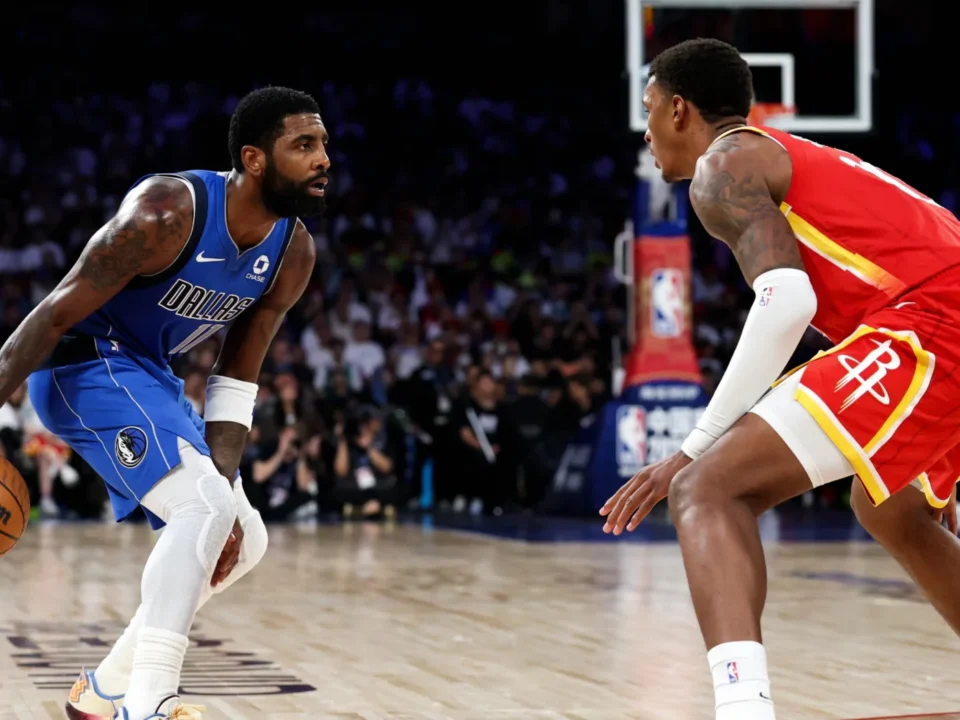
Handle Score is meant to close that gap. It rates the effectiveness and creativity of a player’s work with the ball, including the complexity of the moves and the separation gained from the nearest defender. Rather than treating every dribble alike, the metric turns the entire sequence into one comparative score.
The tracking system supplies the raw material. Sony Hawk-Eye Innovations uses 3D pose detection to follow 29 points on every player’s body along with the ball, collecting location information 60 times per second. The model also accounts for the positioning of the other nine players on the floor, giving each isolation move, drive or escape dribble its on-court context.
That means the score is not limited to whether a possession ended in points. It is built to recognize the handle that created the advantage in the first place: the rhythm of the sequence, the route around pressure and the room a ball handler carved out before the defense could recover.
How the model learned what looks elite
The NBA’s process borrowed an alignment method associated with large language models. Instead of setting a rigid rulebook for a strong dribble package, reviewers repeatedly compared two clips and answered a simple prompt: which handle was better?
Basketball experts made those choices across thousands of side-by-side clips. The database ultimately included more than 10,000 comparisons involving over 1,000 plays, with NBA Top 50 Handles videos used as reference points. Those human judgments taught the model to rank plays in a way intended to reflect how informed viewers assess ball-handling skill.
The resulting system uses two layers of evaluation. One reads the full movement sequence, using the frame-by-frame tracking feed to assess flow, creativity and the overall feel of the dribble work. The other breaks the possession into observable components, including dribble volume, behind-the-back moves, spins and the distance created from a defender.
Put together, those views aim to capture both the visual craft and the practical payoff of a handle. A score near the top of the scale signals a sequence the model believes would be favored against almost any comparison clip.
The league is positioning Handle Score as part of its expanding real-time analytics package powered by AWS artificial intelligence. More than a new column of data, it is designed to give fans a common reference point for a conversation that previously lived almost entirely in clips, memory and argument.