The Ballon d’Or has long been presented as football’s individual verdict, but its history is less orderly than the polished stage suggests. A new account of the award’s inner life, due to be published in France on 30 September, recalls tears, lobbying, rival club manoeuvres and even unsuccessful attempts to test whether the prize could be bought.
The decision
The book, titled The Hidden Face of the Ballon d’Or, traces the evolution of the prize from a magazine initiative into a global event carrying sporting, commercial and political weight. Its former director recounts being approached by a France international who repeatedly tried to establish the cost of securing votes and, eventually, the award itself. The attempt led nowhere: the player was never even among the recognised contenders.
Another approach was more concrete. An agent representing a Premier League footballer reportedly left an envelope on a hotel table during a meeting. It was not opened and was handed immediately to the hotel reception. That player’s Ballon d’Or record remained empty too. No established case of corruption has emerged, but some African members of the voting panel have received threats over their choices.
The current system is far removed from the early workings of the trophy. Gérard Ejnes, one of the figures behind its creation, recalled that the original motivation was partly editorial: the magazine was always looking for something new that might sell more copies. The award acquired its present official name in 1963, when Lev Yashin became its only goalkeeper winner.
For years, the count was almost domestic work. The editor-in-chief would total the votes at home, with his wife typing the outcome and their son helping. Today, voting is handled through a central online platform, used by 100 journalists representing the leading 100 nations in the FIFA ranking.
That modern structure does not prevent pressure around the race. After joining Paris Saint-Germain as communications director, the former France Football executive contacted previous journalistic colleagues to support Ousmane Dembélé’s candidacy. Dembélé received the prize a year ago.
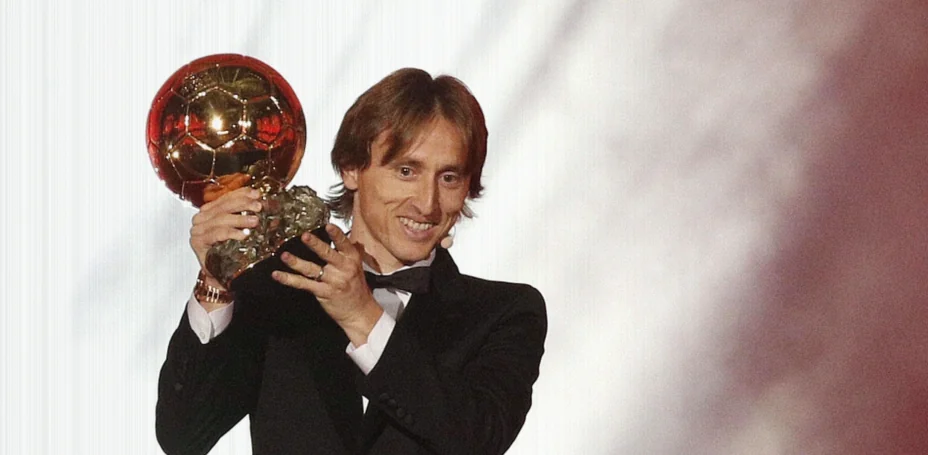
Luka Modric’s 2018 success remains one of the more human moments in the archive. The Real Madrid midfielder had won the Champions League but lost the World Cup final to Kylian Mbappé’s France. When he saw the call informing him of the result, he panicked, answered only on the second attempt and broke down in tears. His reaction was simple: “Why me?” He also promised not to tell anyone before the ceremony, including his wife.
For Lionel Messi, winner of eight Ballons d’Or, the ritual interviews could be notably informal. On one visit, the journalists were welcomed with cold pizza and Sprite. Cristiano Ronaldo preferred formal dinners, particularly during his Manchester United years.
Yet the prize has never been merely a personal distinction. Joan Laporta included a Ballon d’Or bonus in Messi’s Barcelona contract, equivalent to an extra monthly salary, although the payment required the player to attend the ceremony. The award was considered a promotional opportunity for the club as well as the footballer.
Real Madrid’s withdrawal from the 2024 ceremony illustrated the same point. The club reacted angrily when Rodri was selected ahead of Vinicius Jr and cancelled the delegation that had been preparing to travel to Paris. Spanish football’s two great institutional rivals had also carried their rivalry into previous gala trips. In 2022, Real’s plane delayed departure while waiting for Karim Benzema, edging towards the non-negotiable 10.30pm limit and potentially affecting Barcelona’s flight.
At Modric’s ceremony, Laporta also sought to send Mbappé a message: Barcelona, rather than Madrid, should be his preferred destination. The Ballon d’Or stage has often doubled as a space for club positioning.
Ronaldo, meanwhile, chose not to attend in 2021 once it became clear that Messi would win. An offer of a special prize for his record of 111 international goals did not change his mind. His agent Jorge Mendes referred to Messi as “the other guy”, and Ronaldo’s ring from that ceremony is said to remain in a drawer at the magazine’s offices.
Megan Rapinoe’s 2019 trophy was likewise left behind after she opted for a holiday with her partner instead of travelling to Paris. Zinedine Zidane took a different approach in 1998, asking for the wording of the announcement of his victory to be improved because he found the first version insufficiently elegant.
The methods of informing winners have changed with the scale of the occasion. Omar Sivori learned of his 1961 triumph by fax. Pavel Nedved in 2003 and Fabio Cannavaro in 2006 were told discreetly in the car park at Real Madrid’s training ground. Michel Platini, who won three consecutive awards from 1983 to 1985, endured a long and difficult relationship with the French magazine, believing his Italian roots had counted against him before his first victory. Franck Ribéry still feels the 2013 prize was wrongly denied to him.
The grand ceremony itself is a relatively recent development, bringing its own frictions: arguments over front-row seats, competition for invitations, late withdrawals and unusual demands. Rodri’s crutches had to be repainted black for the 2024 event. Emiliano Martínez was asked to exchange his flip-flops for shoes before going on stage. Antoine Griezmann arrived at the Théâtre du Châtelet in particularly high spirits after emptying his hotel minibar with several teammates.
The next ceremony is scheduled for London on 26 October. Jurors have until 28 September to submit their choices, while the leading candidates make their cases in public. The warning from inside the process is that a Ballon d’Or is not won through media campaigning, but excessive noise can still lose it by irritating voters. Mbappé and Lamine Yamal enter the final stretch with that in mind.