Serie A’s refereeing leadership has chosen continuity over correction. The instruction issued at the start of the campaign — fewer marginal penalties, a higher threshold for fouls and cards, and more responsibility for the referee on the pitch — will remain in force until June, even where early decisions have prompted debate.
The decision
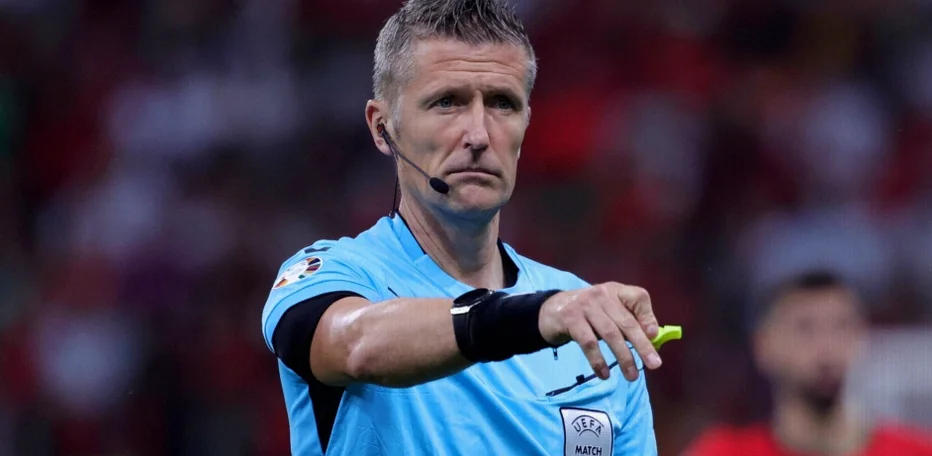
Daniele Orsato, head of the CAN A and B refereeing body, set out the position during a meeting at the VAR centre in Lissone, attended by leading figures from the game’s institutions as well as journalists and television commentators. Luigi De Siervo, Serie A’s chief executive, and FIGC general secretary Marco Brunelli were present, with new AIA technical director Domenico Messina overseeing the work.
The numbers have encouraged the officials to persist. Effective playing time has risen by 5 minutes and 53 seconds compared with last season, while the number of penalties has fallen. The broader UEFA direction is also against the awarding of “soft” spot-kicks.
Orsato said the group would not alter its approach from one week to the next. “Mistakes happen, but I will carry this line through to the end of the season,” he said. “I am not going to change my mind every seven days.”
His message was particularly aimed at younger referees. Orsato said he had been asked to develop officials who understand football and are prepared to make decisions in the middle of the pitch, rather than relying on disciplinary action as protection in difficult moments.
“I knew there would be something to lose at the beginning, but I am looking at what we can gain,” he said. “I want my young referees to return to deciding matters on the field.” He added that they must be given confidence, courage and the right to make errors, while dealing with coaches and players without treating the card as a shield.
Orsato contrasted that objective with what he described as the excessively forensic interventions of recent years. Refereeing, he said, is still being calibrated, and younger officials do not yet possess the authority of former referee Graziano Cesari, who attended the meeting, but must be taught to grow into it.
Where the line has been drawn
The review of recent incidents offered a clearer guide to the intended threshold. Contacts involving Gila and Kolo Muani in Juventus-Milan, and Alajbegovic and Keita in Juventus-Parma, were both regarded as challenges that did not merit penalties.
The decision not to use VAR to intervene over the contact between Kevin De Bruyne and Vasquez was also judged broadly correct. A foul could have been given on the field, but the video evidence did not establish the clear and obvious error required for a review to overturn the original call.
That same principle was applied to the contentious Torino-Bologna episode. Orsato accepted that there could be arguments on either side over whether a penalty should have been awarded, but stressed that VAR must not step in when the on-field ruling cannot be shown to be plainly wrong.
“There have been mistakes,” Orsato said, placing referees in the same imperfect category as goalkeepers, defenders, forwards and coaches. The policy is not a claim that every decision has been right; it is a choice about how much the system should intervene when a match official has made a credible judgement.
Errors acknowledged
Several incidents were nevertheless identified as decisions that should have gone differently. The failure to award Juventus a penalty for Pierre Kalulu’s holding of Rowe against Atalanta was considered unacceptable in the VAR era.
In Frosinone-Fiorentina, Dragusin’s kick to Monterisi’s knee should have resulted in a penalty, while Jimenez should have been sent off for violent conduct against Bracaglia in the same match.
The holding of Pellegrino by Caracciolo inside the area during Fiorentina’s Coppa Italia match with Pisa was described as an obvious penalty. Other missed punishments included Vlasic’s extended arm in Torino-Milan and the absence of a red card for Maxence Caqueret’s serious foul on Britschgi in Como-Parma.
The distinction will matter through the rest of the season. Serie A’s refereeing department wants fewer interruptions and fewer penalties for light contact, but it has also acknowledged that clear holding, violent conduct and serious foul play cannot be allowed to disappear behind a general wish to let matches flow.