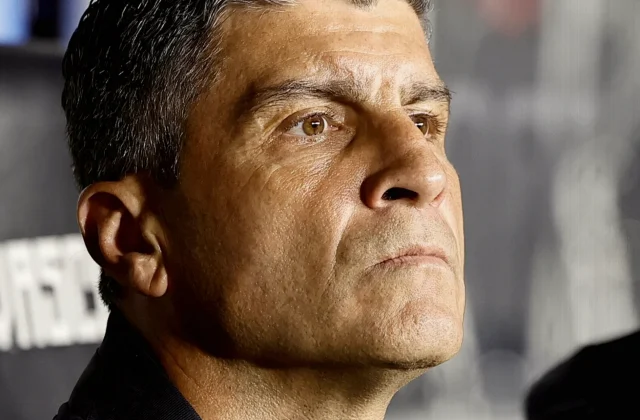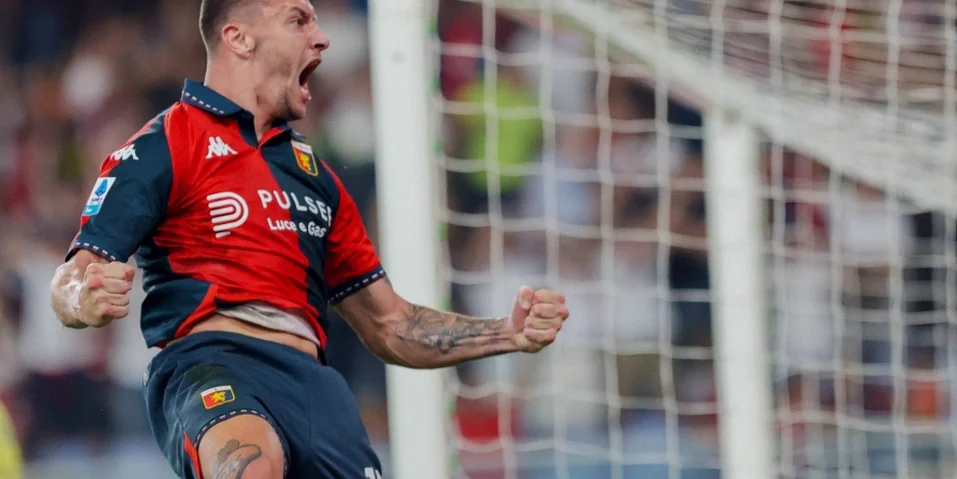
Genoa’s summer recruitment has brought a centre-forward with an old-fashioned profile into Daniele De Rossi’s plans. Milutin Osmajic, the 27-year-old Montenegro international, has already scored three times and is emerging as one of the early stories of the Rossoblu season.
De Rossi sees more than a conventional goalscorer in the former Preston North End striker. He believes Osmajic can shape matches through his presence in the penalty area, his aggression and his willingness to stretch opponents.
Quick facts
- Osmajic joined Genoa after three seasons at Preston North End.
- He scored 31 goals in 111 appearances for the English Championship club.
- De Rossi credited Diego Lopez and Genoa’s scouting department for identifying him.
- The Montenegro forward has three goals so far this season.
- His previous clubs include Cadiz, Bandirmaspor and Vizela.
“He is a fine discovery by Diego Lopez and our scouting group,” De Rossi said. “He has given us energy, depth and enthusiasm.”
The Genoa coach compared his striker to the imposing No. 9s of the 1990s, players who made their living by occupying centre-backs and attacking the six-yard box. De Rossi said Osmajic plays the game in a way he appreciates, even if he does not expect a 20-goal campaign.
“He may not score 20 goals, but I think he will help us win many matches with his instinct, his physical force and his work in front of goal,” De Rossi said. Osmajic is coached in the Montenegro national team by former Roma forward Mirko Vucinic.
For Genoa supporters, the comparison naturally reaches back to Tomas Skuhravy. The former Czechoslovakia striker was a defining figure during one of the club’s strongest modern periods at the start of the 1990s, particularly alongside Uruguay’s Pato Aguilera.
Skuhravy was formidable in the air and difficult to move once he established position in the area. Osmajic has a similarly substantial frame, although De Rossi’s interest lies in the Montenegrin’s practical contribution to the side rather than in a nostalgic imitation of a past hero.
A difficult record in England
Osmajic’s Preston spell also carried disciplinary episodes. Across three years in England, he accumulated 20 matches of suspension.
Eight of those games followed an incident involving Blackburn Rovers player Owen Beck, when Osmajic was found to have bitten his opponent. The referee did not initially spot the offence and issued only a yellow card during the match.
He later received a nine-game ban after an allegation of racist abuse towards Burnley’s Hannibal Mejbri. Osmajic consistently denied the accusation, saying his Balkan background made him an easy target for such claims.
A further three-match suspension came after he headbutted Hull City’s John Lundstram. Osmajic has said he has learned to manage himself better and insists those incidents belong to his past.
The discussion around his arrival has revived memories of a type of forward once common in Serie A: strikers asked first to survive contact, win aerial duels and finish moves. Pasquale Luiso, the “Toro di Sora”, captured that mentality when he said he would dive to head even a washing machine if it were sent into the box.
Pippo Maniero made his name at Venezia by making himself available for every cross, while Dario Hubner, known as “Tatanka”, combined strength with a sharp counter-attacking instinct for Cesena and Brescia. Andrea Silenzi, Karl-Heinz Riedle and Darko Pancev were other prominent examples of physically imposing forwards from that era.
Size alone, however, never guaranteed success in Italy. Colombia’s Ivan Valenciano, prolific for Atletico Junior and nicknamed the “Gordito de Oro”, could not establish himself at Atalanta and made only a small number of appearances.
Before the false nine became part of football’s vocabulary, the role was more direct. The centre-forward was expected to occupy defenders, meet crosses and score. Spain had its own versions in Julio Salinas, called “El Torpe”, and the powerful Ismael Urzaiz, nearly 1.90 metres tall and around 90 kilograms.
Osmajic arrives in Genoa with that older image attached to him, but his place in De Rossi’s season will be decided in present-day terms. Three early goals have given him a platform; the next task is to turn physical promise and raw penalty-box instinct into points for a club seeking consistency.