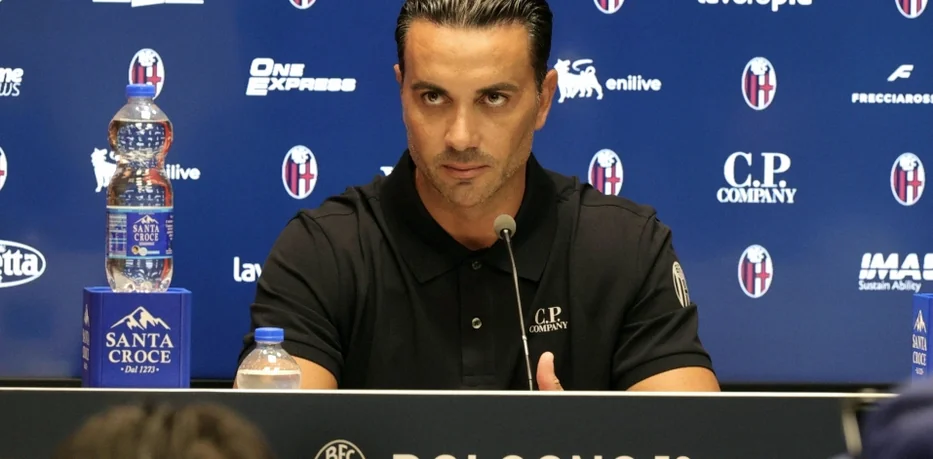
Bologna have turned to Raffaele Palladino on a three-year contract, asking him to restore momentum to a side whose recent standards have made the current malaise all the more striking. His first task is immediate: reconnect a team and a city that have lost some of their shared enthusiasm, beginning with Saturday’s match.
The club acted quickly in dismissing Domenico Tedesco, a move chief executive Claudio Fenucci acknowledged was unusual for Bologna. The decision followed growing concern over performances and over a working approach that, in the club’s view, had failed to take hold with the squad.
Fenucci said doubts became serious after the match against Napoli. Discussions with technical director Giovanni Sartori, sporting director Marco Di Vaio and Tedesco did not provide the clarity Bologna had hoped for, while the work seen during the week was not being reproduced on matchday. The players’ conduct was not questioned, but the club concluded that they were struggling to carry out the former coach’s ideas.
Having spoken with Palladino in the past, Bologna moved once his availability became clear. The objective is to compete again for a European place and, if possible, make another meaningful run in the Coppa Italia, a competition the club have won in their recent successful cycle.
A coach seeking an immediate connection
Palladino said the speed of the agreement reflected the confidence he felt from Bologna’s ownership and directors over the previous few days. He described the project as the right setting in which to begin a new cycle and said the atmosphere around the club had given him a strong feeling from the outset.
“There is an enthusiasm that needs to be recovered,” Palladino said. “I cannot wait for Saturday to be on the pitch. My priority is to spend as much time as possible with the players, understand their feelings and see where the problems have been. In three days, important work can still be done.”
He believes Bologna’s league return has been poorer than the squad deserve, but he avoided setting a numerical target in the table. Instead, his message was that the side must again make the city believe it can compete at an important level.
“The team have taken fewer points than they merit, but they have to relive certain emotions,” he said. “We need to give something back to the supporters.”
Flexibility rather than a fixed shape
The new coach arrives with a reputation for adapting his system. Bologna’s squad was assembled largely around a 4-2-3-1, yet Palladino has long been open to using a three-man defence and sees the current group as capable of making that adjustment.
“I have used three systems, perhaps four, in my career,” he said. “Flexibility is part of who I am. A back three is an option because there are players suited to it, especially out wide. This can be a versatile team.”
He had watched Bologna in person in the opening match against Lazio and said he had seen an intention to take the initiative and impose their football. For now, however, he wants to understand the group before making firm decisions.
Palladino’s non-negotiable principles are effort, initiative and greater intensity. He wants Bologna to play with fewer interruptions, press opponents higher up the pitch and compete aggressively when trying to recover possession. “For me, the forwards are the first defenders,” he said.
Forwards and fitness on the agenda
The coach noted that Riccardo Orsolini has returned to group training and believes he can form a strong partnership with Federico Bernardeschi. He also sees attacking depth in the squad, pointing to Roberto Piccoli, Artem Dovbyk and Enem as options capable of raising Bologna’s goal return.
“I know Piccoli well and have great regard for him,” Palladino said. “I have spoken with him, but also with Dovbyk. We have good strikers and we have to increase the numbers, the goals.”
The forthcoming international break will be used to improve physical condition as well as to establish a clearer collective identity. Palladino wants dialogue with the players and believes the group need a mental shift as much as work on the training pitch.
“They need to feel that they belong to one identity,” he said. “We need communication and belief. There has to be a click in their minds.”
Palladino returns to management after his spell in Bergamo, which ended with qualification for the Conference League. His previous work in Florence and Bergamo brought European football on both occasions, and Bologna are hoping that record can help revive a season that has drifted away from the club’s recent expectations.