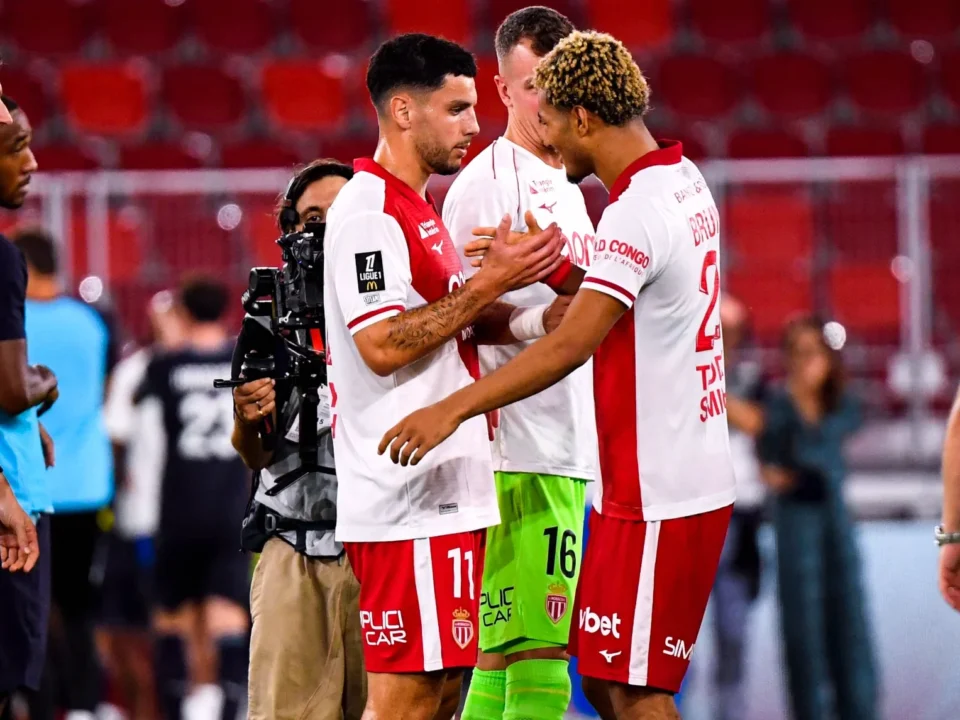
Paris Brunner’s season has moved with the force of a sudden storm in Monaco. The 20-year-old German forward has scored eight times in nine appearances at the start of the campaign, turning a crowded attacking department into a contest he is increasingly controlling. Monaco have won eight of the nine matches in which he has featured, drawing the other, while his absence has coincided with a 1-0 defeat at Lorient and a 2-2 home draw against Toulouse.
There has never been much doubt about Brunner’s talent. His finishes against Marseille, Strasbourg and Freiburg have supplied the kind of moments that linger, and team-mate Jordan Teze has praised the way he can manufacture a goal for himself. “The way he creates that goal is really exceptional,” Teze said. “As we say in the dressing room, he is on fire.” Brunner has also made an impact away from Ligue 1, recording two goals and an assist in two Conference League matches, as well as two goals in three appearances for Germany Under-21s.
Yet Monaco are also aware that his rise carries an old warning label. A regular observer at La Turbie described him as a player who sometimes needs to be kept in check. Brunner was handed a two-match suspension after an excessive celebration following his spectacular goal at Strasbourg, an episode he has accepted with regret. “I regret what I did, and I take it as a lesson for the future,” he said.
A talent rebuilding his reputation
Brunner arrived in the Principality with a complicated record. He helped Germany win both the Under-17 World Cup and European Championship in 2023, taking the best-player award at each tournament, but disciplinary problems at Borussia Dortmund damaged his standing in Germany. Dortmund suspended him twice, including after he left the team hotel during the night on a training camp.
A quieter loan spell at Cercle Bruges brought six goals in 28 matches, while he made only seven appearances in his first Monaco season. This campaign has offered a different picture: a dangerous penalty-box finisher rather than the difficult young prospect some had labelled nonchalant or even unmanageable. Senior figures Eric Dier and Denis Zakaria took him under their wing during the summer, and Brunner’s response has been emphatic.
His international future remains open, too. Brunner represents Germany at Under-21 level, but he is eligible for the Democratic Republic of Congo through his mother. DR Congo coach Sébastien Desabre has recently met people close to the player in the hope of having him available in November.
Brunner’s form has altered the internal order among Monaco’s forwards. Matthis Abline, the club’s most expensive signing of the summer, has versatility on his side, while Ansu Fati and Takumi Minamino have returned to the picture. Aleksandr Golovin offers a different, less direct profile. By contrast, Mika Biereth has slipped down the sporting hierarchy, while Folarin Balogun is still recovering his physical sharpness after a problem suffered at the World Cup and an unsettled transfer window. The only attacking absentee is Idumbo, who has a psoas issue.
“There are a lot of us up front, but it is good for the work,” Abline said. “It means we have to give 100 per cent every day because everyone wants to play.” Coach Filipe Luis sees the depth as a practical advantage, allowing him to adjust to each match and use fresh players. He insists there is no discontent within the squad, despite the inevitable risk that players receiving fewer minutes could lose motivation.
“Nobody likes not playing, but they understand because they see what their team-mates are doing on the pitch to deserve their place,” Filipe Luis said. His message has been consistent since taking charge: status will not protect anyone. “If someone is not at the required level, he goes down. You have to earn the right to play, whatever your name, history or age. You have to prove it every week. And if I think Monaco should play without a striker because that is best for the team, I will do it.”