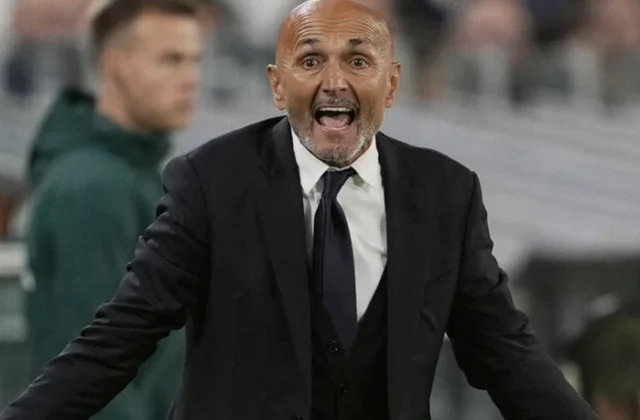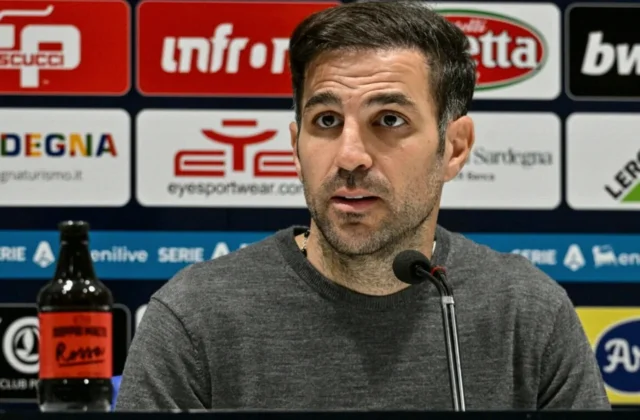
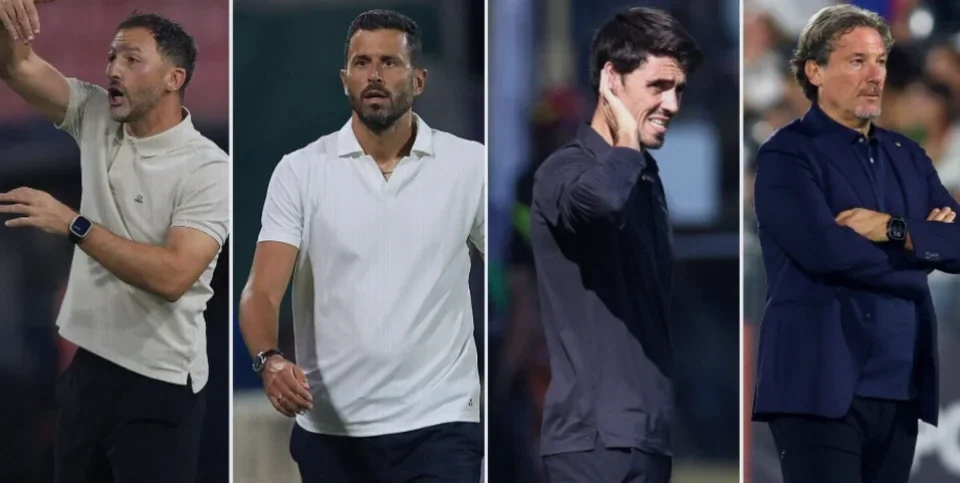
Seven rounds into the Serie A season, the familiar pressure around the benches is already shaping the campaign. Four changes have arrived before autumn has properly settled: Fabio Grosso lasted three matches at Fiorentina before Paolo Vanoli returned, Domenico Tedesco survived four at Bologna, Carlos Cuesta made five games at Parma, and Davide Nicola took over at Venezia after six rounds.
Italy’s managerial cycle is moving at its usual speed. Last season, 2025-26, ended with eight dismissals; the modern high-water mark remains 2023-24, when 14 coaches lost their jobs across nine clubs. At the present rate, that figure is already within sight.
Quick facts
- Serie A has seen four bench changes in its first seven matchdays.
- Italian top-flight coaches average 29.9 matches in office.
- Premier League managers average 43 matches, the highest figure among Europe’s five major leagues.
- Cesc Fabregas and Kosta Runjaic are Serie A’s longest-serving current coaches, both in their third season with their clubs.
- Palermo used five coaches during their relegation season of 2016-17.
The contrast with the other major leagues is clear. Premier League clubs have not changed manager this season, although Michael Carrick has come under scrutiny after a heavy defeat at Como. Spain has recorded two dismissals, at Osasuna and Valencia, while Borussia Monchengladbach account for the Bundesliga’s one change and Lens for Ligue 1’s.
Across the five leading European competitions since 2021, the average spell for a Serie A manager has been 29.9 games. That is below La Liga’s 30.9, Ligue 1’s 32.5 and the Bundesliga’s 33.6, while England stands well clear on 43.
The gap is not merely statistical. A coach in Italy does not, on average, complete a full league season, whereas English clubs tend to give a manager around 13 more matches than their Italian counterparts.
Money, patience and the technical project
The Premier League’s average club value is €746.9 million, the highest in Europe, and greater financial strength appears to bring more tolerance for a difficult spell. Clubs that commit heavily to a coach and squad can be more inclined to protect the original technical plan rather than restart it at the first setback.
Tottenham’s handling of Roberto De Zerbi offers one example. The club gave him a five-year contract and kept faith despite a very poor start to the season. The calculation is straightforward: substantial investment is often matched by more time to make it work.
In Serie A, the opposite instinct remains strong. Dismissal is often treated as part of a coach’s career path rather than an exceptional event; another club, another return, and a new opportunity tend to follow quickly.
Longevity remains the exception
Fabregas at Como and Runjaic at Udinese have both been in place since 2024, making them the longest-serving current Serie A coaches at their respective clubs. Como’s rise has been striking, while Udinese have not developed at the same pace and Runjaic is now under threat.
Elsewhere in Europe, the longer examples are more established. Diego Simeone is in his 17th season at Atletico Madrid, Mikel Arteta has led Arsenal since December 2019 and recently extended his deal to 2030, while Manuel Pellegrini is in a seventh campaign at Real Betis.
Italy’s recent model of continuity was Gian Piero Gasperini, who spent nine seasons at Atalanta from 2016 to 2025 and turned stability into tangible results. Even that spell is modest beside Guy Roux’s 44 years in charge of Auxerre between 1961 and 2005, a tenure from another era.
The cost of constant change
Palermo’s 2016-17 season remains a warning from the recent past. Davide Ballardini lasted two matches, De Zerbi 14, Eugenio Corini seven, Diego Lopez 10, and Diego Bortoluzzi took the final two fixtures after relegation had effectively been decided.
The club fell into Serie B after a season of upheaval under Maurizio Zamparini and then Paul Baccaglini. The succession of changes did not produce a rescue; it accelerated the decline.
Italian football has also developed its own theatre around dismissals. In January 2025, Ascoli president Massimo Pulcinelli announced Domenico Di Carlo’s exit on Instagram before the coach had learned the news himself.
Earlier generations produced even more abrupt scenes. Luigi Radice was removed by Fiorentina in the dressing room after a fierce argument with Vittorio Cecchi Gori. At Vicenza, Gianfranco Bellotto was told at half-time that his duties would end regardless of the final result.
The modern version can be colder. Milan’s decision to dismiss Paulo Fonseca at Christmas 2024 emerged on live television, without a club executive publicly taking responsibility for the call.
Massimo Cellino remains one of Italian football’s most prolific changers of coaches. Across his presidencies at Cagliari, Leeds and Brescia from 1992 to 2023, he oversaw 52 dismissals, 59 changes in the dugout and the hiring of 48 different managers.
His conversation with Attilio Tesser became part of the folklore. Calling from Miami an hour before the opening league match, Cellino told him: “Tesser, let us see whether you are lucky.” Siena beat Cagliari 2-1, and Tesser was gone before the season had truly begun.
That remains the Serie A contradiction: clubs speak of planning, but the bench is rarely allowed to become a long-term home. After only seven rounds, this season has already resumed the old argument between impatience and the work that a project requires.