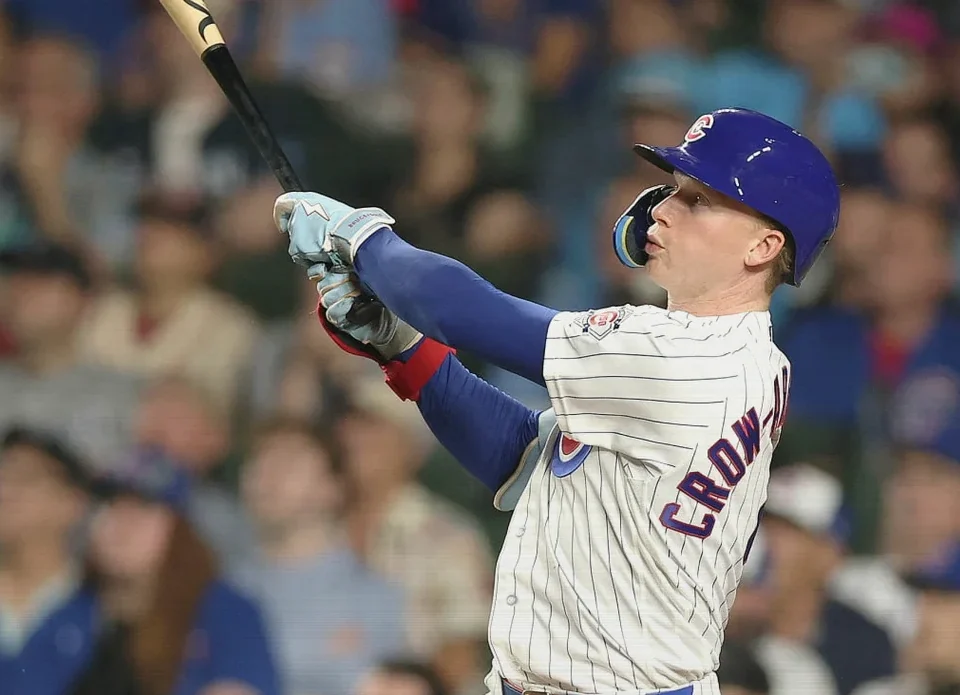
Pete Crow-Armstrong’s four-hit night against Atlanta pushed the Cubs center fielder into territory that has been almost empty for the last three decades. His 42nd homer and 37th stolen base helped Chicago beat the Braves, 7-3, on Monday, while his FanGraphs value climbed from 9.8 WAR to 10.1.
With 11 games left before the Sept. 27 finish, Crow-Armstrong is not merely leading the National League MVP race. He has opened a striking gap on the rest of the sport. Shohei Ohtani is next among Major League players at 6.8 FanGraphs WAR, counting both his work at the plate and on the mound.
That 3.3-WAR cushion is as large as the distance separating Ohtani from Jake Bauers and Bryce Harper, who are tied for 60th. If Crow-Armstrong keeps that margin through the end of the schedule, baseball will have its first gap of at least three FanGraphs WAR between first and second place since 1956, when Mickey Mantle finished at 11.5 and Duke Snider at 7.5.
A season built in every part of the game
Crow-Armstrong has not arrived at this point through one hot stretch or one specialized skill. He has been a force in the batter’s box, on the bases and in center field, a difficult premium position where his defense has rated as the best in baseball, narrowly ahead of Royals shortstop Bobby Witt Jr.
- His 157 wRC+ ranks second among qualified Major League hitters, trailing only Yordan Alvarez. A 100 mark represents league-average, park-adjusted offense.
- His 6.9 baserunning runs above average rank fifth in the majors, reflecting more than just the 37 steals he owns after Monday.
- His defense at an up-the-middle spot gives him the game’s top defensive value.
The 10.1 figure belongs to the FanGraphs model, and it is not necessarily permanent. WAR moves throughout the season, and Crow-Armstrong already briefly touched 10.0 before slipping below it. Baseball-Reference uses a different formula and had him at 9.3 bWAR entering Tuesday, still first in the majors but 1.7 ahead of Phillies left-hander Cristopher Sánchez.
Both major WAR systems can reach different totals because they weigh inputs differently. Still, a 10-WAR season on either ledger would put Crow-Armstrong in rare company. Reaching the line in both remains possible, though hardly settled with the final 11 games still to play.
How unusual the lead has become
Only four players in the modern era, beginning in 1900, have finished at least three FanGraphs WAR ahead of the next player: Rogers Hornsby in 1925 and 1929, Babe Ruth in 1919, 1920, 1923 and 1926, and Mantle in 1956. Crow-Armstrong is presently positioned to join that short list.
His broader target is the 10-WAR club, using total value rather than batting or pitching alone. That distinction matters for two-way players such as Ohtani, for pitchers who hit before the universal designated hitter, and for position players with occasional pitching contributions.
The 10-WAR standard in the 30-team era
Since the 30-club era began in 1998, only a select group has posted a 10-WAR season through at least one of the two major systems.
| Player | Season | WAR mark |
|---|---|---|
| Aaron Judge | 2025 | 10.0 fWAR |
| Aaron Judge | 2024 | 11.2 fWAR, 10.9 bWAR |
| Aaron Judge | 2022 | 11.1 fWAR, 10.8 bWAR |
| Bobby Witt Jr. | 2024 | 10.5 fWAR |
| Mookie Betts | 2018 | 10.2 fWAR, 10.7 bWAR |
| Mike Trout | 2016 | 10.4 bWAR |
| Mike Trout | 2013 | 10.1 fWAR |
| Mike Trout | 2012 | 10.1 fWAR, 10.5 bWAR |
| Barry Bonds | 2004 | 11.9 fWAR, 10.6 bWAR |
| Barry Bonds | 2003 | 10.2 fWAR |
| Barry Bonds | 2002 | 12.7 fWAR, 11.7 bWAR |
| Barry Bonds | 2001 | 12.5 fWAR, 11.8 bWAR |
| Alex Rodriguez | 2002 | 10.0 fWAR |
| Alex Rodriguez | 2000 | 10.4 bWAR |
| Randy Johnson | 2002 | 10.5 bWAR |
| Pedro Martinez | 2000 | 11.7 bWAR |
| Pedro Martinez | 1999 | 11.6 fWAR |
Judge reached the threshold in each of his last three full seasons, despite missing substantial time to injuries in 2023 and 2026. In all three campaigns, he posted a wRC+ above 200.
Witt’s 2024 season offered a useful comparison for Crow-Armstrong’s all-around profile. The Royals shortstop recorded his second consecutive 30-homer, 30-steal season, led MLB with a .332 average and 211 hits, produced a 170 wRC+, won his first Gold Glove after an American League-best 16 Outs Above Average, and placed second in AL MVP voting.
Betts led the majors in 2018 with a .346 average and .640 slugging percentage, hit 32 home runs and registered a 185 wRC+ while taking AL MVP honors for the World Series champion Red Sox. It was the high point of a five-year stretch from 2015 through 2019 in which he averaged 8.1 bWAR annually.
Trout’s three trips to the 10-WAR neighborhood came during the peak of his peak. His 2012 season brought the AL Rookie of the Year Award, 2016 brought an AL MVP, and even his lowest wRC+ across those three seasons was 167.
Pitchers and the older standard-bearers
No pitcher has surpassed 10 WAR since Zack Greinke’s 2009 season with Kansas City. Greinke worked 33 starts and 229 1/3 innings, posted a 2.16 ERA and won the only Cy Young Award of his career.
Randy Johnson reached 10.5 bWAR in 2002, the final year of his four straight NL Cy Young Awards with Arizona. He went 24-5, logged a 2.32 ERA, struck out 334 in 260 innings and finished with a 195 ERA+, meaning his run prevention was 95 percent better than league average.
Pedro Martinez’s consecutive Cy Young seasons in 1999 and 2000 produced two of the era’s towering pitching performances. After finishing second in the 1998 AL Cy Young race in his first year with Boston, Martinez led the majors in ERA and the American League in strikeouts in both award-winning seasons.
Kevin Brown also reached that level during his 1998 campaign with San Diego. The hard-throwing right-hander delivered a 2.38 ERA, 2.23 FIP and 5.2 strikeout-to-walk ratio over 257 innings for the National League champions, the strongest year of a five-season run with the Marlins, Padres and Dodgers.
At the plate, Bonds remains the largest modern example. From 2001 through 2004, he won four straight NL MVP Awards and topped 10 WAR in each year by at least one system. He hit 73 home runs in 2001 to establish the single-season record, then saw opponents intentionally walk him 68 times in 2002, 61 times in 2003 and 120 times in 2004. Before that run, he had also posted more than nine WAR in 1990, 1992, 1993 and 1996.
Rodriguez crossed the 10-WAR mark in 2000 and 2002. With Seattle in 2000, he put up a 1.026 OPS, 41 homers and 132 RBIs before signing a then-record 10-year, $252 million deal with Texas. Two years later for the Rangers, he hit a career-high 57 homers, drove in a major league-leading 142 runs and led the sport with 389 total bases.
Sammy Sosa’s 1998 MVP season came with 66 homers, but 2001 may have been his finer all-around offensive campaign. He belted 64 home runs, drove in 160 and finished with a 186 wRC+.
Crow-Armstrong has not reached the finish line yet, and the numbers can still move. But after Monday’s four-hit push against the Braves, the Cubs have a center fielder chasing a milestone reserved for the game’s most complete seasons—and doing it with a lead over the field that evokes the sport’s oldest giants.