Jeppe Corfitzen’s decision is part of a familiar sporting pattern: a career can change direction through conviction, injury, tribute or simple curiosity. Football has often been one side of those crossroads, whether for an elite cyclist who once represented Anderlecht’s youth system or for a sprinter who tested himself on the pitch after leaving the track. The results are rarely predictable, but the change itself can become a defining chapter.
When football became another beginning
Remco Evenepoel is among the clearest examples of an athlete leaving football behind for an entirely different path. Before becoming one of cycling’s leading names, the Belgian played at a high level with Anderlecht and for Belgium’s youth national teams.
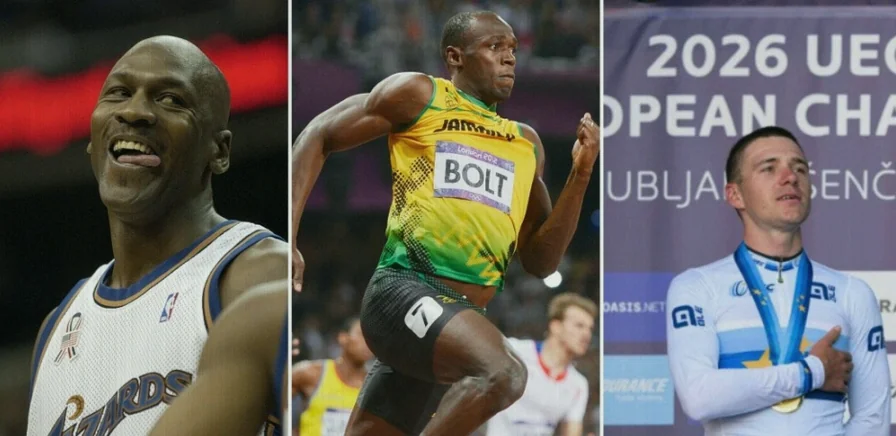
In 2017, Evenepoel chose cycling and progressed rapidly. Within a year, he had collected both the junior world title and junior European title in 2018. His later record has included the road world championship, the world time-trial championship, a European championship and two Olympic gold medals in Paris in 2024. His story offers a useful reference point for Corfitzen: leaving a first sporting identity does not necessarily mean abandoning ambition.
Usain Bolt also turned towards football once his sprinting career had ended. His attempt began in 2017, when he trained with Borussia Dortmund, before he signed for Australia’s Central Coast Mariners. He scored twice in his second appearance for the club, but the spell did not last long. In 2019, Bolt stepped away from football and focused on business interests across commercial and property sectors.
- Evenepoel moved from Anderlecht and Belgian youth football into cycling in 2017.
- Bolt trained with Borussia Dortmund before joining Central Coast Mariners.
- Both cases showed how a football opportunity can emerge after a career has already taken shape elsewhere.
From one sporting world to another
Some changes have been driven by personal attachment. French biathlete Emilien Jacquelin has repeatedly spoken of falling in love with cycling through Marco Pantani and the Italian’s 1998 Tour de France. At Antholz, which will host biathlon events during the Milan-Cortina 2026 Winter Olympics, Jacquelin became recognisable for wearing a bandana in Pantani’s style and an earring lent by the Italian rider’s family.
The five-time biathlon world champion has now formally joined the French junior Decathlon-CMA CGM cycling team on a six-month agreement beginning in May. The cycling experience does not alter his longer-term target: he intends to compete at the 2030 Winter Olympics on home soil.
Michael Jordan’s move from basketball to baseball came from a much more personal place. At 31, and already an international basketball star, Jordan pursued professional baseball after the death of his father. He explained that his father believed he had achieved all he could in basketball and always felt he could also succeed in baseball.
A year after his father’s death, Jordan signed with the Chicago White Sox, owned by Jerry Reinsdorf, who also owned the Chicago Bulls. From 1994, he played for the White Sox affiliate Birmingham Barons and later for the Scottsdale Scorpions, competing in lower-level leagues. The baseball episode eventually ended with his celebrated return to the Bulls and basketball.
Wilt Chamberlain found a second sporting role through volleyball. The former Philadelphia and Los Angeles Lakers centre first approached the game in the early 1970s as part of knee-strengthening work following an injury. He developed a particular interest in both beach volleyball and indoor games at Will Rogers Beach.
In 1974, Chamberlain joined the new International Volleyball Association and became its president a year later. His profile helped bring crowds and television exposure to the league. His contribution to volleyball’s growth in the United States later earned him a place in the Volleyball Hall of Fame.
Injury, speed and the search for a different arena
For other athletes, a forced break provided the opening. Primoz Roglic first emerged as a ski jumper, winning the junior world title with his team in 2007 at the age of 18. An injury then required a long rehabilitation period, with cycling becoming part of that recovery.
That unforeseen route produced one of modern cycling’s most consistent champions. Roglic won the Vuelta a España three times in succession, in 2019, 2020 and 2021, added Liège-Bastogne-Liège in 2020, and has taken three stages each at the Giro d’Italia and Tour de France.
Bob Hayes carried Olympic speed into American football. Known as “Bullet Bob”, Hayes won two gold medals at the Tokyo Olympics in 1964 and held the 100 metres world record for four years. In 1965, he signed with the Dallas Cowboys as a wide receiver and remained with the NFL club for a decade.
The Cowboys won Super Bowl VI in 1972, making Hayes the first and only athlete to combine an Olympic gold medal with a Super Bowl ring. He died in 2002 and was inducted into the Pro Football Hall of Fame.
Gable Steveson has attempted a comparable transition, although without Hayes’s final achievement. The 2020 Olympic champion in freestyle wrestling at 125kg, and a dominant collegiate wrestler with Minnesota, signed with the Buffalo Bills in 2024 as a defensive lineman. Buffalo were drawn by both his athletic ability and his lack of conventional American-football experience, viewing him as a raw prospect for the 2024 practice squad.
- Hayes won Olympic gold in Tokyo before becoming a Super Bowl winner with Dallas.
- Roglic’s cycling career began during rehabilitation from a ski-jumping injury.
- Steveson moved from Olympic wrestling to the Bills’ defensive line group in 2024.
Motorsport’s difficult second acts
John Surtees remains unique in having won world championships on both motorcycles and in Formula 1. Between 1956 and 1960, the Englishman secured seven world titles across the 350cc and 500cc classes. After dominating motorcycle racing, he sought a fresh challenge in Formula 1.
Enzo Ferrari wanted Surtees at Maranello, valuing his driving sensitivity and mechanical understanding. The partnership delivered the Formula 1 world championship in 1964 with Ferrari.
Didier Pironi’s change of direction came after a devastating accident. During the 1982 Formula 1 season, his Ferrari 126 C2 struck Alain Prost’s Renault, which was travelling slowly immediately ahead. Pironi suffered severe leg fractures and faced a long, painful recovery.
Four years later, he tested a Formula 1 car privately in the hope of returning, but the verdict ended that possibility. Pironi instead pursued powerboat racing, winning several events before his death on 23 August 1987. He and two crew members were killed when their boat crashed at 170 km/h during the Needles Trophy Race off the Isle of Wight.
For Corfitzen, as for the athletes who have crossed from football into cycling, from Olympic competition into new professional environments, or from one form of motorsport to another, the next step will be judged over time rather than in a single afternoon. Sporting careers are often mapped out by plans, but some of their most lasting chapters begin when the original route disappears.