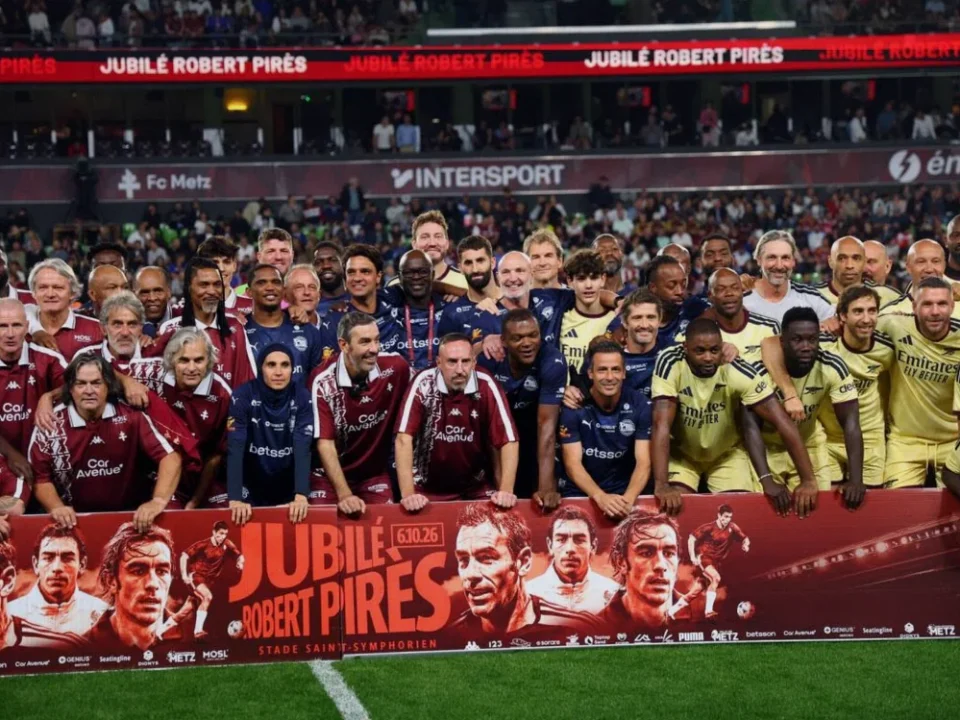
Under the lights at a sold-out Stade Saint-Symphorien, Robert Pirès returned to the ground where his professional story began. Metz staged a late but deeply personal tribute on Tuesday night, as around 90 leading figures from football gathered for the former France and Arsenal midfielder’s jubilee.
A reunion built around Metz
- Pirès made his professional debut for Metz on 2 April 1993, when the club beat Lyon 2-0.
- More than three decades later, he chose Saint-Symphorien for what he preferred to call a “match of friendship and brotherhood”, rather than simply a testimonial.
- The celebrations began around the Hôtel de la Citadelle before moving into the corridors and onto the pitch at the packed stadium.
- Former teammates, opponents and friends filled the evening with old stories, jokes and a match in which the result mattered far less than the reunion.
The scale of the gathering spoke for Pirès’ standing. Olivier Dacourt joked that he would struggle to attract even a fifth of such a cast for his own testimonial. Laurent Blanc, Patrick Vieira, Franck Ribéry, Marcel Desailly, Lilian Thuram, Frank Leboeuf, Thierry Henry and Bixente Lizarazu were among the France contingent.
There was international company too. Jens Lehmann, Lukas Podolski, Samuel Eto’o and El-Hadji Diouf all travelled to Metz, while Henry was still sharp enough to make an impression for the Arsenal legends side.
From a slight teenager to a global name
Pirès’ rise had started quickly after his early football education in Reims and his breakthrough at Metz. Frédéric Meyrieu, who played for the Grenats between 1997 and 2002, recalled first seeing a slight young player with an unusual running style but obvious talent.
Meyrieu said Pirès had remained modest and uncomplicated despite crossing remarkable levels in the game. Former Marseille figures had encouraged him to move south and toughen his game, a step that helped launch the next phase of a career that included France’s 1998 World Cup triumph.
For Les Bleus, Pirès finished with 79 caps and 14 goals. His performances with Arsenal, particularly during the 2001-02 campaign, remain central to how many of his contemporaries remember him.
Thuram felt Pirès was, for a period, among the finest players in world football. He pointed to the midfielder’s Arsenal form before the knee injury that ruled him out of the 2002 World Cup, where Zinedine Zidane was also absent. Leboeuf compared that loss to asking today’s France side to operate without both Kylian Mbappé and Michael Olise.
Tributes to the player and the man
Lizarazu praised Pirès as an elegant, technical and fluid footballer, a player who left his mark on the final years of the 1990s and the opening decade of the new century.
Yet the dominant theme in Metz was his character. Desailly said Pirès deserved his moment as the night’s central figure. Henry said the turnout reflected not only the quality of the player, but above all the person who had brought everybody together.
Thuram described Pirès as profoundly kind and said those close to him had wanted to make him happy. The former midfielder’s friendships have stretched from his earliest days in football through Reims, Metz, Marseille, Arsenal, the France national team and his later work as a television pundit.
Leboeuf said the occasion had been an almost perfect party, with laughter continuing even during the match itself. Winning and losing had been irrelevant; the point was to share time with Pirès and see familiar faces again, older now but still smiling.
Metz gave Pirès a homecoming, and French football gave one of its most graceful modern players an evening worthy of his journey.