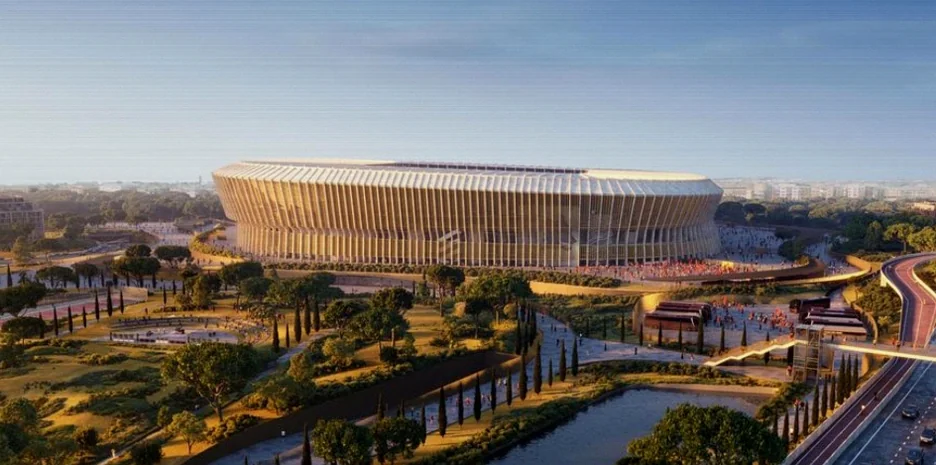
Roma have cleared a decisive institutional hurdle in their plans for a new stadium at Pietralata, with the Services Conference formally approving the project at the Ministry of Infrastructure and Transport.
The final approval was announced at around 1.15pm by extraordinary commissioner Massimo Sessa, who read the five points of the official resolution before the Superior Council of Public Works. Lazio regional president Francesco Rocca and Rome mayor Roberto Gualtieri attended as deputy commissioners, while Sports and Youth Minister Andrea Abodi joined remotely. Davide Bordoni represented Infrastructure Minister Matteo Salvini.
For Roma, the decision moves the proposed Pietralata ground beyond another major administrative stage. The club and the Friedkin family now have what the city administration described as the necessary conditions to push the development forward, with the project intended not only as a new home for the Giallorossi but as part of a wider regeneration of the surrounding area.
A 90-day approval process
Abodi said the conclusion of the conference represented a significant result for Rome, particularly given the pace of the procedure. He noted that the process had been completed in 90 days rather than the 270 days initially expected.
“There is satisfaction, emotion and gratitude for work completed in a very short period,” Abodi said. “This is an extraordinary step for the city of Rome. The signature has symbolic value, but it is also practical, and it should encourage others who will take a similar route.”
The minister added that Italy would submit its final list of venues to UEFA for Euro 2032 within two days. While Pietralata is still a project rather than a completed stadium, he considered the rapid conclusion of the administrative conference an important achievement in itself.
Abodi also expressed hope that progress could soon follow for the Flaminio Stadium, while recalling former Roma presidents Dino Viola and Franco Sensi, whose ambitions for a new ground did not have the same regulatory tools now available.
City sees regeneration opportunity
Gualtieri framed the approval as a landmark moment for the capital and for a district that the development is intended to transform. He praised the joint work of institutions, Roma and the club’s ownership.
“It has been a major team effort,” the mayor said. “It is fundamental in allowing Rome to have a strategic facility and the chance to redevelop an entire part of the city. Roma and the Friedkin family deserve thanks for their ambition to create one of the finest stadiums in the world.”
Gualtieri said the authorities would work to maintain the speed shown during the approval phase. “This is a historic moment,” he added. “We will do everything possible to ensure that the next stages are also completed in record time.”
Targeting the centenary year
Speaking on behalf of Salvini, Bordoni said there was hope that construction could begin in 2027, the year of Roma’s centenary.
“We hope the works can start in the club’s centenary year,” Bordoni said. “This will be an important project for the city on a social level, not only from a sporting perspective.”
The project remains tied to further operational steps, but the Pietralata plan has now gained the formal backing that Roma had long sought. In a season in which results on Sunday shape the immediate mood, the club’s longer story has also taken a meaningful turn: the possibility of a new stadium has moved closer to becoming a real part of Rome’s future.