
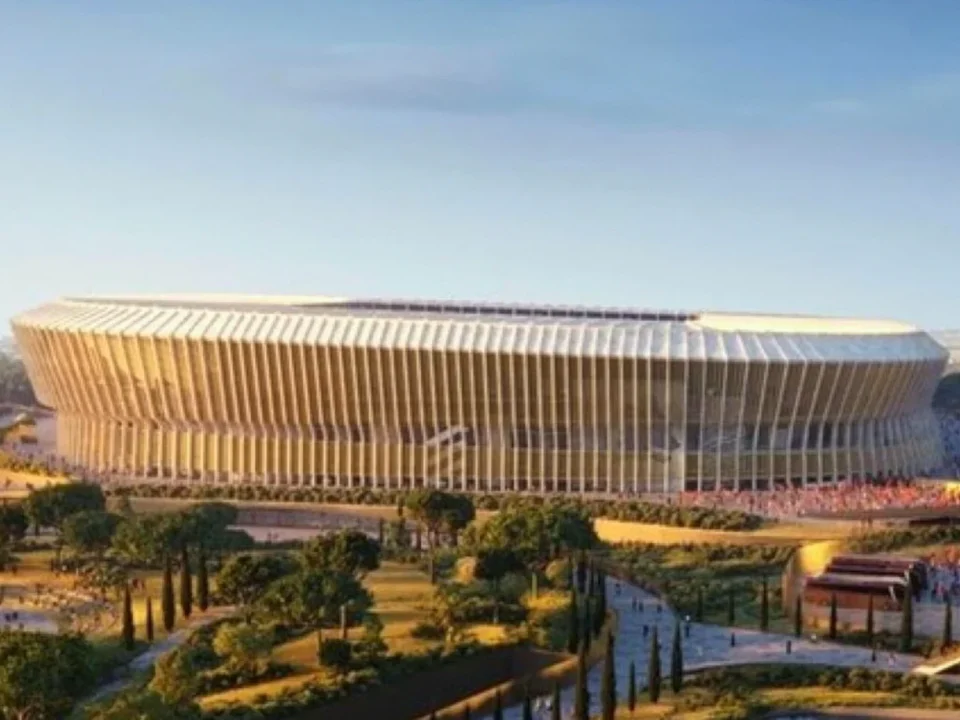
Roma’s Pietralata stadium project has moved into its decisive administrative stretch, bringing the club closer to a building site that could reshape both its matchday life and its long-term finances.
Following approval from the Conference of Services, the remaining procedures are aimed at making the project ready for construction by March 2027. The club and the City of Rome are then targeting a spring groundbreaking, after four years of work on the plan.
Quick facts
- Planned capacity: 60,605 seats.
- The Curva Sud is expected to hold almost 23,000 supporters.
- The financial plan forecasts €154 million in net revenue for 2031.
- Hospitality is projected to provide €71.6 million in the first year.
- Ticket sales are estimated at €47.8 million.
- The first concession horizon runs through 2116.
The proposed ground is intended to be more than a replacement home for Roma on Sundays. Pietralata has been designed as a year-round destination, with public green space, squares, pedestrian and cycle routes, a museum, club shop, hospitality areas, restaurants and space for events.
That wider use sits at the centre of Roma’s economic case. The club’s plan does not depend solely on Serie A fixtures: concerts, conferences, corporate functions, tours, food service and premium stadium experiences are all expected to generate income beyond the football calendar.
A stadium built around recurring revenue
The 2031 projection of €154 million in net revenue is led by hospitality, valued at €71.6 million. The figure underlines the importance placed on premium seating, corporate facilities and services designed around the stadium experience rather than the match ticket alone.
Ticketing is forecast to contribute a further €47.8 million. Combined, hospitality and ticket sales would account for almost €120 million, comfortably more than three quarters of the expected first-year total.
Other planned income streams include €7.8 million from naming rights and the same amount from sponsorships. Food and beverage sales are projected at €4.5 million, while non-football events are expected to bring in €4.4 million.
The plan also assigns €3.5 million to the museum and stadium tours, €3.1 million to parking, and €2.1 million to business events. Merchandise is estimated at around €1 million.
The long view at Pietralata
The projections rise gradually after 2031: €156.5 million in 2032, €159.5 million in 2033 and €168.8 million in 2036. The model anticipates annual revenue passing €200 million in 2046.
At the far end of the first concession period, the financial plan forecasts €760.8 million in revenue for 2116. Such a distant estimate naturally belongs to a long-range infrastructure model, but it shows the scale of the club’s ambition.
For Roma, Pietralata is becoming a boardroom project as much as a sporting one. If the final approvals arrive on schedule and construction begins in spring 2027, the club’s next era will be tied not only to results on the pitch, but to a stadium intended to work every day of the year.