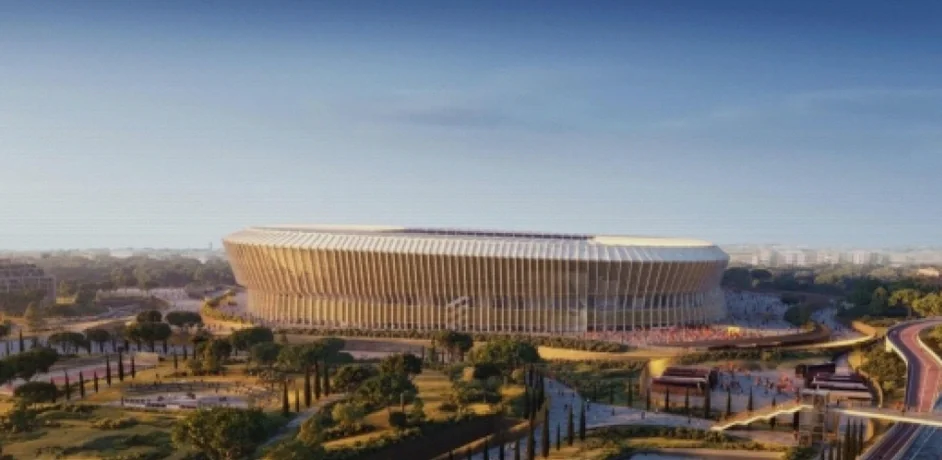
Roma’s plans for Pietralata are moving from ambition towards a defining project for the club’s next era. With the latest approval from the Conference of Services and clearance from the other bodies involved, the Friedkin ownership expects the first stone to be laid by March 2027, beginning construction on a stadium intended to alter both the matchday experience and the club’s financial position.
The proposed 60,605-seat ground has been designed in the close, English-style format increasingly favoured across Europe, with a Curva Sud holding around 23,000 supporters. It would give Roma a home of their own after decades at the Stadio Olimpico, where the club does not retain full control of the income generated on matchdays.
That difference sits at the centre of the Pietralata case. The technical and economic feasibility plan projects total stadium revenues of €153 million in 2031, compared with the €44.4 million taken from tickets at the Olimpico during the 2024-25 season. The estimate represents an increase of 245 per cent, with the club’s premium seating expected to account for approximately €71.6 million in the first year of operation — 46.6 per cent of projected overall revenues of €153.6 million.
Roma believe the stadium’s opening, combined with regular Champions League participation, could lift annual revenues by 60 to 65 per cent compared with the latest available accounts, which closed in June 2025. European football remains a major part of that calculation: the Champions League is expected to bring between €70 million and €80 million, considerably above the €20 million to €30 million associated with the Europa League.
Such growth would not simply narrow the gap to Italy’s highest-earning clubs. It would also strengthen Roma’s capacity to invest in the squad, while making the club more attractive to commercial partners. New sponsorship income has not been included in the stated projections, leaving another possible source of growth beyond the stadium’s direct takings.
The €1.3 billion development is intended to work throughout the year rather than only on Sunday afternoons. Concerts, private events and Italy national-team fixtures are envisaged, with Euro 2032 among the potential occasions for the venue. The project could also host NHL games, following the example of European cities such as London and Berlin.
Beyond the turnstiles, the wider Pietralata area is planned to include a central park, green spaces, leisure facilities and food and drink outlets. Roma’s aim is to create a district that remains active seven days a week, making the stadium a civic development as well as a football ground. For a club seeking a more permanent place among Europe’s leading sides, the project may prove as consequential as any signing or single result on the pitch.