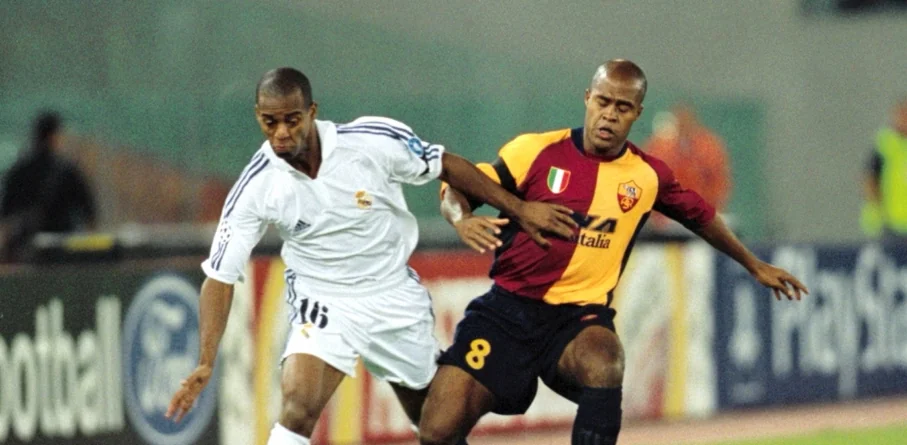
On 11 September 2001, football did not immediately stop. Six hours after the attacks in New York, Roma and Real Madrid walked out at the Olimpico for a Champions League match that had been meant to mark the champions of Italy returning to Europe’s main stage. Instead, it became an uneasy footnote to a day that had changed the world.
Roma were back in the competition after a long absence under Fabio Capello, carrying the Scudetto and the expectations that came with it. Real Madrid arrived as overwhelming favourites, with a squad built for Europe. Yet the football was never the central matter inside a packed stadium gripped by silence and fear.
Quick facts
- Roma played Real Madrid at the Olimpico on 11 September 2001 despite widespread calls for a postponement.
- UEFA allowed only a minute’s silence and black armbands; neither the Champions League anthem nor Roma’s anthem was played.
- Real won 2-1 through a Luís Figo free-kick and a Guti header, with Francesco Totti scoring Roma’s penalty.
- Lazio lost 1-0 at Galatasaray on the same evening.
- Juventus’ following-day match at Porto was later called off, along with the remaining European fixtures scheduled for 12 and 13 September.
Franco Carraro, then president of the Italian Football Federation, had urged UEFA to postpone the fixtures, citing both the scale of the tragedy and concerns over security. UEFA president Lennart Johansson decided the matches should go ahead. Roma and Real had no choice but to play.
The atmosphere around the Olimpico made that decision feel increasingly detached from events elsewhere. Shortly before kick-off, the stadium announcer said he had an announcement to make. With spectators fearing fresh news from the United States, panic briefly spread through the stands. The message concerned a car that needed to be moved, and it was met with a chorus of whistles.
UEFA removed the usual ceremonial elements. There was no Champions League music and no Roma anthem, only the minute of silence and mourning bands on the players’ arms. The Curva Sud sang without accompaniment, while much of the ground seemed to be watching the evening through the shock of the day.
Capello’s players were not in the condition for a European occasion. Vincenzo Montella would later say that everyone’s thoughts were in New York, a reflection rather than an excuse for a subdued Roma display. The Italian champions had Totti, Montella and Gabriel Batistuta in attack, but none could lift the occasion out of its wider reality.
Real were without Zinedine Zidane, though Raúl and Figo still led their forward line. The pre-match attention had included the meeting between Brazilian full-backs Cafu and Roberto Carlos, who had exchanged confident words before the game. Roberto Carlos told his international teammate that Madrid were not travelling for a draw; Cafu replied that Roma would surprise them.
On the pitch, Madrid found the decisive edge. Figo put the visitors ahead from a free-kick, then supplied the cross from which Guti headed in the second. Totti converted a penalty to reduce the deficit, but Roma never truly rebuilt the contest.
In the directors’ area, Alfredo Di Stéfano and Florentino Pérez sat alongside Roma president Franco Sensi and his daughter Rosella. Sensi left little doubt about his view of the decision to play. He said the scenes from the United States were unimaginable, comparing their impact to the horrors associated with the end of the Second World War, and argued that such a tragedy may have required football to pause.
He questioned whether UEFA had made the right call, even as he admitted that Madrid’s attack had been stronger than Roma’s. Montella answered sharply, suggesting that the president should buy all of Real’s forwards if he admired them so much. The defeat had opened a wound on an already impossible night.
Capello was blunter still after the final whistle. His position was that the match should not have been played, describing the situation as shameful. For Roma, the return to the Champions League had become a fixture few connected with tactics, form or the final score.
A European programme out of step with the day
Elsewhere, Lazio were playing in Istanbul, where they lost 1-0 to Galatasaray in another match overtaken by events. The following day, Juventus were due to face Porto in Portugal, but the club moved quickly to arrange a private flight home.
The Juventus squad had its own distressing episode before leaving. A shopping centre beside the team hotel was called the World Trade Center, and a bomb warning reported to police caused alarm among the players, including Alessandro Del Piero.
Del Piero had visited the Twin Towers only two months earlier. On the journey home, he said it was astonishing to think that they no longer existed. He felt the players could not focus on football and that not playing could itself carry a meaningful message.
The remaining Champions League and UEFA Cup fixtures scheduled for 12 and 13 September were subsequently cancelled. In the United States, sporting events due to take place in the following days had also been called off.
That left the Roma-Real match as a stark marker of football’s delayed response. The sport eventually stopped, but only after an evening in which the Olimpico had been asked to stage a gala occasion while the wider world was in mourning.
The old meeting has gained another resonance with Roma again preparing for a home European debut against Real Madrid after a seven-year absence from the Champions League under Gian Piero Gasperini. The names, coaches and circumstances have changed. The memory of 2001 has not: a night when a major match went ahead, but the game itself could not matter.