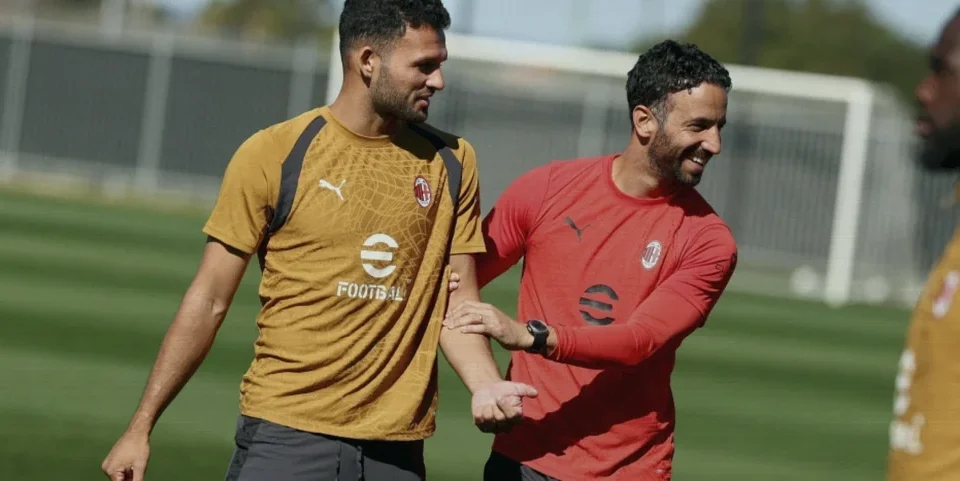
Ruben Amorim sees Milan as more than the next stop in his coaching career. As he works to guide the club beyond the disappointments of last season, the Portuguese coach has described his arrival as the meeting point between a childhood attachment, a sense of responsibility and a project built with an eye on both immediate results and the years ahead.
Key takeaways
- Amorim says Milan had been one of the clubs he followed since childhood, during an era when Italian football set the standard in Europe.
- The coach believes his experiences in Portugal and at Manchester United have prepared him for the scrutiny surrounding a club of Milan’s stature.
- He backed Gonçalo Ramos despite the forward’s limited scoring opportunities, insisting his work remains important to the side’s attacking output.
- Amorim is satisfied with Milan’s transfer approach, which combines established players such as Ramos with younger prospects including Moreira.
- He wants the club to improve the existing squad as well as recruit, with attractive football the stated objective.
A personal connection and a demanding assignment
For Amorim, Milan’s place in his imagination was formed long before his appointment. He recalled following the Rossoneri when he was young, in a period when Milan were among Italy’s leading sides and Serie A was widely regarded as the world’s strongest league. The historical links between Milan and Portuguese football also helped to make the club familiar to him.
Yet he made clear that sentiment alone did not determine his choice. Amorim felt a connection with the club and with its present phase, while also valuing the work done by Milan to persuade him to take the role. He believes it was the right decision and said his early period has been positive overall, even if difficult spells have inevitably arrived alongside the better ones.
The task, however, carries weight. Amorim said he feels a strong duty to help Milan reclaim the level he believes belongs to the club. That expectation is shaped not only by the side’s recent struggles, but by the intensity with which supporters and the wider football public live every development around the team.
He compared that emotional involvement to the atmosphere he knew in Portugal. England, he suggested, offered a different environment, although his time at Manchester United was still valuable preparation. United’s global profile meant that every action was examined closely, and Amorim said the experience taught him the need to conduct himself carefully at a club where even small decisions have significance.
In his view, the path through Portuguese football and Manchester had led him towards this opportunity. He expects those earlier lessons to be useful through both winning runs and more testing afternoons in charge of Milan.
Ramos, recruitment and the longer Milan plan
Amorim was equally firm when discussing Gonçalo Ramos. He rejected any suggestion that he would ask the Portuguese striker to reduce his effort, stressing that a player should not be told to run less. Milan’s ability to score, he argued, is the priority, and Ramos has contributed to that process even without receiving as many chances to score as he does with Portugal.
The coach acknowledged the importance of goals to a centre-forward’s confidence and role, but remains convinced Ramos will find them. His message was that the striker should continue serving the collective with the same application, because the finishes will eventually follow.
That collective thinking also runs through Milan’s work in the market. Amorim said he had felt from his first day that decisions were being made together, a relationship he considers essential between the coach and the club. The recruitment strategy, he explained, is not confined to solving the immediate needs of the season.
Milan are looking for players who can contribute straight away, as Ramos can after becoming a European champion, while also investing in players with room to grow, with Moreira offered as an example. Amorim welcomed that balance, but underlined that recruitment cannot be the only route to progress.
The present group must also develop. For Amorim, that is central to restoring Milan over the course of the season: adding the right profiles, raising the level of those already at the club and building a team capable of playing good football.