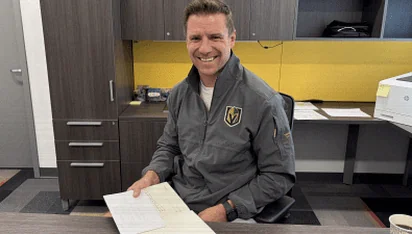
Ryan Craig’s black hardcover journal has followed him from the American Hockey League to the Vegas Golden Knights’ head coach’s office. Its opening line is a personal standard: take responsibility for your career and your life, because only you can know whether you have given it everything. On Monday in St. Paul, the 44-year-old rookie NHL coach gets another reminder of that path when Vegas visits John Hynes and the Minnesota Wild at Grand Casino Arena.
From captain’s notebook to the NHL bench
The Golden Knights enter the matchup at 4-1-0, with puck drop set for 8 p.m. ET on Wild+, MINNHL and SCRIPPS. For Craig, it is a meeting with the coach who helped start him toward this job.
Craig began writing down drills, video ideas, culture notes and coaching reminders in 2010-11 while captaining Wilkes-Barre/Scranton under Hynes. At 28, after moving from the Tampa Bay organization to Pittsburgh’s system, he was already looking for a way to remain in hockey after his playing days.
“I loved the game and wanted to stay in it,” Craig said. “Coaching was the closest thing to playing for me. You are in the battle every day: preparing, winning, losing and competing.”
Hynes saw the signs well before Craig’s transition behind the bench. The current Wild coach described Craig as a sharp, professional leader who understood systems but also understood people, communication and relationships.
- Craig played professionally from 2003 through 2017, appearing in five ECHL games, 711 AHL games and 198 NHL games.
- His NHL work included 184 games with the Tampa Bay Lightning from 2005-10, six with the Pittsburgh Penguins in 2010-11 and eight with the Columbus Blue Jackets between 2013 and 2015.
- He wore the captain’s “C” in nine of his 12 AHL seasons, leading Springfield, Norfolk, Wilkes-Barre/Scranton and Lake Erie/Cleveland.
- He started the journal during his two seasons under Hynes in Wilkes-Barre/Scranton, asking questions about tactics, matchups, ice time and the reasoning behind coaching decisions.
Hynes said Craig could bridge the room and the staff, understanding when a group needed a hard push and then setting the tone by being the first player to work. He called that ability unusual.
Former teammate Matt Calvert remembered Craig as “the coach in the room,” a player who could take a fiery message from Springfield coach Brad Larsen and deliver it in a way younger players could absorb. Calvert, now a Nashville Predators player development coach, said Craig’s calm approach still influences his own coaching.
Jared Bednar, who coached Craig in Springfield and Lake Erie, saw the same qualities. Craig captained Bednar’s 2016 Calder Cup winner and was later compared by Bednar to Colorado Avalanche captain Gabriel Landeskog: steady, team-first and dependable with the right message at the right time.
Long Vegas connection made Craig more than an internal candidate
Craig’s relationship with Golden Knights general manager Kelly McCrimmon reaches back to 1997. McCrimmon, then running the WHL’s Brandon Wheat Kings, selected the 15-year-old Craig in the second round, No. 34 overall, even though the Abbotsford, British Columbia, native came from far outside the club’s usual Prairie recruiting area.
The fit proved even more natural when the club learned Craig’s grandparents were from Dauphin, Manitoba. Craig and his parents later visited McCrimmon’s Manitoba cottage to sign his WHL contract.
After one game in 1997-98, Craig spent five full seasons with Brandon and served as captain in each of his final two years. Bob Lowes, now Vegas’ assistant director of player personnel, coached him from 1997-2001.
McCrimmon said Craig was mature beyond his years and widely respected for his leadership. He believed even then that Craig would eventually remain in the sport as a coach.
That history mattered when Vegas announced Craig’s hiring June 17. The move stood apart from the club’s usual approach. The Golden Knights had previously gone with veteran NHL coaches and had replaced Bruce Cassidy with John Tortorella with eight games remaining last season before reaching the Stanley Cup Final. Three days after losing Game 6 to the Carolina Hurricanes, Vegas handed the job to a first-time NHL head coach.
McCrimmon’s view was that Craig was not simply ready for the opportunity; he was the best coach available.
“Every coaching search in Vegas has been about finding the best person,” McCrimmon said. “That is what we did here, too. I think he will be outstanding.”
Six seasons as an assistant, then three years running Henderson
Craig retired after the 2016-17 season at an ideal time for an organization he would soon know inside and out. Vegas was about to begin its expansion season, and Gerard Gallant wanted a former player as his third assistant coach.
Craig joined Gallant’s first staff and was part of the expansion club’s run to the 2018 Stanley Cup Final. He remained through a coaching change to Peter DeBoer on Jan. 15, 2020, then stayed again when Cassidy took over after the 2021-22 season. Vegas reached the third round in both 2020 and 2021 and won the Stanley Cup under Cassidy in 2023.
- Gallant gave Craig his first NHL assistant-coaching opportunity during Vegas’ inaugural season.
- DeBoer valued Craig’s willingness to take on any assignment required by the staff.
- Cassidy inherited Craig without a prior relationship but found that players respected him and that he could relate to veterans and younger players without losing firmness.
- Craig worked six seasons as a Golden Knights assistant before taking the Henderson Silver Knights job after the 2023 Cup win.
Henderson allowed Craig to stay in the Las Vegas area with his family while learning every part of running a staff and a bench. The Silver Knights finished eighth in the Pacific Division at 28-36-3-5 in 2023-24, then placed 10th at 29-38-3-2 in 2024-25. Last season brought a major step forward: Henderson went 39-21-7-5, took third in the division and reached the Calder Cup Playoffs.
Cassidy regularly watched Henderson games and spoke with Craig afterward. He said the players recalled to Vegas arrived prepared to play the way the NHL club wanted.
McCrimmon said AHL head-coaching experience forced Craig to make every decision, oversee his staff and balance winning with player development. It also gave him a clearer feel for the pressure that comes with a losing streak.
Craig has adopted a leadership idea he credits to Los Angeles Rams coach Sean McVay: the head coach is the thermostat, setting the daily temperature through his message and his ability to empower others.
“You do not fully understand it until you are sitting in that chair,” Craig said. “It is good pressure, but it comes with decisions and all the business that has to be handled.”
A contender’s expectations and a former mentor across the ice
The NHL chair brings a different pace. Hynes pointed to the quick turnaround between games, the challenge of managing a roster with varying roles and the need to adapt without abandoning the principles that earned a coach the job.
Cassidy said the defining test for any first-time NHL coach is accountability, particularly when dealing with a roster carrying major star power. He also cited delegation, communication with the general manager, in-game adjustments, line changes, practice management and reading the club’s physical and emotional state as areas that receive far greater scrutiny in the NHL.
Craig and McCrimmon talked extensively about hockey when Craig was a player. As a Vegas assistant, McCrimmon respected the coaching structure and dealt primarily with the head coach. Now their relationship shifts again.
“This takes our relationship to a new level as a coach and general manager,” Craig said.
The pressure is substantial. Since entering the NHL, Vegas ranks fifth with 404 victories and first with 76 playoff wins. The Golden Knights have reached the postseason in eight of their first nine seasons, and the standard remains a Stanley Cup.
Craig takes over a built contender rather than a rebuilding team, but Vegas’ coaching history shows how quickly the job can change. Gallant and DeBoer each lasted fewer than three complete seasons, Cassidy did not reach four seasons, and Tortorella’s tenure ended after two months.
For Craig, the appeal is clear: he gets to lead an organization that has invested in him for a decade and coach a driven group chasing hockey’s biggest prize.
“You stay on the day-to-day work until someone tells you that you cannot,” Craig said. “Things move quickly in this league, but that is also what makes this job special. You get to live it every day and compete.”