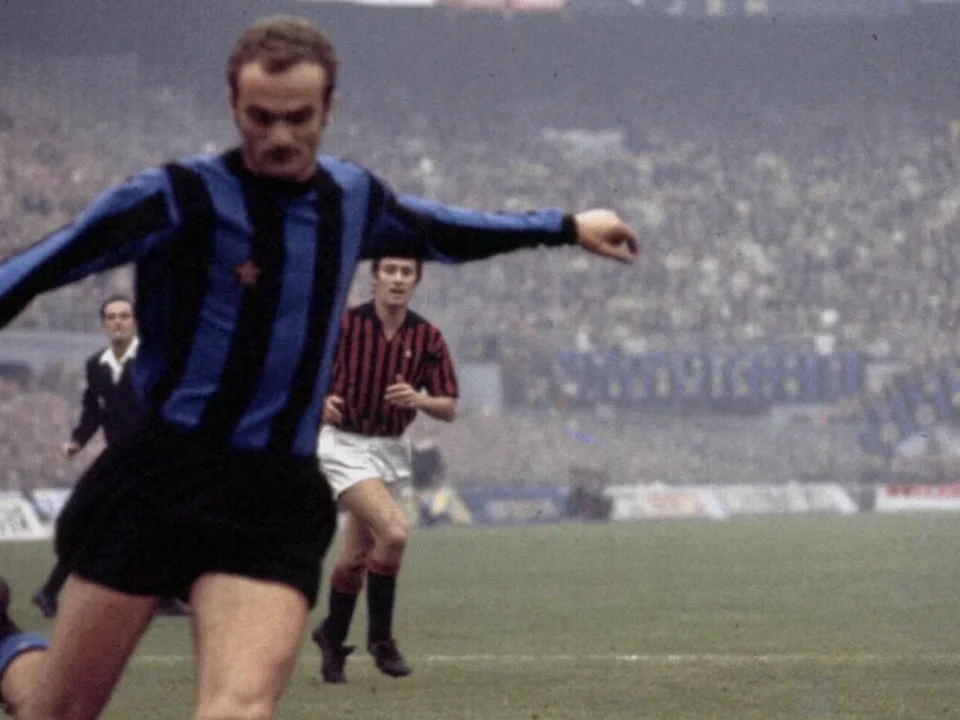
Sandro Mazzola’s death closes one of the great chapters in Italian football: a life spent under the weight of a famous name, then beyond it, until his own became inseparable from Inter, the national team and an era when San Siro seemed to stage the country’s imagination.
In his final period, the former forward had gradually withdrawn from public view. Yet the memory remains of a quick-witted, lively and ironic figure, recognisable for his high voice, sharp humour and the unmistakable moustache-and-cigar image that accompanied his years after retirement.
Quick facts
- Mazzola became an Inter regular at 21 in 1963.
- With Inter between 1963 and 1966, he won three Serie A titles, two European Cups and two Intercontinental Cups.
- He scored twice in Inter’s 3-1 European Cup final victory over Real Madrid.
- For Italy, he won the European Championship and featured in the 4-3 win over West Germany.
- After ending his playing career in 1977, he returned to Inter as an executive from 1995 to 2003.
He was Valentino Mazzola’s son, and that inheritance could have been a burden impossible to escape. Valentino, the leading figure of Grande Torino, had become a sporting legend before Sandro and his brother Ferruccio were left without their father.
Sandro’s answer was not to imitate him. He built a separate place in the game, first through talent and then through the authority of a career that made him one of Italy’s finest players in his own right.
The decisive turn came in 1963. Helenio Herrera reshaped an Inter side that had taken only two wins from its first seven league matches, bringing Mazzola into the team alongside fellow young player Giacinto Facchetti.
Herrera moved Armando Picchi into the libero role and drew Luis Suarez back into midfield. Ahead of them, Mazzola linked the attack with Jair on the wing and Di Giacomo through the middle, a framework that became the foundation of La Grande Inter.
That Inter side did more than win. Under Herrera’s direction and Angelo Moratti’s ownership, it changed the scale of the club, with Milan nights and European victories becoming part of the city’s footballing identity.
Across the 1963-66 spell came three Scudetti, two European Cups and two Intercontinental Cups. Mazzola was central to the side, a forward with close control, a direct finish and the imagination to change the rhythm of an attack.
His most personal confirmation arrived after the first European Cup final, when Inter beat Real Madrid 3-1 and Mazzola scored both goals. Ferenc Puskas, who had faced Valentino, told him that he had honoured his father’s memory and that the family had another champion.
For Italy, Mazzola also carried the weight of a national argument. His relationship with Gianni Rivera became the enduring debate of its time, framed as Inter against Milan and one footballing personality against another.
The rivalry was never a personal rupture. Mazzola and Rivera retained mutual respect, even as their selection and roles became a subject that gripped supporters across the country.
Mazzola won the European Championship with the Azzurri and was among the protagonists of Italy’s celebrated 4-3 victory over West Germany. That match, and the Mazzola-Rivera discussion around the national side, gave him a lasting place beyond Inter’s own history.
His bond with Inter did not end when he stopped playing in 1977. During Massimo Moratti’s presidency, he worked as a club executive from 1995 to 2003 and strongly urged Inter to sign Ronaldo, another decision that connected him to a later generation of Nerazzurri ambition.
Off the pitch, he remained a voice with weight: candid with players and journalists, often playful in tone but rarely superficial. He spoke as someone who belonged to the club’s past without treating that past as a museum piece.
Inter mourns one of its defining men, but so does a wider Italian football world. Mazzola leaves behind the lasting image of La Grande Inter, its names recited like a team sheet that has become part of the game’s shared language: Sarti, Burgnich, Facchetti and the rest, with Sandro Mazzola forever among them.