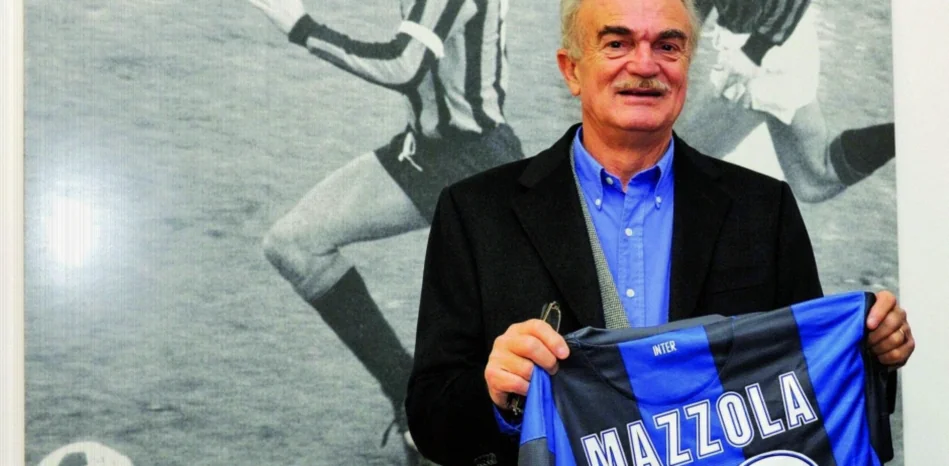
Sandro Mazzola’s passing closes a long chapter of Italian football in which one life seemed to carry several of its strongest memories: the Grande Torino of his father Valentino, the European rise of Inter under Angelo Moratti and Helenio Herrera, the blue shirt of Italy, and a later place beside the microphone. Inter was the club of his entire playing career, even if a final season in Torino’s granata, his father’s shirt, had remained a private wish.
The coach and the club
Mazzola was six and a half when Valentino Mazzola, the captain of Grande Torino, died in the Superga air disaster on 4 May 1949. His mother Emilia soon left Turin with Sandro and his older brother Ferruccio, born in 1945, returning to Cassano d’Adda in Lombardy, where the children later gained a stepfather.
As a boy, Sandro considered basketball as well as football. He later recalled that his pace and agility suited the court, but Benito Lorenzi used to take the family to watch Inter on Sundays. Lorenzi saw him with the ball and brought him into Inter’s youth set-up, where Giuseppe Meazza became an important teacher.
His name carried the weight of one of Italy’s most loved football families, but Mazzola made his own way through Inter’s academy. The memory of Grande Torino remained central to him. He felt that the team had inspired affection beyond club loyalties: when people spoke of those players, he said, supporters did not divide themselves into Juventus, Milan, Roma or Napoli camps.
He joined Inter’s youth system in 1957, and his first Serie A goal arrived in circumstances that have never left the championship’s history. During the 1960-61 season, Angelo Moratti ordered Herrera to take the De Martino youth side, the equivalent of today’s Primavera team, to Turin for the replay against Juventus, protesting the decision to replay the original fixture. Juventus won 9-1, but the 18-year-old Mazzola scored Inter’s goal from the penalty spot.
- He opened his Serie A scoring account against Juventus in the 9-1 replay defeat of 1960-61.
- On 24 February 1963, he scored after 13 seconds in the Milan derby, still the quickest goal in that fixture.
- Later that season, his goal in Turin helped Inter beat Juventus and move clear in the title race.
The derby strike came in his first campaign as an established starter. Herrera had reshaped his Inter side and used Mazzola as an attacking midfielder permitted to break into the area behind centre-forward Di Giacomo, alongside Jair on the right and Mariolino Corso on the left, with Luis Suárez operating deeper as the playmaker.
Inter’s start to that league season had been poor, but the revised team reeled in leaders Juventus. The away victory over the Turin club in late April, four rounds from the end, was settled by Mazzola. It gave Inter a decisive advantage and delivered the first league title of the Moratti-Herrera era, the starting point of the Grande Inter.
Mazzola would become one of that side’s defining figures. His two goals against Real Madrid brought Inter their first European Cup, while the club’s great 1960s cycle produced two European Cups, two Intercontinental Cups and three Scudetti. He was Serie A’s leading scorer in 1964-65 with 17 goals and topped the European Cup scoring list in 1963-64 with seven.
A forward with different answers
Although he initially saw himself as a midfielder and organiser, Mazzola adapted as Herrera’s Inter developed. He moved further forward and could play as a central striker or supporting forward. His game was built on technique, sudden dribbling, speed over distance and the ability to arrive in scoring positions. He was also capable in the air, effective from outside the area through accuracy rather than sheer power, and composed when through on goal.
| Competition | Appearances | Goals |
|---|---|---|
| Serie A | 418 | 116 |
| Coppa Italia | 80 | 24 |
| Italy | 70 | 22 |
In Europe, he added 20 goals across the European Cup and Intercontinental Cup competitions. International football brought another major part of his story. With Italy he won the European Championship in 1968, then reached the 1970 World Cup final in Mexico, where Brazil prevailed after Italy’s celebrated 4-3 semi-final victory over West Germany.
That World Cup was also remembered for Ferruccio Valcareggi’s alternating use of Mazzola and Milan’s Gianni Rivera. Tactical constraints meant the two outstanding attackers were not seen as compatible in the same line-up: Mazzola generally played the first half and Rivera the second. Neither was pleased to leave the field, but both kept their objections within the team, leaving the wider argument to others.
The fourth and final Scudetto of Mazzola’s career came in 1971, with Gianni Invernizzi on the Inter bench. It led to another European Cup run, ending in Rotterdam with Ajax beating Inter 2-0 through Johan Cruyff’s two goals. Mazzola finished second to Cruyff in that year’s Ballon d’Or voting; an Inter victory might have changed the award’s destination.
There had already been a sharper European disappointment in May 1967. Mazzola scored an early penalty in the European Cup final in Lisbon, but Celtic came back to win 2-1. The season then ended with Inter losing 1-0 at Mantova on the final day, allowing Juventus to take the title. That sequence brought Angelo Moratti’s first spell at the club to an end.
The captain after the great years
After the 1971 title, Inter’s seasons did not meet either Mazzola’s standards or those of the support. He settled deeper in midfield, wore his father’s number 10 and became captain. His playing career ended in 1977, after a 2-0 derby defeat that decided the Coppa Italia.
Twenty years after entering the youth ranks, Mazzola moved into Inter’s executive structure under president Ivanoe Fraizzoli. Giancarlo Beltrami, the sporting director closely associated with that period, remained alongside him. The experience delivered little success and ended abruptly in 1984 when Ernesto Pellegrini became president.
There was then a short spell with Genoa, but broadcasting became his next significant football role. He had begun working with Luigi Colombo at Telemontecarlo in 1982, the year Enzo Bearzot’s Italy won the World Cup. Mazzola’s technical contribution alongside the commentator helped establish the two-person commentary format in Italian football television.
His manner made him a familiar and valued presence on Lombardy broadcasters: articulate, sharp, able to judge when to intervene, and respected for his football understanding despite a lifetime in Inter colours. Rai took him to the 1990 World Cup alongside Bruno Pizzul. In 2006, next to Marco Civoli, he experienced from the commentary position the World Cup triumph that had escaped him as a player in 1970.
Torino, the Morattis and a lasting place
Torino gave Mazzola another emotional connection to his father’s world. Between 2000 and 2003 he held a club role, and in the years before the pandemic he was honoured at the Fila, Valentino Mazzola’s stadium. On that occasion, his grandson Valentino Mazzola junior played in a youth match wearing Torino’s famous number 10 shirt. Sandro received the moment with particular emotion and expressed gratitude for the consideration shown by club owner Urbano Cairo.
His deepest institutional bond nevertheless remained with the Moratti family. Angelo Moratti had been the president of his greatest playing years. When Massimo Moratti bought Inter in February 1995, he brought several figures from his father’s era back into the club: Corso, Suárez, Jair, Antonio Angelillo, Gianfranco Bedin and Angelo Domenghini were employed in scouting roles, while Giacinto Facchetti first became a close adviser and later, in 2004, president.
Mazzola was appointed sporting director and served until 1999, carrying out the role with evident commitment. Beyond the positions and trophies, he remained part of Italian football’s shared culture: a respected former rival for Rivera, an engaging storyteller, recognisable for his moustache, cigar and quick humour, and a man whose presence reached well beyond the years he spent on the pitch.