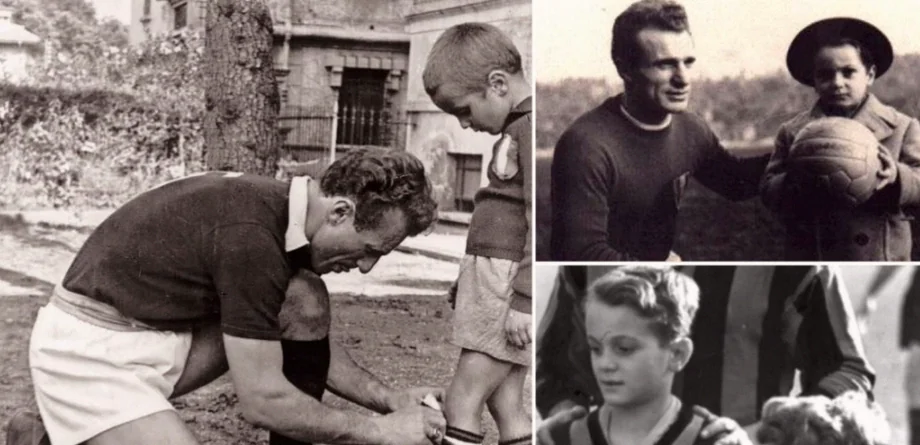
For Sandro Mazzola, the image of his father was never confined to the legend of the Grande Torino captain. It was the memory of a hand holding his on the way to the stadium, of socks being pulled up before training, and of a child who believed he belonged in the Granata dressing room beside Valentino Mazzola.
Those early memories were made in wartime Turin. Sandro remembered the modest family flat in via Torricelli, in the Crocetta district, where Valentino lived with his son after separating from Sandro’s mother Emilia. Their home had two rooms, a kitchen and a bathroom. Outside were streets scarred by bombing, an air-raid shelter and the nearby Santa Teresina parish, where Sandro first kicked a ball.
Valentino would take his son to training, giving him a locker close to his own, with a Granata shirt and white shorts inside. They even played small-sided games together. Sandro later recalled feeling like a Torino footballer despite being only a boy.
He also remembered the attention around his father. Valentino was Torino captain and an Italy international, recognised wherever he went. On Saturdays, father and son would walk from their home towards the city centre, sometimes reaching the Vittoria café opened by teammates Franco Ossola and Guglielmo Gabetto near via Roma and via Gramsci. There was another bar close to home, beside a grocer’s, where Valentino bought ice cream for Sandro.
“I thought the two of us could do anything,” Sandro recalled. “I believed I could play because I scored penalties against Bacigalupo, but he was letting them in for me.”
A father beyond the football myth
Before becoming the central figure of Torino’s great side, Valentino had been registered by Fiat as an essential wartime worker, helping him avoid military service. He was photographed operating a lathe at the Lingotto factory. On the pitch, he would win five league titles; away from it, he opened a shop selling footballs to supplement his income.
To Sandro, however, his father’s greatness came with ordinary gestures. He remembered Valentino’s hands on his head and the firm grip that reassured him when crowds pressed around them, asking to touch or embrace the Torino captain after a match.
On Sundays, Valentino walked on to the Filadelfia pitch with Sandro at his side. The feeling remained with him for the rest of his life. “Even in my dreams, I still enter the Filadelfia holding his hand,” he said.
His childhood was spent around the families of Torino players. He played football with the daughters of Virgilio Grezar and Ezio Loik, while the city’s rivalry reached even the children: in derby days, Sandro admitted he would glare at the son of Juventus captain Carlo Parola’s teammate Pietro Rava?
In fact, the rivalry was more personal in his recollection: he said he looked badly at the son of Juventus captain Teobaldo Depetrini during derby occasions.
Superga and a month away from home
Everything changed when the Torino team’s aircraft crashed at Superga. Sandro, then still a child, was not immediately told that his father had died. Valentino’s partner secretly placed him with friends living in the countryside, in an old mill, telling him only that his father was travelling.
“He always came back to see me when he travelled,” Sandro said. “That time, he never came.”
Emilia had to seek help from the Carabinieri and hundreds of Torino supporters to find her son. It took a month before he was brought back to her. Only then did he discover that he had a brother, Ferruccio, who had been living with their mother in Cassano d’Adda after the parents’ separation.
The confirmation of Valentino’s death came indirectly. Sandro was under a table, pretending to be radio commentator Nicolò Carosio and describing a Torino match, when he overheard his mother talking to a friend. He understood that his father would not return.
“When he died, I was six years, five months and 23 days old,” he said. “Everyone embraced me, but I did not understand why.”
He had been too young to retain much of his father’s advice and spent years seeking out people who had known Valentino, trying to recover another detail of the man behind the monument. Giampiero Boniperti once told him that, if he had to build a team, Valentino Mazzola would be the first player he selected.
Living with the Mazzola name
Growing up under such a surname was not simple. Valentino had become a popular hero after Superga: gifted, charismatic and inseparable from Torino’s tragic mythology. Sandro carried a far more private absence, while also hearing comparisons from the stands.
There were supporters who would say that he was not as good as his father. At one stage, the pressure was such that Sandro considered basketball instead of football.
Ferruccio persuaded him that football could not be avoided forever. Sandro eventually attended a Torino trial, but was not selected. Looking back, he said the decision was understandable: from the field he could see the Basilica of Superga, where the plane had gone down, and he believed he had played badly.
He did become a professional footballer, though not for Torino. His career would be tied to one club alone. Yet each return to Turin brought the old memories back. Looking towards the basilica on the hill made his legs shake, and a visit to the Filadelfia dressing room proved especially painful when the historic kit man Zoso showed him Valentino’s locker.
“I started crying,” Sandro said. “For me, Valentino Mazzola had meant the cemetery, flowers and my mother’s tears.”
The Juventus offer he could not accept
The weight of the past shaped one of the defining choices of Sandro’s career. Boniperti wanted a Mazzola at Juventus and invited him to Turin to discuss a contract over dinner. The proposed salary was so large that Sandro said he could not sleep that night.
He told his mother about the offer. Her response was decisive: she said Valentino would turn in his grave. Sandro declined Juventus.
Decades later, the memory that remained was not the rejected contract, nor the comparisons, nor even the scale of the public legend. It was still the exchange imagined between father and son: Sandro passing the ball to Valentino, Valentino returning it, and an empty goal waiting ahead.