Sandro Mazzola’s influence at Inter did not end when he left the pitch. His years as a player, when he already carried authority inside the dressing room, shaped the executive who later helped steer the club through changing ownerships, difficult decisions and some of Italian football’s most memorable transfer pursuits.
Key takeaways
- Mazzola’s football experience and knowledge of dressing-room life became central to his work in Inter’s technical management.
- He persuaded Ivanoe Fraizzoli to appoint Eugenio Bersellini, while also identifying the importance of Alessandro Altobelli and Evaristo Beccalossi.
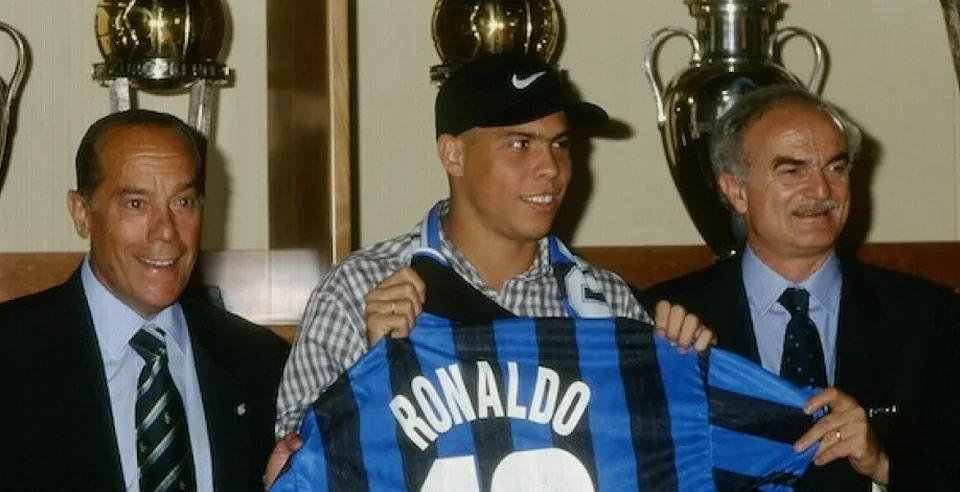
- During Massimo Moratti’s first presidency, Mazzola played a leading behind-the-scenes role in bringing Ronaldo to Milan.
- Andrea Pirlo joined Inter after Mazzola listened to Mircea Lucescu’s assessment of the young Brescia player.
- Several major targets, including Michel Platini, Falcao and Eric Cantona, came close without becoming Inter signings.
A football man in the boardroom
Mazzola regarded his past as a player as an advantage rather than a closed chapter. He believed that years spent in football gave him the instincts to understand a squad’s changing needs, the pressure around a club and the balance required between personal attachment to Inter and professional responsibility.
Fraizzoli entrusted him with a role combining representation and technical oversight, recognising both his international standing and his eye for talent. One of Mazzola’s earliest major interventions was to urge the president towards Bersellini, the demanding coach Inter needed at that stage. In Mazzola’s view, the appointment mattered as much as the emergence of attacking figures such as Altobelli and Beccalossi.
His first spell did not last uninterrupted. When Ernesto Pellegrini succeeded Fraizzoli, Mazzola ended his relationship with the club after concluding that his responsibilities would be reduced. He later explained his position clearly: “I could not accept having fewer responsibilities, because in life one moves forward, not backwards.”
The separation proved temporary. When Massimo Moratti became president in 1995, he brought Mazzola back into the club’s inner workings. As sporting director and head of the technical area, Mazzola became an important figure during a period in which Inter sought to restore its weight at the top end of the European game.
The deals completed, and those that slipped away
Mazzola’s return coincided with an ambitious recruitment drive. Inter had already brought in players including Javier Zanetti, Roberto Carlos, Iván Zamorano, Youri Djorkaeff and Álvaro Recoba when the club moved for Ronaldo, the Brazilian forward then regarded as one of the game’s most difficult targets.
Moratti supplied the financial strength and the determination to make the operation possible, while Mazzola handled much of the delicate work away from public view. Meetings and discreet trips were used to limit outside attention and prevent rivals from entering the race. His task went beyond discussions with Ronaldo’s representatives: he also needed to persuade a 20-year-old player that Inter offered the right sporting future.
The move developed amid restrictions involving Barcelona and La Liga, as well as tension between Ronaldo’s entourage and the Barcelona leadership. Those circumstances created an opening, and Mazzola helped Inter turn it into a deal that became one of the defining signings of that era in Italian football.
Ronaldo was not the only young future star to arrive with Mazzola’s involvement. Andrea Pirlo followed a year later, with Mazzola taking seriously the recommendation of Mircea Lucescu, who had closely watched the midfielder at Brescia.
There were also the signings that remained unfinished business. Platini had agreed a six-year contract after Inter reached an arrangement with Nancy, including a provision that he would play abroad until Italy reopened its borders to foreign players. The expected change was then delayed by the Italian Football Federation, leaving the agreement without its intended outcome.
Falcao was another player believed to have put pen to paper before the transfer collapsed. Fraizzoli discussed the matter with Roma president Dino Viola before the clubs had reached their agreement, and it was said that Giulio Andreotti intervened to prevent the move from progressing.
Later came Cantona, a player strongly admired by Moratti. Mazzola met the French forward in Monte Carlo and came close to convincing him, but Cantona ultimately chose to continue with Manchester United.
Those near-misses sat alongside the successes of a long Inter story. Mazzola never entirely detached himself from the club’s daily world, whether in the dressing room, the offices or the negotiations that helped define an important part of its modern history.