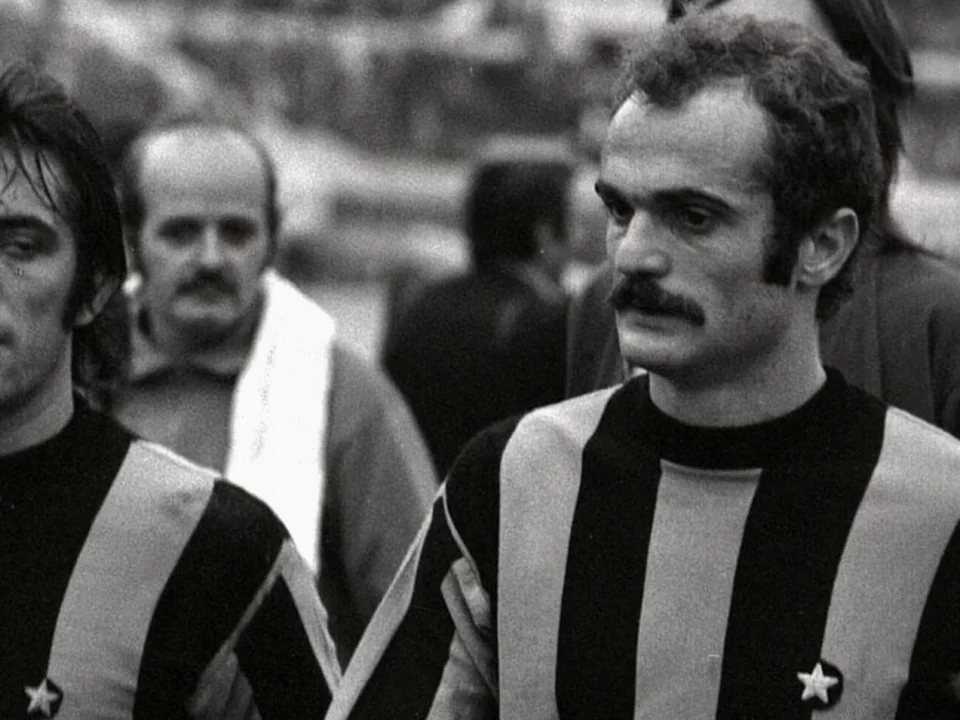
Sandro Mazzola’s place in Inter history was built not simply on goals, but on the way he gave shape to a great side. He could finish moves, begin them and turn a match with one burst beyond a defender. For two decades he belonged to the Nerazzurri story, first carrying the weight of his father Valentino’s name and then becoming a figure entirely his own.
The coach and the club
Mazzola arrived at Inter with an inheritance few players could have carried easily. Valentino Mazzola, the captain and symbol of Grande Torino, had set a standard that inevitably followed his son into football. Early comparisons made Sandro uncomfortable: father and son were not the same kind of player. Valentino had seemed capable of representing an entire team, while Sandro would become one of the defining individuals within a formidable Inter.
The distinction became clearer on the biggest European stage. In the 1964 European Cup final at Vienna’s Prater Stadium, Mazzola scored twice as Inter defeated Real Madrid. After the match, Ferenc Puskas spoke to him privately, recalling that he had once faced Valentino and telling Sandro that he had honoured his father’s memory. It was a moment of recognition that helped settle the burden of the family name.
Mazzola’s game did not fit neatly into one position. He was described as both a number nine-and-a-half and an eight-and-a-half: an attacker with the instincts of a scorer, yet also a midfielder and creator. Quick, technically refined and sharp in the penalty area, he could make chances as readily as he took them.
His connection with Luis Suárez was central to that Inter. The Spanish midfielder supplied the passes, and Mazzola attacked the spaces at speed. Their understanding extended beyond the pitch, but it was on the field that it became one of the features of the side.
Enea Masiero, first his teammate and later his coach at Inter, called him impossible to mark. Mazzola combined athleticism with close control and could accelerate repeatedly within the same run, changing pace as opponents struggled to recover. Under Helenio Herrera, he developed from an advanced midfielder into a more recognisable forward, operating around Inter’s central striker. Across different eras those reference points included Milani, Peirò and Boninsegna.
From that role he scored in every manner: with power, from close range, through a dribble, with a long-range shot, or by exploiting a small opening. Between 1964 and 1967, he registered 53 league goals in three Serie A campaigns. In 1964-65, he shared the division’s top-scorer award with Alberto Orlando.
Mazzola’s Inter career lasted 20 years, including 17 Serie A seasons. His league debut came against Juventus in the 1960-61 campaign, while his final appearance as a player was the 1977 Coppa Italia final.
The club’s change of ownership, from Angelo Moratti to Ivanoe Fraizzoli, also brought a different use of Mazzola. Gianni Invernizzi moved him back into midfield, while retaining his attacking responsibility. The intention was to give Inter more imagination and creativity at the beginning of their moves.
His farewell came in difficult circumstances. Inter lost the 1977 Coppa Italia final 2-0 to Milan, and Mazzola responded to an interview after the game with a line from Dante: “Thus it is willed where power resides.” His frustration was directed at Gussoni, the referee. That September, with his playing career already over, the federation fined him 700,000 lire.
It was an abrupt final note to a long Inter chapter, but it did not alter what Mazzola had become: not merely Valentino’s son, but one of the players through whom the club’s greatest period could be understood.