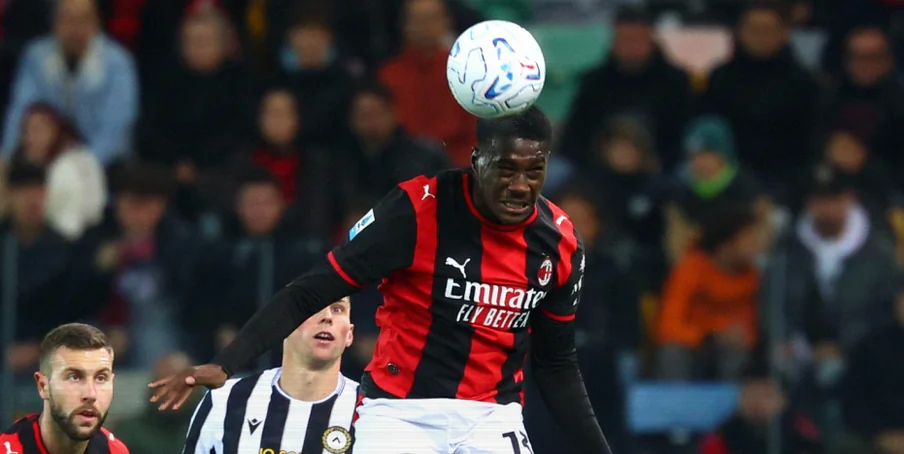
Sankhoun Diawara’s first Serie A start for Milan at Udinese was not supposed to arrive in such demanding circumstances. The 20-year-old Frenchman had spent seven straight league matches on the bench, had played only around half an hour across Europa League appearances against Salzburg and Bournemouth, and was deployed at left-back rather than in his more familiar central defensive role. Yet Ruben Amorim saw a player who looked immediately at home.
“He played his first complete match for this club and it felt as if he had been with us for ten years,” Amorim said after the game. It was a striking assessment for a newcomer who only joined Milan in the summer and had never previously played in Italy’s top division.
A patient route to his Serie A opportunity
- Milan signed Diawara from Troyes for roughly €3 million during the summer, with the initial plan centred on making him a left-footed alternative to Pavlovic at centre-back.
- The defender arrived after helping Troyes win promotion from France’s second tier, useful experience but one that did not offer a clear answer on how quickly he could adapt to Serie A.
- Known as Papis within the Milan environment, Diawara initially featured only briefly in Europe, collecting limited minutes against Salzburg and Bournemouth.
- His league wait extended through seven consecutive bench appearances, while Amorim turned at different points to Terracciano and then Tomori, who had been left out during the summer before returning to the squad.
- An injury-driven need finally opened the door in Udine, where Diawara began the match at left-back and completed the full 90 minutes.
Composure in an unfamiliar role
Diawara had played on the left of defence before, but it has not been a regular position in his career. Against Udinese, however, he handled the assignment with physical presence and concentration, while also showing comfort in possession. He recorded 82 touches, the fourth-highest total among Milan players, and completed 86% of his passes.
He also shared the defensive line with Pavlovic, the player he had been expected to understudy. The pair operated close together and showed a promising understanding in Milan’s defensive work, offering Amorim an encouraging early indication that Diawara may cover more than one need over the course of the campaign.
One match against Udinese does not settle his place in the hierarchy, particularly with tougher opponents ahead. But the important part of the evening was the manner in which he responded: there was no sense of a young player merely surviving his chance. He brought order and personality to a role that was not his usual one.
A different path from Odogu
Before the Udinese match, there had been concern that Diawara might follow the difficult early Milan experience of David Odogu. Both are from the 2006 generation, and Odogu’s previous season was largely spent watching from the sidelines. He made only 16 minutes of appearances across the year before being sent on loan to Toulouse in the summer, where he has yet to make his debut.
The situations are not identical. Under Allegri, with fewer fixtures and less need for rotation, it was harder for young players to enter the side and absorb its demands. Even so, Diawara had begun to look like another name buried among the substitutes. Udine has at least changed that perception.
Milan’s wider development plan
Champions League qualification remains Milan’s principal target this season, but the club’s plans also involve creating real value from younger players. Amorim had repeatedly spoken early in the campaign about trusting youth, and Diawara’s opportunity gave that approach a tangible example.
Comotto and Camarda are still waiting for their own openings, while Diawara has taken a first step that may shorten his route into the regular rotation. Born in Paris to parents with Senegalese, Malian and Guinean roots, he arrived in Milan as a little-known signing. After waiting through a quiet start, he has now made himself visible.
The next tests will determine whether his performance in Friuli was the beginning of a meaningful Milan chapter or simply a positive isolated night. For now, Amorim has one more young defender to consider, and Diawara is no longer merely an unfamiliar name at the bottom of the squad list.