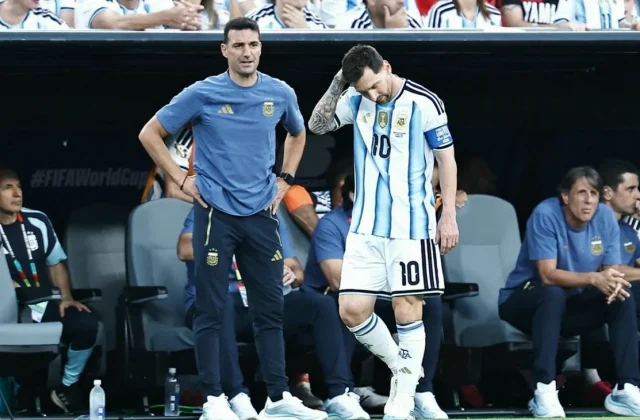
At Ezeiza, where Argentina’s next chapter is being prepared between training pitches and farewell plans, Lionel Scaloni has left open the possibility that he will remain in charge beyond December. The coach, whose departure had appeared close after he suggested his cycle might have ended following the World Cup final defeat, says he is ready to discuss a new agreement with Argentine Football Association president Claudio Tapia.
Argentina’s upcoming programme brings Bolivia to Córdoba on 30 September before Burkina Faso and Benin visit Buenos Aires on 3 and 6 October. Yet the fixtures also frame two larger questions around the world champions: whether Scaloni’s era will continue, and how the country will say goodbye to Lionel Messi after the forward announced in late August that he would end his international career.
Scaloni leaves room for a new deal
Speaking after a session at the national-team complex, Scaloni said there was willingness on both sides to sit down and talk. He made clear that he wants to stay, while stressing that a number of matters must first be resolved with Tapia.
“We will speak, and there is a real readiness to meet,” he said. “Of course I want to be here, but there are many points to discuss with the president.”
The 48-year-old said he expects to meet Tapia in the coming days. Asked whether the decision would turn on sporting or financial considerations, Scaloni replied that it involved “a bit of everything”.
His position has also been publicly backed by members of the squad, including Cristian Romero, who has taken over the captaincy following Messi’s international retirement. Scaloni has overseen the most decorated period in Argentina’s history, lifting the 2022 World Cup as well as the Copa América in 2021 and 2024.
He described the job as the fulfilment of a dream, but said that did not mean he should hold on to it indefinitely. The conditions for an extension, he added, would determine whether an agreement can be reached.
A final evening for Messi in Buenos Aires
Argentina will play Bolivia at the Mario Alberto Kempes Stadium in Córdoba, then return to the Monumental in Buenos Aires for Burkina Faso and Benin. The Benin match is set to be Messi’s final appearance for the national side, giving supporters one last opportunity to see him in Argentina colours at the age of 39.
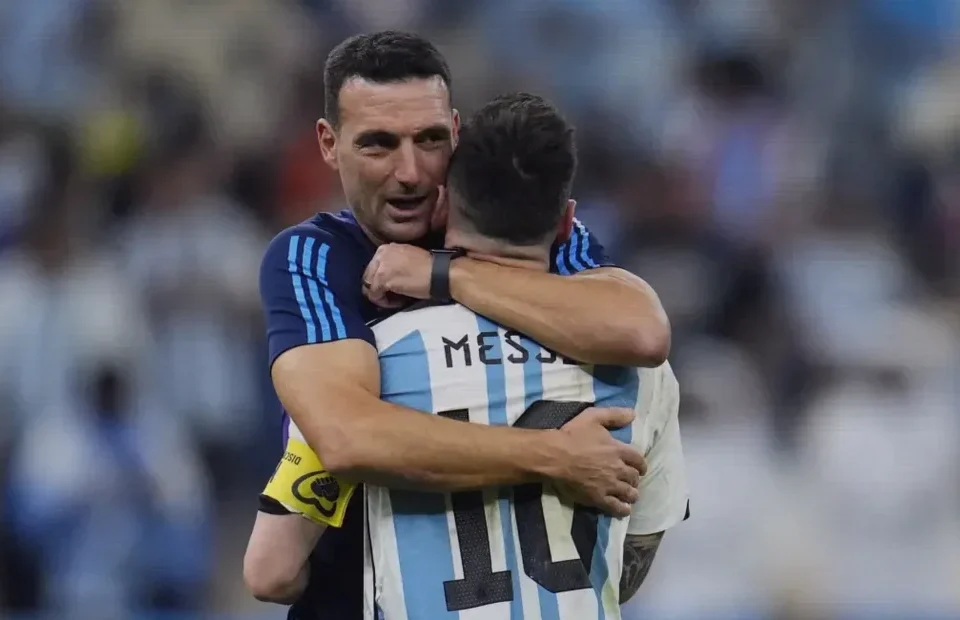
Scaloni spoke warmly of managing the eight-time Ballon d’Or winner, calling it the defining experience of his career. He said he had told Messi, and would continue to say, that no other player had matched him. In the coach’s view, Messi’s rarity is not confined to his work on the pitch but also lies in what he conveys away from it.
“We should enjoy this,” Scaloni said. “A footballer like him appears very rarely.”
Messi played all eight matches at his sixth and most recent World Cup, scoring eight goals. He will leave Argentina as their record scorer with 125 goals, including 21 at World Cups.
He is also among the nominees for the Ballon d’Or, to be awarded on 26 October. Scaloni argued that Messi’s latest World Cup had made the case emphatic: if the honour is intended for the game’s best player, he believed there could be no uncertainty, with the numbers supporting him.
The coach said Argentina had worked hard to ensure Messi could take part in the farewell despite everything surrounding the occasion. Messi, he said, had shown the desire and made the effort to come back and take leave of the public that has embraced him throughout his international life. A tribute, Scaloni felt, belongs in this moment; the affection will not disappear, but the magic of seeing Messi play for Argentina may not feel the same later on.