The fifth round of the 2026-27 Serie A season left a familiar trail of small decisions that may yet matter over a long spring: penalties given with conviction, others not awarded, a disputed disallowed goal and a new substitution rule applied without hesitation. Across the weekend, referees generally favoured a high threshold, but several incidents ensured that the balance between continuity and protection remained under scrutiny.
The coach and the club
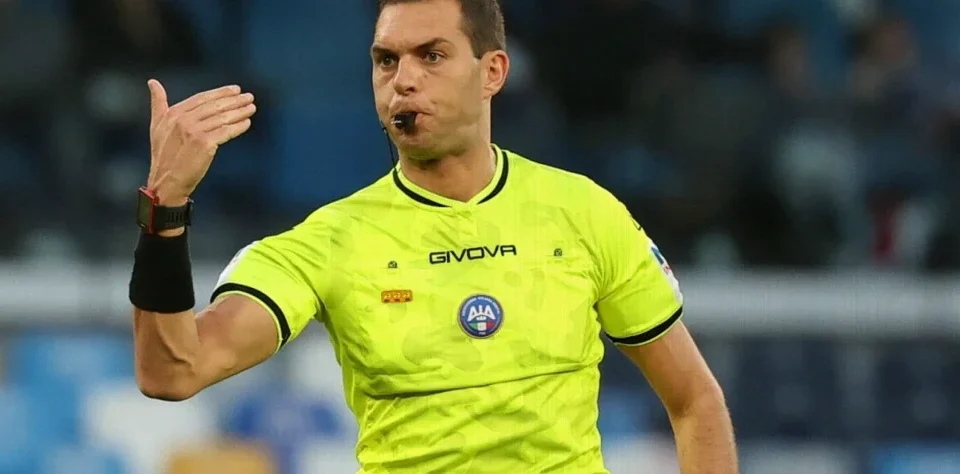
The clearest procedural moment came when Chiffi enforced the new rule on delayed substitutions. Kvernadze took longer than the permitted 10 seconds to leave the pitch, meaning Zerbin could not immediately enter. His side played with 10 men for around a minute, a reminder that the technical area now has to manage substitutions with greater precision.
Chiffi’s match also contained the weekend’s most questionable cancelled goal. Raimondo’s effort in the 87th minute was ruled out for a foul on Ramon, although the apparent contact between their legs looked light and accidental. VAR official Ghersini did not call for a review. Earlier, Ghedjemis went down under pressure from Chalobah with no offence detected, while Couto was booked after raising his leg dangerously near Kvernadze’s head; the challenge was close to deserving a harsher sanction.
Penalties, missed calls and a strict new rhythm
Perenzoni was quick to award a penalty in the 61st minute when Sebastiano Esposito and Dani Mota challenged for the ball. The Sassuolo forward began his shot without recognising that his opponent had reached the ball first, and the ensuing contact was substantial. The spot-kick was correctly given without delay.
Another contest began with a generous standard for physical contact. Ferguson escaped a booking for a challenge on Bragança in the 28th minute, while Bragança was cautioned two minutes later after fouling Ferguson. Pobega also avoided punishment for an incident involving Mandragora, and Helland’s first-half block in the area was correctly judged to have struck his chest.
The major debate in that game arrived late. Heggem’s first challenge on Oristanio, in the 72nd minute, involved a touch on the ball between the Torino player’s legs and did not warrant action. Ten minutes later, however, Heggem caught Oristanio again. The Norwegian’s contact took the opponent’s foot away and affected the play; a penalty should have been awarded, but VAR did not intervene. The bookings issued were appropriate, though other physical challenges went unpunished.
Sozza correctly pointed to the spot twice in Venezia’s meeting with Lazio. Mandas caught Correia’s right foot, producing a clear Venezia penalty. The Lazio goalkeeper was not booked because the offence occurred away from the central path to goal. Sozza then awarded Lazio their own penalty after Yeboah’s right leg made contact with Taylor’s left. There were minor inaccuracies elsewhere, but he maintained control of a match with moments of tension.
Doveri also allowed the game to flow, particularly before the interval, before becoming more exacting after the restart. Rrahmani and Njie collided heads in the Napoli area in the 19th minute, with no foul involved. Dragusin’s intervention on Hojlund and Ranieri’s challenge on Lucca were both clean.
Mastantuono and Ranieri received deserved yellow cards, although De Gea’s caution for delaying a goal-kick appeared severe. After that, Doveri closely monitored the time taken for restarts. He was equally firm over delayed substitutions, yet the later decision to remove Raimondo’s 3-0 goal for a doubtful foul remained the principal concern.
Key decisions around the grounds
One match was controlled with limited intervention, though its principal incident was significant. In the fourth minute, Zaniolo was cautioned after catching Obert on the ankle, a poor tackle that sat near the boundary between yellow and red. Zaniolo later struck Rodriguez with an extended arm and argued the decision, but a second booking would have been excessive.
Winks appealed for a penalty after the ball struck Karlstrom’s arm, but the arm was close to the body and there was no case for a spot-kick.
Inter’s game with Roma brought several important checks. Thuram risked a card early on after making contact with Balerdi, though the elbow appeared accidental. Lautaro was stopped while running through because of an earlier hold by Thuram on Hermoso, and Barella was booked for protesting.
Lautaro’s first-half appeal was also correctly rejected when his header hit Dybala on the shoulder. Roma’s second goal initially appeared in doubt after assistant referee Berti raised his flag once the ball had crossed the line, but the video review confirmed it: Koné was behind the ball when Mancini played it.
Akanji was rightly booked in first-half stoppage time for a late challenge on Malen. No penalty was due when Balerdi challenged Thuram in the box in the 48th minute. Bastoni received a yellow card for halting a promising Malen break, while Koulierakis was correctly cautioned for a late foul from behind on Diouf in the 82nd minute.
Mariani’s assignment produced no major penalty-box controversy. He issued six yellow cards, all judged appropriate, and kept the game moving despite repeated crowd complaints. His coordination with the assistant referees was sound and VAR was not required.
Zufferli, however, faced a more consequential missed decision. Kalulu visibly held Rowe’s shirt in the 31st minute after Rowe had gained the advantage in the area. The pull was sufficient for a penalty, yet no spot-kick was awarded and VAR did not overturn the on-field call. Bremer then avoided a booking for a foul on Rowe before half-time.
Kristensen’s header was cleared on the line by Kolo Muani in the 62nd minute. Juventus’ two goals were valid, while there was no penalty case involving Veiga’s arm.
A composed finish in Lecce
La Penna’s match contained fewer contentious moments. Monteiro caught Gila with an elbow while challenging in the air, and the referee gave the Lecce player a verbal warning rather than a card. Pulisic’s shot then struck the upper arm of Veiga, but the arm was close to his body and no penalty was warranted.
Pavlovic’s header was correctly ruled out because he was clearly offside when Rabiot delivered the ball. Ramos then set up Moreira for the 3-0 goal, with no foul committed by the Portuguese player in the build-up.
The round therefore offered a mixed picture: several officials read decisive penalty situations correctly, while missed intervention in the Heggem-Oristanio incident and the disputed Raimondo disallowance left the most enduring questions. In a championship built on margins, those details will continue to follow clubs from one Sunday afternoon to the next.