Serie A’s opening weeks have been shaped by a clearer determination to keep the ball moving and to reserve major sanctions for more obvious offences. The approach, widely described as the “Orsato line”, has produced a competition with longer active passages, fewer whistles and a noticeably higher bar for penalties and dismissals. Yet the same opening stretch has also left a series of decisions open to argument, particularly where VAR has either supported the referee or declined to intervene.
The average effective playing time has reached 59 minutes and 31 seconds, almost five and a half minutes more than in each of the past two seasons. Fouls have fallen to 22.60 per match, compared with 26.23 after four rounds last year; the current Italian figure is also below the Premier League’s 23.28. The change is most pronounced inside the penalty area. Only five penalties have been awarded so far, against 12 at the same point a year ago, while the comparable totals were 14 in 2024-25 and 16 in 2023-24.
Red cards have followed the same direction. There have been two dismissals in the current championship, compared with five a season ago and six in each of the two campaigns before that. The figures suggest a refereeing department intent on avoiding interruptions and marginal punishment, but they do not remove the pressure attached to the decisions that still define matches.
The decisions testing the new threshold
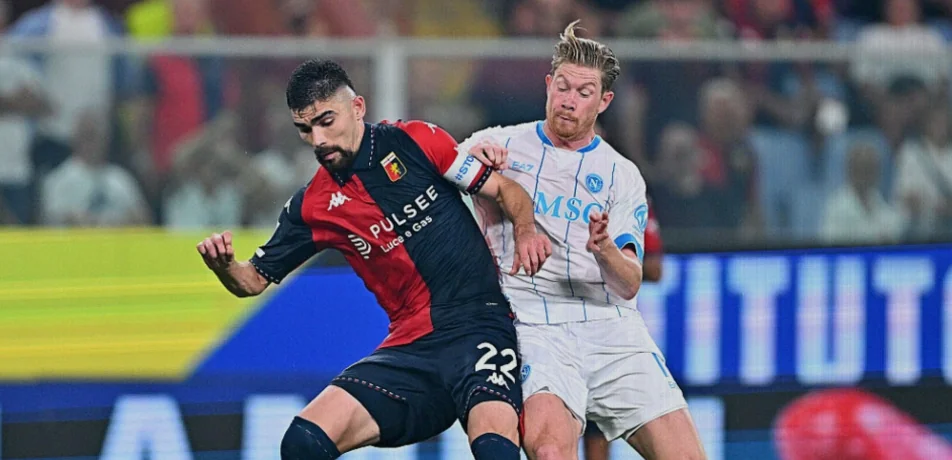
Napoli’s first goal was allowed to stand despite a challenge in which Kevin De Bruyne appeared to push Vasquez before the move developed. Di Bello kept the goal, with Meraviglia on VAR duty. In another episode, Vlasic made contact with the ball using his arm in his own area, but Zufferli and VAR official Mazzoleni judged that no penalty should follow.
Collu, assisted by Prontera at VAR, did not award a spot-kick when Dragusin caught Monterisi while attempting a clearance after Monterisi had reached the ball first. Fourneau and VAR colleague Sozza also allowed play to continue after Alajbegovic, arriving late in a sliding challenge, blocked Keita’s cross.
There was a different outcome after Perenzoni initially penalised Lucchesi for handball in the area. VAR official Pairetto called the referee to the monitor, and the original penalty award was overturned. Sozza, with Di Paolo at VAR, similarly found no infringement when Lobotka touched the ball with his hand in his own penalty area.
Mariani confirmed Milan’s goal despite contact between De Winter and Kolo Muani earlier in the attacking sequence, with Fabbri supporting the call from VAR. Sacchi and VAR official Piccinini did not award a penalty after Gagliardini struck the Giallorossi player N’Dri in the area.
Late in another match, Heggem took away Oristanio’s standing foot inside the box, but Guida and VAR official Santoro let the incident pass. Kalulu’s holding of Atalanta’s Rowe was likewise not punished by either the referee or VAR, despite the contact taking place in the penalty area.
Those episodes explain why the early statistical shift cannot be read simply as a story of smoother football. Serie A is playing for longer and stopping less, but every raised threshold asks referees and VAR to be consistent when the decisive contact arrives.